Sponsored by UltrarayReviewed by Olivia FrostAug 17 2026
When choosing the most appropriate radiation shielding, the material will significantly influence the build cost, footprint and floor space, construction timeline, and long-term performance.
Lead lining, high-density (HD) concrete, and concrete all offer radiation protection, but each material offers different advantages that are dependent on the project and application.
This is why it is important to understand the differences between them so facility planners, architects, and contractors can make an informed decision before breaking ground.
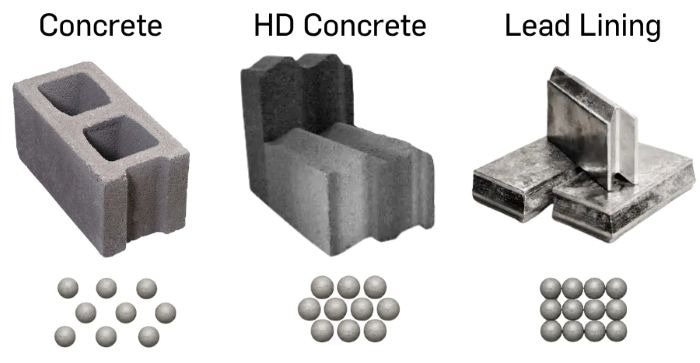
Concrete, HD concrete, and lead lining shown with an exaggerated density comparison below. From left to right: ∼145 lb/ft3, 240 to 300 lb/ft3, and ∼707 lb/ft3. Image Credit: Ultraray
How the Three Materials Compare
Lead Lining
Of all the shielding solution materials, lead lining offers the most compact footprint of the three. The density of lead is approximately 707 lb per cubic foot (11.34 g/cc), which surpasses both HD and standard concrete by a considerable measure.
As a result, lead offers high shielding performance in extremely thin layers, making it the go-to choice of material in applications where wall space is a premium.
Lead lining is usually applied as sheets directly affixed to wall studs, concrete, or drywall structures. It is compatible with new construction and can be easily retrofitted while integrating smoothly into standard construction workflows.
However, the cost of lead per square foot is more than concrete-based solutions, and it must be carefully installed to maintain shielding continuity at seams, penetrations, and transitions.
Lead lining is most appropriate for space-limited environments with stringent shielding requirements as long as the project budget supports increased material costs for a thinner wall assembly.
High-Density Concrete
The shielding performance of HD concrete blocks is far greater than the shielding performance of standard concrete. HD concrete is formed by substituting standard aggregate with high-density mineral aggregates such as hematite (Fe2O3), ilmenite (FeO·TiO2), magnetite (Fe3O4), and steel aggregate.
As a result, the density of HD concrete can reach 240 to 300 lb per cubic foot (3.84 to 4.81 g/cc), nearly double that of standard concrete.
Practically speaking, HD concrete offers shielding equivalent to that of standard concrete in approximately half the wall thickness. That footprint offers a space-saving advantage which can be a significant design advantage for vault upgrades, medical construction, and nuclear environments.
HD concrete blocks are offered in a range of configurations and densities, as listed below:
4" Blocks (4" thick x 6" tall x 17" wide)
- 240 PCF/3.84 g/cc
- 250 PCF/4.00 g/cc
- 300 PCF/4.81 g/cc
6" Blocks (6" thick x 6" tall x 12" wide)
- 240 PCF/3.84 g/cc
- 250 PCF/4.00 g/cc
- 300 PCF/4.81 g/cc
Solid Rectangular HD Blocks and 2-Core HD Masonry Units come in stock densities of 250 PCF / 4.01 g/cc and 300 PCF / 4.81 g/cc, with equivalent density HD Grout to preserve shielding continuity across the line. HD concrete is available as chevron (interlocking) and flat (straight) prefabricated blocks, solid pavers, and 2-core CMU units.
Like standard concrete, it can also be poured, pumped, or conveyed into tailor-made castings for non-standard project requirements, making it highly versatile. The composite aggregate formulation of HD concrete also eradicates the need for additional borated polyethylene or composite lead shields in many upgrade scenarios.
Concrete
Standard concrete is the most readily available shielding material; what’s more, it is also the lowest-cost. It is suitable for low-level radiation environments where there are no space-saving requirements.
This is because standard concrete carries a density around 145 lb per cubic foot (2.32 g/cc), meaning it produces very thick walls that offer practical shielding. This can be a limiting factor in medical imaging facilities, vault upgrades, or any environment where space is at a premium.
The effectiveness of standard concrete can also be limited when higher-energy gamma radiation is present, and its neutron shielding is minimal. As shielding requirements increase, concrete alone quickly becomes impractical without the need for additives.
Side-By-Side Comparison
Source: Ultraray
| |
Lead Lining |
HD Concrete |
Concrete |
| Density |
∼707 PCF/11.34 g/cc |
240 to 300 PCF/3.84 to 4.81 g/cc |
∼145 PCF/2.32 g/cc |
| Wall thickness required |
Low |
Moderate |
High |
| Relative material cost |
Higher |
Moderate |
Lowest |
| Neutron shielding |
Limited |
Good |
Limited |
| Gamma shielding |
Excellent |
Good |
Adequate at thickness |
| Retrofit suitability |
Excellent |
Good |
Limited |
| Custom sizing |
Yes |
Yes |
Limited |
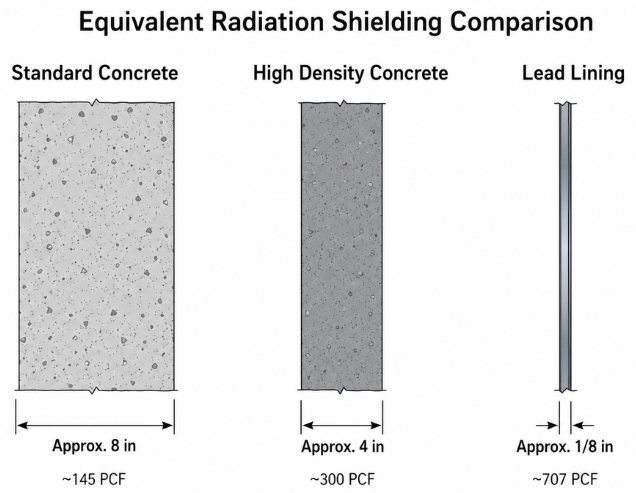
A visual comparison of wall thickness required for equivalent radiation shielding performance. Standard concrete requires approximately eight inches, high-density concrete approximately four inches, and lead lining approximately 1/8 inch at 707 PCF. Image Credit: Ultraray
The above visual comparison exhibits the equivalent wall thicknesses required for corresponding radiation shielding performance. Standard concrete takes up approximately eight inches of wall space, high-density concrete around four inches, and lead lining approximately 1/8 inch at 707 PCF.
Which Material Should You Choose?
Lead lining is best suited for environments with stringent shielding requirements where space is limited, and the project budget allows for increased material costs to achieve a thinner wall assembly.
HD concrete is suitable for vault construction, nuclear facilities, and medical environments where moderate to high shielding is necessary and space is not at a premium. It is compatible in new construction environments and vault upgrades where modular block installation is practical.
Concrete is most suited to low-requirement environments where there are no space limitations, and budget is the main driver. It is not suited for use in medical imaging or nuclear environments where strict shielding requirements are well defined.
Across numerous high-profile projects, both HD concrete and lead lining are used in combination, with HD concrete being used as the primary wall structure and lead lining used for covering transitions, penetrations, and areas where additional shielding performance is required.
Shielding material selection should always be verified by a qualified medical physicist or radiation safety officer based on the specific radiation source, energy level, and room layout of the project.

This information has been sourced, reviewed, and adapted from materials provided by Ultraray.
For more information on this source, please visit Ultraray.