Sponsored by UltrarayReviewed by Olivia FrostNov 10 2026
Many decisions and questions are involved in the construction of a new medical facility, whether concerning the medical suite, nuclear room, or the hospital overall. Selecting the ideal surface finish for furniture and appliances is one of these decisions.
Image Credit: MAFPHOTOART8/Shutterstock.com
For example, medical storage cabinets, whether lead lining is required or not, entail two choices between powder-coat or stainless steel. This article details four reasons why stainless-steel surface finishes are a crucial requirement for applications in medical construction.
1. Sterility
To mitigate bacteria, infectious contaminants, and disease, upholding a clean working environment is key in medical applications. Sterility ranks first among health priorities. Given that stainless steel is non-porous, unlike powder coat, which has micro-pores, medical personnel do not need to sanitize a non-uniform surface. This is similar to how human skin has pores where sweat, dust, and oil can build up during the day and cause breakouts if the face is not properly cleansed.
The primary reason why stainless steel is preferred over powder-coated medical cabinets is that it resists chipping, cracking, or damage after three to five years of continuous use and cleaning processes. With prolonged use, divots and cracks create non-uniform surfaces where contaminants become trapped, making them difficult to clean.
This can lead to a contaminated medical environment and surfaces, which can negatively influence patient outcomes. This impact in itself is enough for experts to prefer a smooth-edged and clean stainless-steel surface.
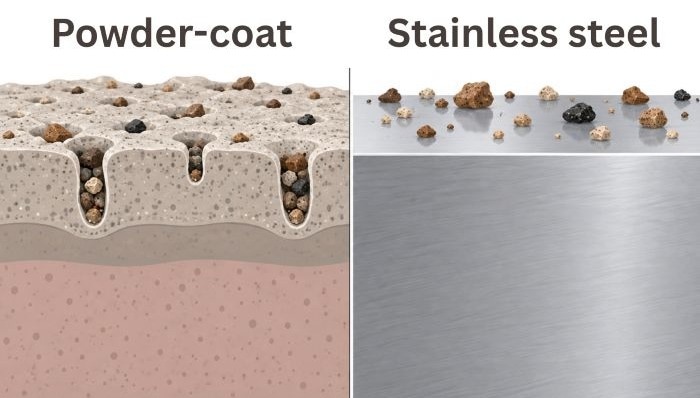
Powder-coat surfaces trap contamination in their pores and micro-cracks, making thorough cleaning increasingly difficult over time. Stainless steel keeps contaminants on the surface where they can be wiped away completely. Image Credit: Ultraray
2. Corrosion Resistance
This second factor is closely related to sterility. In healthcare, more aggressive chemicals are employed to clean surfaces to maintain a safe working environment. Stainless steel surfaces do not break down or deteriorate as significantly as powder-coated finishes.
When a powdered layer degrades, the raw materials underneath become exposed, which then results in rust accumulating along the chipped edges.
For example, when a car is chipped and parts of the paint are scraped off as a result of a collision. The damage has already made an impact, even if another layer of paint is added to even the finish. The car will never be able to return to its initial construction. This is the same mechanism seen in powder-coat cabinets, except that rust can build up even if the exposed raw materials are painted over.
The absence of corrosion resistance works against powder-coated cabinets, as they risk creating more challenges than benefits over time. For many years, this may not pose a challenge, but as the cabinet wears due to cleaning, dents and chips are inevitable, which lead to rust. Stainless steel finishes do not involve this risk.
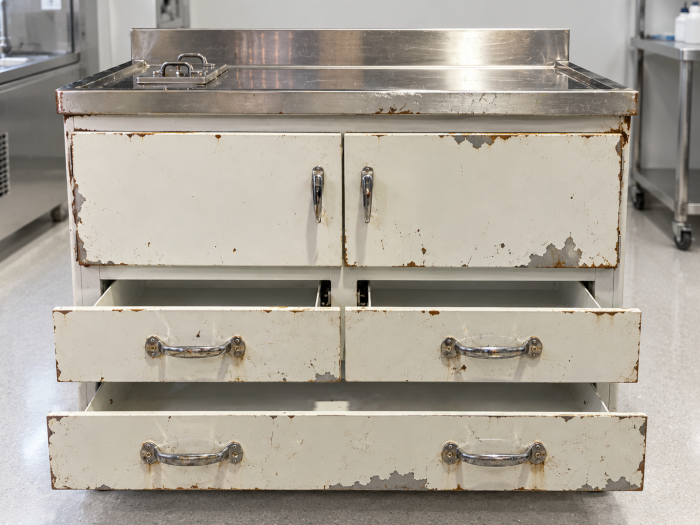
Visual representation of a decayed powder-coat cabinet after a few years of usage. Decay is caused by continuous surface cleanings using harsh chemicals to maintain sterility. Image Credit: Ultraray
3. Faster Inspection Approval
Audits evaluate a facility's design risk factors and determine safety compliance for patients and staff alike. An ideal way to minimize these warnings regarding cabinetry and alternative equipment surfaces is to have an easy-to-clean, flat surface material, such as stainless steel, with no rough edges or other risks that negatively compromise clinical areas.
A powder-coat cabinet can meet inspection standards without issue during initial audits. The key challenge is due to the continual decay and use, which then results in delayed rates of approval.
One can visualize an exponential curve (as Figure 1 demonstrates) where the x-axis represents years of service, and the y-axis represents the level of inspection risk over the first seven years.
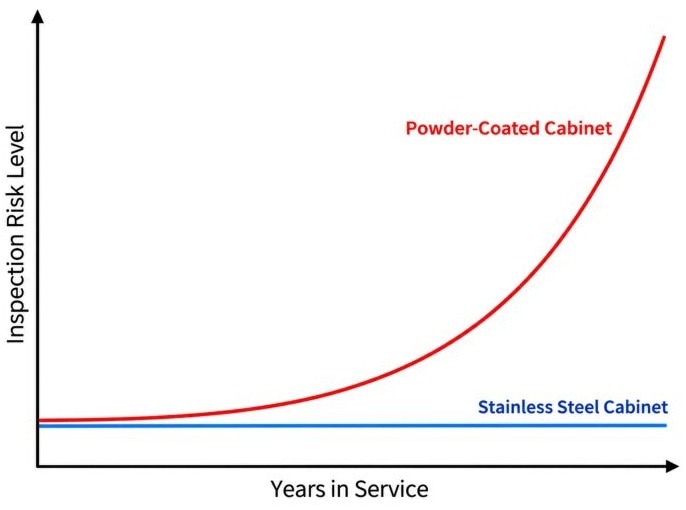
Graph comparing inspection risk level over years in service for powder-coated versus stainless steel medical cabinets, showing exponential risk increase for powder-coated and a flat low-risk line for stainless steel. Image Credit: Ultraray
The Canadian Nuclear Safety Commission (CNSC) is responsible for nuclear evaluations. Based on a facility's track record (such as isotope handling, license type, and compliance record), audits can occur more frequently each year or less regularly, in cycles of every three years.
A selection of the metrics they evaluate are:
- Contamination management
- The integrity of working surfaces
- Storage environments
- Handling of waste
- Record keeping
Ultraray recognizes that audit compliance can be a daunting task, and so its approach is to deliver the soundest advice possible. Backed by its 40 years of shielding expertise, stainless steel remains the superior choice. For a specific project, high humidity levels caused the cabinets to fail to dry completely even after one to two weeks, which substantially extended lead times and postponed delivery.
4. Longer Product Life
When discussing products, affordability and cost are usually always a consideration, but for medical items, such as lead-lined cabinets, it can be challenging to compare.
In some cases, a stainless-steel finish may be less expensive compared to a powder coat layer for the equivalent specifications, or vice versa. One metric that remains important when comparing both cabinet finishes is each finish's durability.
As the exponential curve idea demonstrates, stainless steel cabinets have negligible risks during inspection over the initial five to seven years of service, as the cabinets can normally last approximately 15 to 20 years, versus powder-coated cabinets, which last roughly five to eight years before a replacement is required.
The tables below provide a few speculative pricing comparisons.
Scenario 1:
Source: Ultraray
| Cabinet Type |
Unit Cost |
Replacements
(16 years) |
Total Cost |
| Powder-coated, 5-year life |
$1,000 |
3x |
$3,000 |
| Powder-coated, 8-year life |
$1,000 |
2x |
$2,000 |
| Stainless steel, 15-year life |
$1,500 |
2x |
$3,000 |
| Stainless steel, 20-year life |
$1,500 |
1x |
$1,500 |
Scenario 2:
Source: Ultraray
| Cabinet Type |
Unit Cost |
Replacements
(20 years) |
Total Cost |
| Powder-coated, 5-year life |
$1,000 |
3x |
$3,000 |
| Powder-coated, 8-year life |
$1,000 |
2x |
$2,000 |
| Stainless steel, 15-year life |
$1,100 |
2x |
$3,000 |
| Stainless steel, 20-year life |
$1,100 |
1x |
$1,100 |
Comparison Table
Source: Ultraray
| Cabinet Type |
Unit Cost |
Replacements
(45 years) |
Total Cost |
| Powder-coated, 5 year life |
$1,000 |
9x |
$9,000 |
| Powder-coated, 8 year life |
$1,000 |
5x |
$5,000 |
| Stainless steel, 15 year life |
$1,500 |
3x |
$4,500 |
| Stainless steel, 15 year life |
$1,100 |
3x |
$3,000 |
| Stainless steel, 20 year life |
$1,500 |
2x |
$3,000 |
| Stainless steel, 20 year life |
$1,100 |
2x |
$2,200 |
These tables make it even more sensible to choose stainless steel cabinets when planning a medical building's future. The final comparison table shows a comparative cost rate for a construction that spans 45 years. Please note that the cost evaluations are for one standalone cabinet unit so the expense becomes greater when all units that require replacement are considered.
By contrasting the ideal outcome for the product life durability of a powder-coated cabinet (roughly eight years) versus the longer life cycle of a stainless steel cabinet (approximately 15 years) across a range of 45 years for 10 units at a price ratio of 1:1.5, the results are:
Powder Coat
At $1000 per unit, where 10 units and five replacements are required, the total is $50,000.
Stainless Steel
At $1500 per unit, with 10 units and three replacements required, the total is $45,000.
These are replacement cost comparisons and do not account for the unit that is first installed.
Even in the most challenging example, it is still more sensible to select a stainless steel cabinet finish, as its extended product life cycle gives it a significant financial advantage in most use cases compared with powder coat finishes.
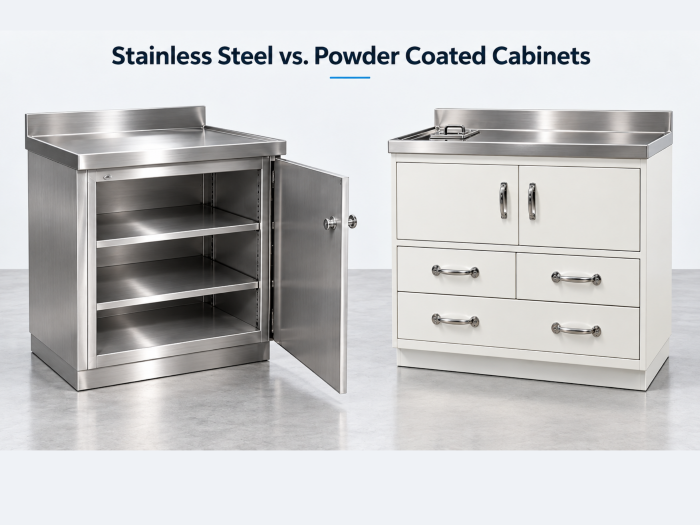
Image Credit: Ultraray
Summary
Stainless steel cabinets remain the most viable surface finish for medical applications. They are easier to clean, are better at avoiding corrosion, pass audits faster and for longer, and last two to three times more than equivalent powder coated cabinets.
While the initial expense is higher in some cases, its extended product life makes it significantly more cost-effective over 20, 40, and 60 years.
Based on these four reasons, Ultraray made the transition from powder-coated to stainless steel cabinets due to the clear evidence behind them. Ultraray’s 40 years of industry expertise helped it to develop industry-leading advice for nuclear medicine and medical applications.

This information has been sourced, reviewed and adapted from materials provided by Ultraray.
For more information on this source, please visit Ultraray.