Gas analyzers are key to reducing corrosion and quality issues in hydrocarbon processing pipelines and storage infrastructure. From petrochemical plants to natural gas operations and oil refineries, effective gas analyzers provide the reliable data necessary for plant operators to drive performance, compliance, and safety.
Image Credit: Rangsarit Chaiyakun/Shutterstock.com
Compromised readings can lead to accelerated pipeline corrosion, misrouted gas, custody transfer errors, and potentially expensive operational interruptions.
Contaminant gas analyzers should, therefore, be considered cyber-critical devices. These systems are key to protecting data integrity, maintaining product quality, supporting safe operations, and ensuring reliable hydrocarbon processing performance.
As digitalization becomes more prevalent across industries, cybersecurity has become increasingly key to protecting devices and the operations that rely on them. A large number of legacy field devices tend to lack the cybersecurity capabilities integrated into modern equipment, however, allowing malicious actors to exploit vulnerabilities.
There are growing numbers of cyberattacks worldwide, with critical oil and gas infrastructure experiencing a major increase in ransomware activity. Ransomware attacks targeting the oil and gas industry rose 935% between April 2024 and April 2025, according to cybersecurity firm Zscaler.
Zscaler has not published a follow-up report since April 2025, but later research from Waterfall and Trellix shows that energy and industrial infrastructure was continually targeted throughout late 2025 and early 2026.
According to the Trellix Operational Technology Threat Report, operational technology (OT) and industrial control systems (ICS) “faced unprecedented threats from sophisticated adversaries” between April 1 and September 30, 2025.9
The energy sector was identified among the highest-risk industries in this report, which also emphasizes the need for more robust network segmentation aligned with ISA/IEC-62443 standards and advises the prioritization of OT security investments.
The Waterfall Threat Report 2026 also discusses the ongoing exposure of critical infrastructure to cyber threats, advising the use of deterministic, hardware-enforced protections to prevent threats originating in IT environments from escalating into OT systems. The report raises a key point, stating that, “To keep cyber sabotage from reaching OT networks, organizations need to harden security at every network connection.”10
Cybersecurity vulnerabilities can threaten intellectual property (IP), business continuity, and operations as industrial systems become increasingly connected.
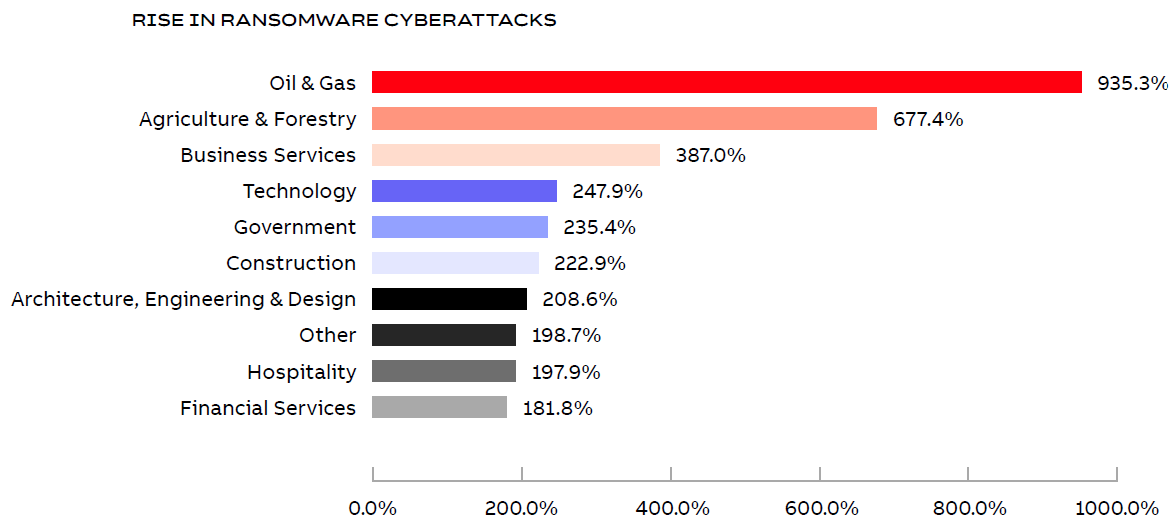
Year-over-year percentage change in ransomware extortion attacks by industry. Image Credit: Zscaler
Cyberattacks targeting oil and gas operations could potentially compromise public safety, disrupt fuel supply chains, and catalyze cascading effects across utilities and customer services.
The degree of integration of IT and operational systems means that the sector is especially vulnerable, turning every breach into a potential risk to national infrastructure. The risk of exposing operational data means that cyberattacks can reveal key details. Gas contaminant analyzers are, therefore, attractive targets.
According to the American Petroleum Institute (API), “Natural gas and oil companies recognize that their assets are the targets of a growing number of increasingly sophisticated cyberattacks perpetrated by a variety of attackers including nation-states and organized international criminals” in its article titled ‘Defense-in-Depth: Cybersecurity in the Natural Gas and Oil Industry.’2
The article went on to highlight that cyberattacks now pose enterprise-level risks that can potentially threaten business continuity and operational resilience.
Cyber risks continue to grow across critical infrastructure, but the advent of built-in cybersecurity protections is helping to support business continuity and reliable industrial operations by safeguarding vital gas analyzers.
This article explores the use of built-in cybersecurity to support industrial organizations’ efforts to improve operational resilience while also enabling secure, compliant, and easy deployment for IT decision-makers, analyst specialists, and plant managers.
References and Further Reading
- Zscaler (2025). ThreatLabz 2025 Ransomware Report. Available at: https://www.zscaler.com/resources/industry-reports/threatlabz-2025-ransomware-analysis.pdf.
- Defense-in-Depth: Cybersecurity in the Natural Gas and Oil Industry
- Cybersecurity and Infrastructure Security Agency CISA. (2025). Unsophisticated Cyber Actor(s) Targeting Operational Technology | CISA. Available at: https://www.cisa.gov/news-events/alerts/2025/05/06/unsophisticated-cyber-actors-targeting-operational-technology.
- Cyber Resilience Act (2024). The Cyber Resilience Act Explained: Scope, Classes & Deadlines. Available at: https://www.cyberresilienceact.eu/explained.html.
- Geller, E. (2025). Ransomware attacks against oil and gas firms surge. Cybersecurity Dive. Available at: https://www.cybersecuritydive.com/news/zscaler-ransomware-report-manufacturing-targeted/756147/.
- Cushing, S. (2026). 2026 CIO Agenda for Oil and Gas: Technology Priorities and IT Strategy Shifts. Gartner. Available at: https://www.gartner.com/en/documents/6995166.
- Dal Cin, P., Kendzior, D. and Yusof Seedat (2025). State of Cybersecurity Resilience 2025. Accenture. Available at: https://www.accenture.com/en/insights/security/state-cybersecurity-2025.
- World Economic Forum (2022). The Global Risks Report 2022. Available at: https://www3.weforum.org/docs/WEF_The_Global_Risks_Report_2022.pdf.
- Trellix (2025). Operational Technology Threat Report. Available at: https://www.trellix.com/assets/reports/ot-threat-report-nov-2025.pdf.
- Ribeiro, A. and Ribeiro, A. (2026). Waterfall Threat Report 2026 finds ransomware slowdown masks deeper shift toward nation-state attacks on critical infrastructure - Industrial Cyber. Industrial Cyber. Available at: https://industrialcyber.co/reports/waterfall-threat-report-2026-finds-ransomware-slowdown-masks-deeper-shift-toward-nation-state-attacks-on-critical-infrastructure/.
Acknowledgments
Produced from materials originally authored by David Lincoln, Global Digital Lead at ABB Measurement & Analytics.

This information has been sourced, reviewed and adapted from materials provided by ABB Measurement and Analytics Analytical Products.
For more information on this source, please visit ABB Measurement and Analytics Analytical Products.