In this interview, AZoM speaks with R. J. Balch, Senior Writer at Interpower, about the challenges of designing safe, compliant power connections for global markets. He discusses regional standards, certification requirements, component selection, and how manufacturers can prepare for evolving regulations and supply-chain challenges.
To begin, could you introduce yourself, explain your role at Interpower, and describe how your work relates to power cord safety and regulatory compliance?
I help provide customers, staff, and electrophiles the content they need through our marketing team content via articles, blogs, white papers, video scripts, and advertising copy, led by our outstanding Vice President of Marketing, Ralph Bright. Our Technical Support Guru, Dan Ford, handles the extremely tough questions.
Our repository of electrical knowledge is available on our website, from testing lab experiments, and from the hundreds of years of staff experience in the cord set, cable, component, and safety agency fields since our founding over half a century ago.
Why is power connectivity often more complex than manufacturers initially expect when they begin designing a product for multiple global markets?
Often, complexity starts with the customer being unsure of what they really need in their electrical design; for example, they want a NEMA plug on an international cable, or a European or Asian plug on a North American cable. We must explain that this is illegal (per safety agency standards and/or country directives) and then drill down from there.
Additionally, customers and prospective customers often contact us by phone or email seeking to use country-specific plugs or IEC 60320 connectors with cables that are not compatible with those components, under the relevant country-specific or safety agency standards.
In these situations, we review the specific application and advise accordingly. Where applicable, we explain that the requested configuration cannot be supplied because it may not meet legal or safety requirements, could present a fire risk, or may damage the connected equipment.
To support our guidance, we reference the relevant standard and direct customers to our website for further technical information and clarification.
Another hurdle is complying with a country’s standards and manufacturing to their product specifications, and then testing that product in house before sending it for testing and certification to a safety agency representing that country, agencies such as UL, VDE, BSI, ASTA, and JET.
Also, the 100-lb cord-set molds must match the proper country-specific cord set, and the correct steel inserts are used, with their proper markings, which get embossed or intaglioed onto the product. Another example is that you must be RoHS compliant when exporting electrical products to Europe, but that does not apply to products outside of Europe.
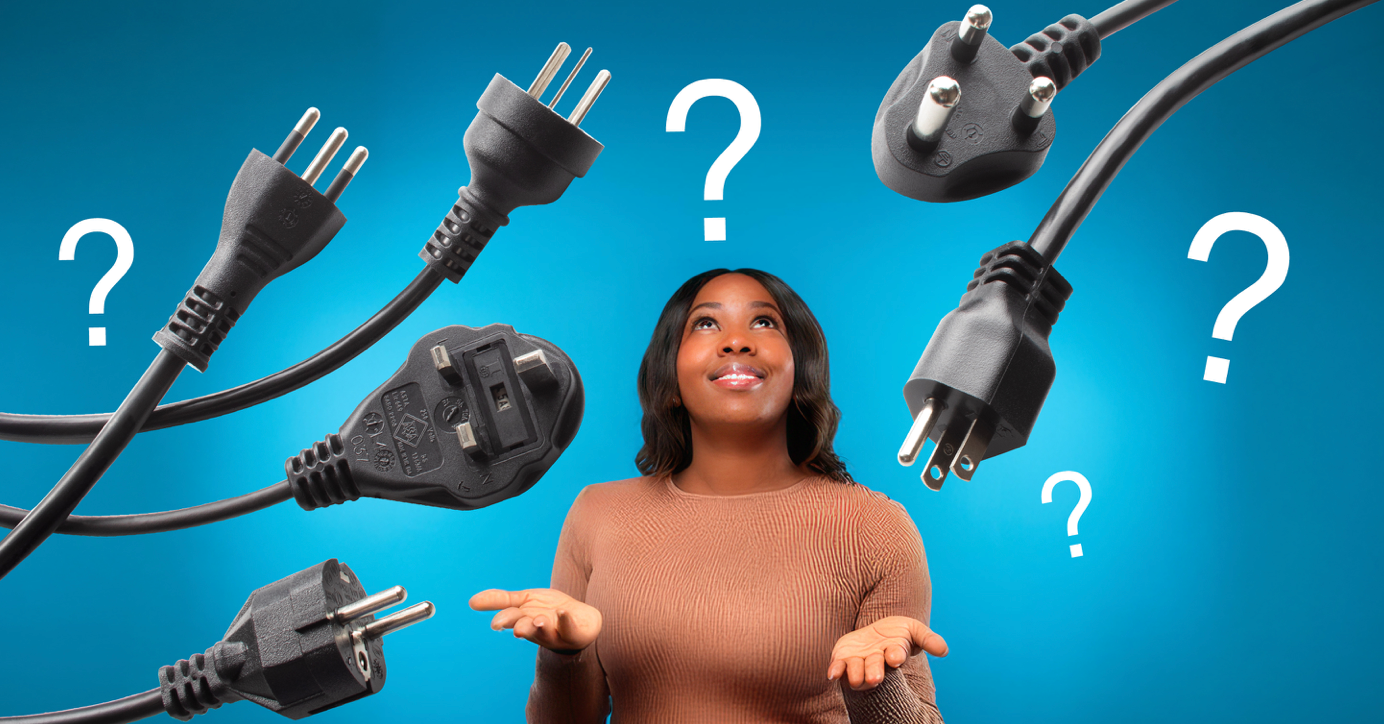 Image credit: Interpower
With plug and socket configurations varying significantly between regions, what should manufacturers consider when deciding which power connection is appropriate for each target country?
The first two considerations should generally be: do we already have the approvals, and if not, how much will they cost, and what is the timeline to submit them for testing to get approvals (typically several months).
After this, manufacturers should then ask the following: do we have the precise CAD drawings per the exact standards, and are the dimensions and tolerances correct? Do we have the right raw materials? Are we extruding or buying our North American and international cable that will become the cord set?
If you do get certified, you will need to get the engraved metal insert to emboss or intaglio onto/into the molded or rewired plug, plug connectors, connector, etc. Is it standard three-conductor wire, and what is the gauge of the cord, mm2 or 14-18 AWG? Incidentally, it’s not the diameter of the jacketed cord, but the diameter of the three-conductor wires inside the extruded cord jacket when talking about cable size.
Beyond the physical plug pattern, how do differences in voltage, frequency, current ratings, grounding, and polarization influence the design of a globally compatible product?
Worldwide, the frequency used is typically 50 Hz (Europe) or 60 Hz (U.S.). While Japan uses both in different regions, frequency is unlikely to be an issue in most evaluations, especially with modern electronics; in fact, it’s barely mentioned in many standards. Europe and the U.S. (NEMA) have slightly different power cord ratings, with international ratings usually slightly lower than North American ratings.
The most important thing to remember about ratings is that the lowest-rated component in a cord set determines the set's overall rating. For optimal global compatibility, ensure that the opposite end of the country-specific cord set bears an IEC 60320 plug connector such as an IEC C13 to plug into an accessory power strip’s (APS) C14 inlet, the APS containing IEC Inlets and outlets to power multiple devices via IEC jumper cords: universal power designs are essential for exporting globally.
Current and voltage ratings will eliminate some components from consideration. Often, equipment manufacturers either don’t know this or forget, which can cause headaches and lead to design rework and higher costs.
At what stage of product development should manufacturers begin addressing regional power and regulatory requirements, and what problems can arise when these decisions are left until later?
This should be priority number one once a project is green-lighted to prevent rework.
Be sure to gather all the information you need during what I would call the discovery phase. A useful starting point is Interpower’s Worldwide Guide to Plug and Socket Patterns.
For example, suppose you receive a request for an electrical design in the Azores. At first, you might assume the project will require CEE 7 plugs and sockets, along with CEE 7/16 EuroPlugs and international cable. However, it is important not to rely on assumptions alone.
If the new factory is located near a Portuguese air base on one of the islands, and that area has a large American population, the local infrastructure may also include NEMA plugs and sockets. In that case, the facility may have a mix of wall sockets: some designed for Continental European plugs and others designed for North American plugs.
Before moving too far ahead, confirm the details directly with the customer. Do they need both European and North American plugs and sockets? Will both international and North American cable be required? Are there separate generators, or does the facility operate from a shared mains supply? These are the kinds of questions that should be answered early so the final design is safe, compliant, and fit for purpose.
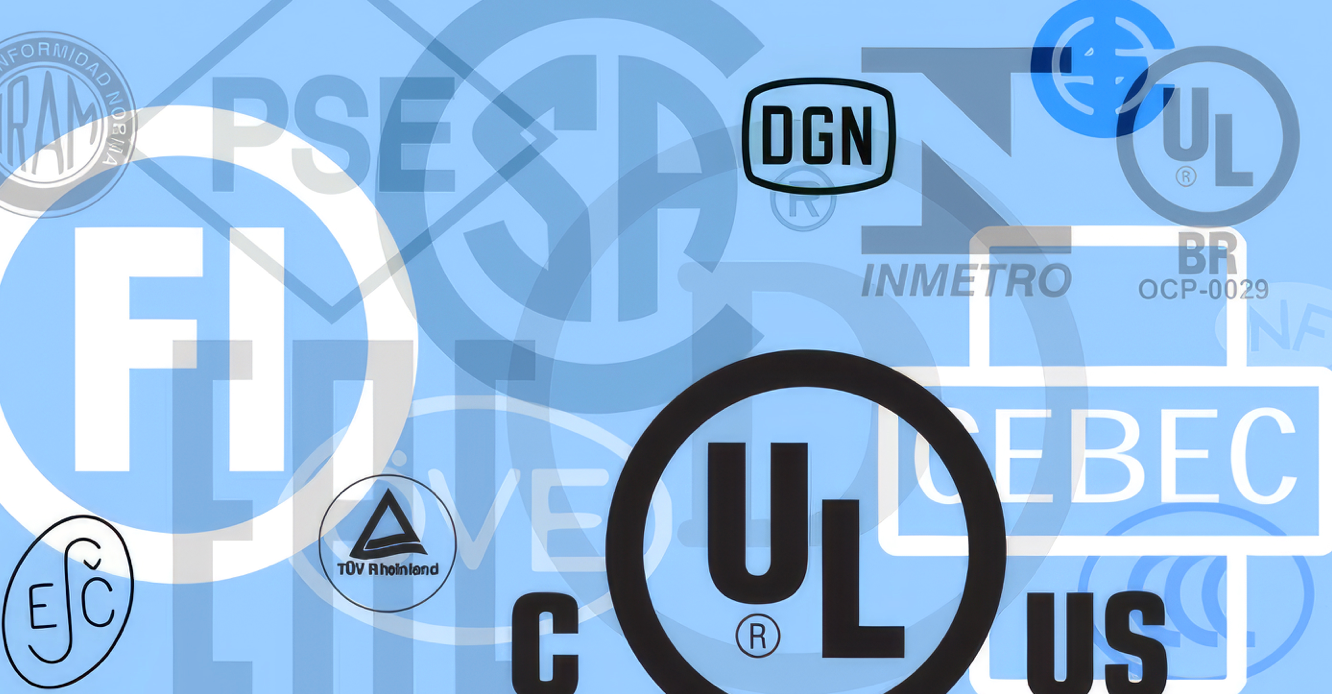 Image Credit: Interpower
Certification requirements can differ between countries and approval agencies. What are the most common certification challenges manufacturers encounter when entering several markets at once?
Ensure your drawings have precise measurements to avoid costly rework, including the tolerances (+/-). Understand the testing parameters of the agency conducting the testing, and thoroughly test it in your own laboratory before the submittal process, to prevent paying for failure.
Time and cost are also challenges, as the process typically drags on for months. Also, excellent in-house quality-control staff can assist newer agency auditors during inspections if said auditors don’t completely understand the process.
How can using pre-approved or appropriately certified power cords, cord sets, plugs, sockets, and cables help simplify the broader product approval process?
Unless the agency or certification body has changed the standards, working with an approved product is a great benefit. However, there is usually a time limit in years pertaining to recertification, which varies from safety agency to safety agency, as well as quarterly or yearly on-site audits performed by agencies.
However, if dimensions have changed slightly, or the raw materials have been slightly altered, one will likely have to do a full resubmittal.
For many raw materials, you can do your homework using UL’s i.Q. site to see what has been approved in North America and beyond. Interpower’s website is replete with both practical and technical electrical cord set and component knowledge available to everyone.
What information should a manufacturer provide to a power-component supplier to ensure that the proposed solution is both technically suitable and compliant in every intended market?
Describe what use the product is intended for, and what you’re currently using, including the voltage and current draw of the device to be powered. And if you already have approvals/certifications, make that known. This will help us know if we need to buy 50,000 components or fewer than 5000.
How can manufacturers balance compliance with supply-chain priorities such as component availability, lead times, customization, inventory management, and continuity of supply?
There are programmed algorithms to forecast supply-chain volatility. History of such volatility is included, as are current and past economic trends and the historical product use. Safety stocks are built in, alerting purchasers when it is time to reorder raw materials.
Nothing is infallible, however, and the world is constantly changing, so you may want to diversify your product line while maintaining the staples you’re currently manufacturing. Often, however, when supply chains go off the rails, it’s global and affects everyone: individual manufacturers are not alone.
Looking to the future, how do you expect global power connectivity standards, certification processes, and supply-chain strategies to evolve, and how should manufacturers prepare for those changes?
The ongoing trend is to reduce certain metals and chemicals through directives, percentage limits, etc. This often changes from continent to continent. While reducing anything toxic is a good thing (think RoHS and REACH), one must keep in mind that a few of the largest manufacturing nations care less about toxins than more developed ones, and it would give them an iron grip on manufacturing.
This is the so-called slippery slope: what hazardous chemicals/metals do we eliminate or minimize without regressing civilization? Are there substitutes for these toxic materials? Who is the grand arbiter of said material? Is their data solely based on empirical science? These questions are certainly worth exploring.
As far as supply chains go, American manufacturing has made huge strides over the past six years in reshoring production back to the States. This should have a visible impact in 2027 and 2028 as new manufacturing facilities open, as many already have in 2026.
There have been multiple worldwide supply-chain issues for decades, so flexibility is key. Maybe you ramp up domestic production, with a more local or regional supply chain. Because the events that cause supply-chain issues, such as natural disasters, wars, pestilence, and union strikes, are not modern phenomena, the likely key is how a manufacturer can adapt to broken supply chains until they smooth out.
About R.J. Balch
R. J. Balch has been writing cover stories, articles, and advertising copy since the 1990s. Formerly the editor of Business & Industry Magazine, Balch has traveled coast to coast in the U.S. covering multiple industries such as IT, metals, plastics, heavy equipment, and electrical among others. In 2020, he joined the Interpower Corporation in Oskaloosa, Iowa, where he is currently the Senior Writer.

This information has been sourced, reviewed, and adapted from materials provided by Interpower.
For more information on this source, please visit Interpower.
Disclaimer: The views expressed here are those of the interviewee and do not necessarily represent the views of AZoM.com Limited (T/A) AZoNetwork, the owner and operator of this website. This disclaimer forms part of the Terms and Conditions of use of this website.