Geochemical analysis is driven by two core questions across a variety of applications and research areas: What is it? Where is it hosted?

Image Credit: Exum Instruments
Whether dealing with unexpected characteristics, melt or fluid inclusions, or an unknown mineralogy, recognizing and tracing their origin is crucial for research and industry.
In the following application examples, you can see how precise elemental mapping and trace-element compositional analysis help solve this problem.
Trace-Element Geochemistry for Mining and Exploration
Mineral systems must be characterized using multi-element geochemical data throughout mining and exploration operations.
The Analysis: In about 25 minutes, Massbox® generated millimeter-scale elemental maps of a mineralogical thin-section sample.
The Results: Massbox revealed the following:
- The distribution of essential elements (e.g., Na, K, and Mn) used to differentiate mineralogy
- Trace elements (e.g., Y) below X-ray detection limits
The Value: Trace-element geochemistry is becoming increasingly relevant for detecting subtle deposits. Massbox combines trace-element analysis and rapid element mapping in a field-deployable solution.
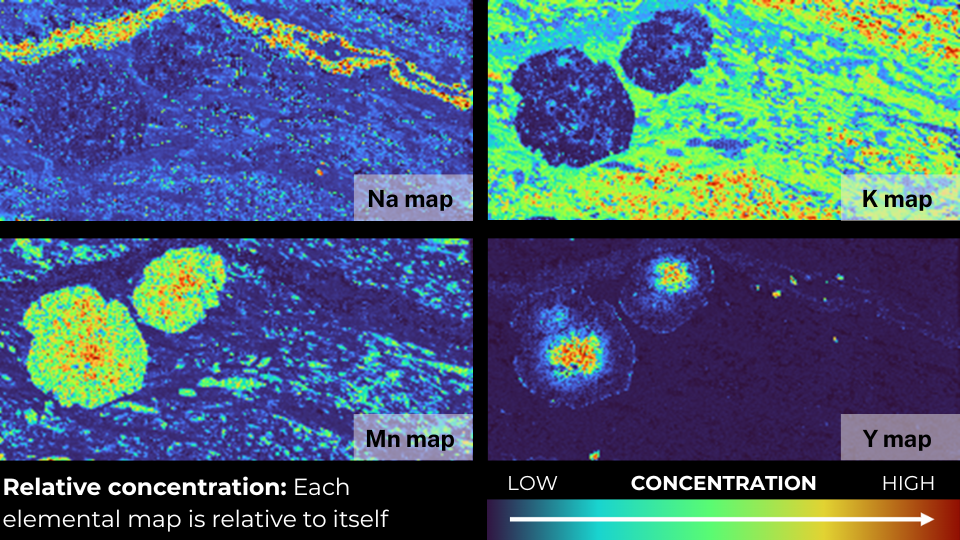
Image Credit: Exum Instruments
Determining the Host of Critical Minerals
Mineralogy informs how to extract and process important minerals. Although automated mineralogy technologies are useful, trace elements can provide critical information for thoroughly characterizing the mineralogy and determining its formation history.
The Analysis: Massbox carried out detailed elemental mapping across a rock thin slice, revealing a zone rich in Co, the essential element of interest. A higher-resolution study revealed the elements associated with the Co-rich zone.
The Results: Through detailed elemental composition research, Massbox showed:
- The sample's key mineralogies include high Co, low Fe, and high Ti; major components of the primary mineralogies identified in the sample
- Significant Co levels were associated with relatively high concentrations of Zn, a trace element in the ppm range that would have been difficult to detect using current techniques
The Value: Understanding the distribution of both major and trace elements enables a thorough understanding of target key elements and mineral hosts.
Elemental Mapping for Mineralogy | Massbox LALI-TOF-MS in Critical Mineral Exploration
Video Credit: Exum Instruments
Beryllium Zoning in Granite for Gem-Quality Aquamarine
Exploration and grading of particular gemstones rely on detecting light elements, which are notoriously difficult to detect using traditional equipment.
The Analysis: Beryllium (Be) is the element that defines aquamarine (beryl) and distinguishes it from the surrounding granite. Massbox directly measured Be in a rock sample collected from a region noted for its high-quality aquamarine. Massbox mapped Be and major elements (Si, Al, Na, and K) at 20 μm resolution in around 21 minutes.
The Results: Through direct, high-sensitivity elemental mapping, Massbox discovered:
- Clear Be zoning identifies aquamarine inside granite
- Superior precision and speed in multi-element mapping compared to other approaches
The Value: Traditionally, validating gem-quality zoning with light elements such as Be required submitting samples to a lab for analysis. Massbox extends that capacity beyond the lab, allowing exploration teams to analyze aquamarine potential on-site rather than relying on external conclusions.
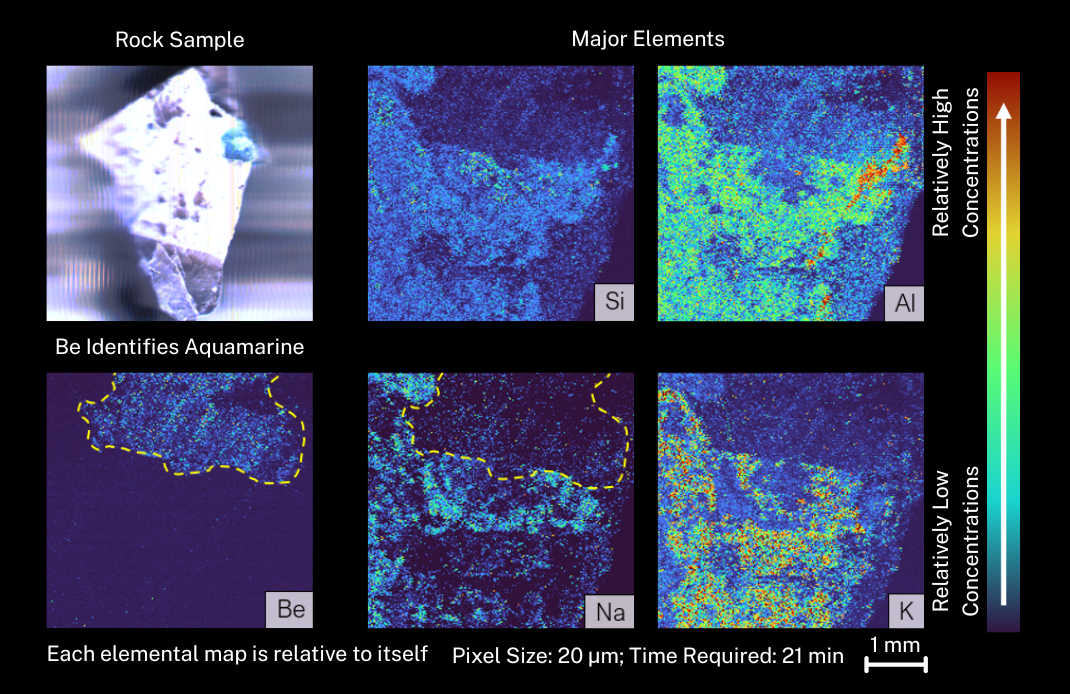
Image Credit: Exum Instruments

This information has been sourced, reviewed, and adapted from materials provided by Exum Instruments.
For more information on this source, please visit Exum Instruments.