Sponsored by MicrotracReviewed by Louis CastelNov 13 2026
Formulation development depends on understanding not just whether a dispersion is stable, but how and when it begins to change. TURBISCAN provides researchers with a quicker quantitative method for detecting instability before it becomes visible, making formulation decisions more informed and less reliant on extensive storage research.
For researchers developing emulsions, suspensions, foams, and other dispersions, knowing how a formulation behaves over time is an essential part of the process. Early detection of formulation instability can help researchers make adjustments before crucial time is lost.
Although conventional stability assessment can deliver useful insights into formulation behavior, it can also be time-intensive and may not detect changes until instability is already well established. Visual inspection, centrifugation, and long-term storage studies all have a place in formulation workflows, yet each has limitations in identifying subtle alterations early or monitoring how instability develops within a sample.
TURBISCAN offers a more sensitive method for tracking these alterations earlier. The TURBISCAN Stability Analyzer employs static multiple light scattering (SMLS) to assess the entire sample and identify subtle alterations in particle or droplet behavior before they become visible. This enables researchers to detect early signs of instability and better understand how a formulation changes over time.
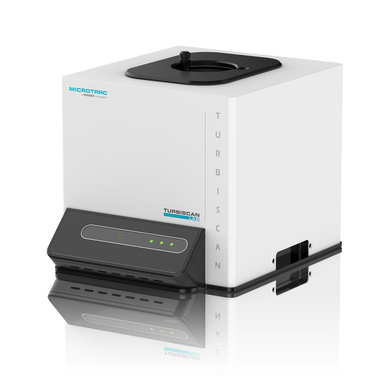
Image Credit: Microtrac
Why Conventional Stability Assessment Is Time-Intensive
Visual stability assessment is familiar to researchers. They can inspect a sample for sediment, creaming, separation, or other visible alterations and compare it with other formulations. The issue is that visual inspection usually detects instability only after it has progressed far enough to be visible. Results can also depend on lighting, sample presentation, and the operator.
While long-term storage research delivers important data on practical product behavior, it can take weeks or months. For formulation teams working through several compositions, waiting for each sample to complete a storage study can hinder development and, ultimately, delay progression toward commercialization.
Centrifugation can deliver quicker outcomes, but accelerated conditions do not always simulate the same instability mechanisms observed during normal storage. A formulation may exhibit different responses to elevated centrifugal forces than it will to gravity over time. This means that while centrifugation can be advantageous as part of a larger workflow, it may not provide the complete picture on its own.
An additional constraint is that traditional stability assessments may show that a formulation has changed without clearly identifying the mechanism responsible, complicating the process of understanding why instability is occurring and how to improve the formulation.
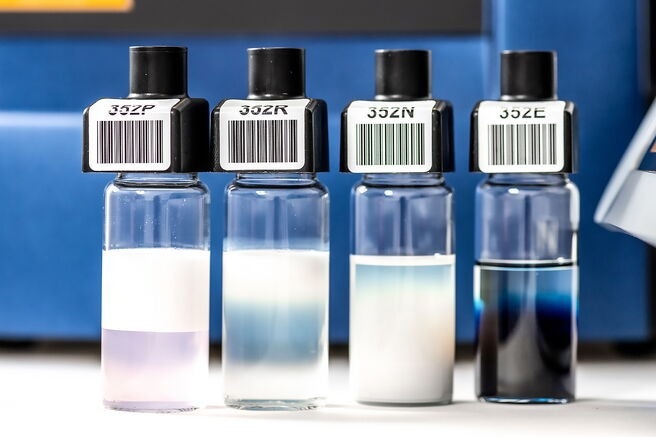
Image Credit: Microtrac
The Advantage of Accelerated Dispersion Analysis
TURBISCAN takes a different approach by tracking alterations throughout the sample.2 Since the system measures the sample instead of depending on a visual endpoint, it can identify physical instability before alterations become obvious to the eye.
This is especially useful when comparing formulations. Subtle composition differences can influence particle or droplet interactions, and those differences may eventually result in sedimentation, creaming, flocculation, coalescence, or phase separation. Early detection of these changes provides formulators with an opportunity to examine the cause before spending substantial time on longer stability studies.
For formulation researchers, TURBISCAN is not only about quicker outcomes. It can also deliver a clearer picture of what is occurring within a sample. While a visual check may reveal that two formulations appear different, TURBISCAN can identify alterations earlier and help researchers understand how instability is developing. This makes it easier to decide which formulations should be developed further and which should be ruled out.3
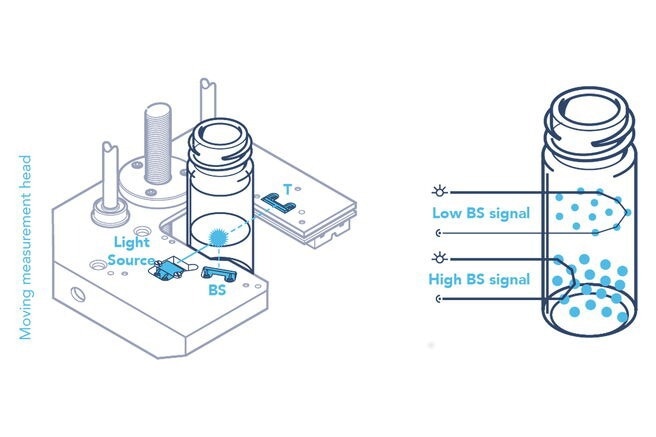
Image Credit: Microtrac
What Changes in a Formulation Workflow?4
One of the principal benefits of TURBISCAN is that it moves stability testing earlier in the development process. Rather than relying primarily on long-term storage studies, researchers can employ accelerated dispersion evaluations to screen formulations and detect differences faster.
For instance, research comparing visual observation with TURBISCAN demonstrated that SMLS could identify instability earlier and could be used to facilitate quick screening of liquid formulations.5
Early detection of an unstable formulation can also minimize unnecessary reformulation cycles, providing scientists with more information before committing to extensive stability research.
Quantitative measurements simplify objective formulation comparisons, delivering reproducible data for R&D, product comparison, and quality control, while facilitating formulation optimization and more confident go/no-go decisions about which candidates should advance to longer-term assessment.
The TURBISCAN Stability Index (TSI) offers a numerical measure of stability alterations over time, making it easier to compare and rank diverse formulations.6
In addition, TURBISCAN is engineered for a wide variety of dispersions, such as emulsions, suspensions, and foams. This makes it relevant across sectors such as pharmaceuticals, cosmetics, food, chemicals, and advanced materials, where physical stability can directly impact product performance and shelf life.
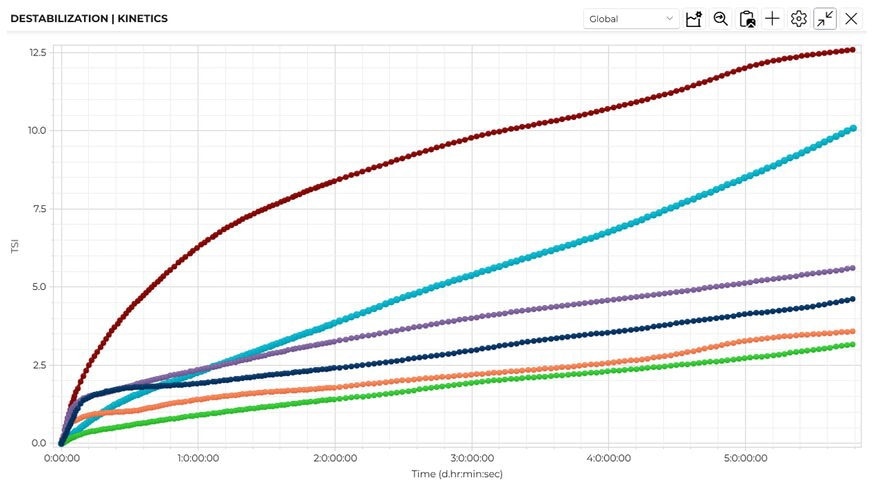
Image Credit: Microtrac
TURBISCAN Versus Conventional Stability Assessment: Selecting the Correct Approach
TURBISCAN can run at high temperatures to replicate storage conditions and speed up the evaluation of physical stability. However, traditional long-term research remains crucial for analyzing parameters beyond physical alterations, including sensory characteristics such as taste, odor, and texture, as well as microbiological stability. Visual inspection also contains practical value, especially for regular checks and finished products.
Therefore, TURBISCAN's aim is not to replace conventional stability assessment.
The difference is that TURBISCAN can deliver an earlier, more comprehensive view of what is occurring within the sample. It complements established techniques by helping researchers screen formulations faster, examine instability mechanisms, and make more informed decisions about which samples require longer-term assessment.
For teams under pressure to reduce development timelines, that shift can be substantial. Rather than waiting for instability to become visible, researchers can search for the signals that precede it. Instead of only asking whether a formulation is stable, they can examine how it is becoming unstable.
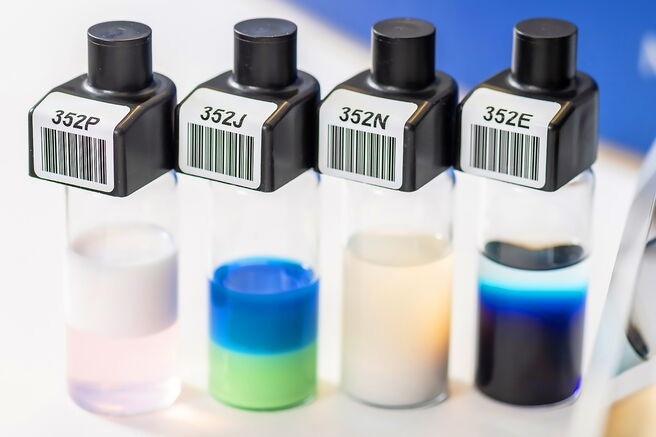
Image Credit: Microtrac
A More Efficient Path to Formulation Decisions
The practical value of TURBISCAN lies in transforming stability assessment from a largely endpoint-driven process into a more proactive component of formulation development.7 Earlier detection, quantitative measurements, and accelerated evaluation can help researchers compare candidates sooner and focus development effort where it is most likely to pay off.
For shortlist buyers comparing dispersion evaluation technologies, the question is which technique delivers valuable information sufficiently early to affect the formulation itself.
By revealing physical instability before it becomes visible and helping detect mechanisms including sedimentation, creaming, flocculation, coalescence, and phase separation, TURBISCAN provides formulation teams with the evidence needed to make quicker, more confident decisions.
References and Further Reading
- Sentis, M.,P. L., et al. (2023). Numerical prediction of long-term stability of liquid formulations determined by visual observation and static multiple light scattering. Colloids and Surfaces A: Physicochemical and Engineering Aspects, 663, p.131070. DOI:10.1016/j.colsurfa.2023.131070. https://www.sciencedirect.com/science/article/pii/S0927775723001541.
- Shen, H., et al. (2026). Development and validation of a static multiple light scattering (SMLS) method for real-time colloidal stability assessment in nanoparticle formulations. Journal of Pharmaceutical Analysis, 16(3), p.101396. DOI:10.1016/j.jpha.2025.101396. https://www.sciencedirect.com/science/article/pii/S2095177925002138.
- Sentis, M. P. L., et al. (2024). Size distribution of migrating particles and droplets under gravity in concentrated dispersions measured with static multiple light scattering. Journal of Colloid and Interface Science, 653, pp.1358–1368. DOI:10.1016/j.jcis.2023.09.163. https://www.sciencedirect.com/science/article/abs/pii/S0021979723018775.
- Lemahieu, G., et al. (2024). Coupling static multiple light scattering (SMLS) analysis with the Hansen approach for the rationalization of the dispersibility and colloidal stability of TiO2 particle dispersions. Colloids and Surfaces A Physicochemical and Engineering Aspects, 688, pp.133630–133630. DOI:10.1016/j.colsurfa.2024.133630. https://www.sciencedirect.com/science/article/abs/pii/S0927775724004916.
- Sentis, M. P. L., et al. (2023). Numerical prediction of long-term stability of liquid formulations determined by visual observation and static multiple light scattering. Colloids and Surfaces A: Physicochemical and Engineering Aspects, 663, p.131070. DOI:10.1016/j.colsurfa.2023.131070. https://www.sciencedirect.com/science/article/pii/S0927775723001541.
- AZo Materials (2024). Combining particle size, zeta potential and shelf-life for cutting edge research. AZoM. Available at: https://www.azom.com/article.aspx?ArticleID=24133.
- Shen, H., et al. (2026). Development and validation of a static multiple light scattering (SMLS) method for real-time colloidal stability assessment in nanoparticle formulations. Journal of Pharmaceutical Analysis, 16(3), p.101396. DOI:10.1016/j.jpha.2025.101396. https://www.sciencedirect.com/science/article/pii/S2095177925002138.

This information has been sourced, reviewed, and adapted from materials provided by Microtrac.
For more information on this source, please visit Microtrac.