Sponsored by MicrotracReviewed by Louis CastelNov 20 2026
Suspensions and emulsions are dispersed systems whose physical characteristics can evolve during storage. With time, the particles or droplets they contain may move, cluster, increase in size, or separate. Formulators therefore need to look beyond whether a sample appears stable and evaluate how quickly it is changing, which mechanisms are involved, and whether those changes could affect appearance, dose uniformity, texture, processing, or performance. 1,2
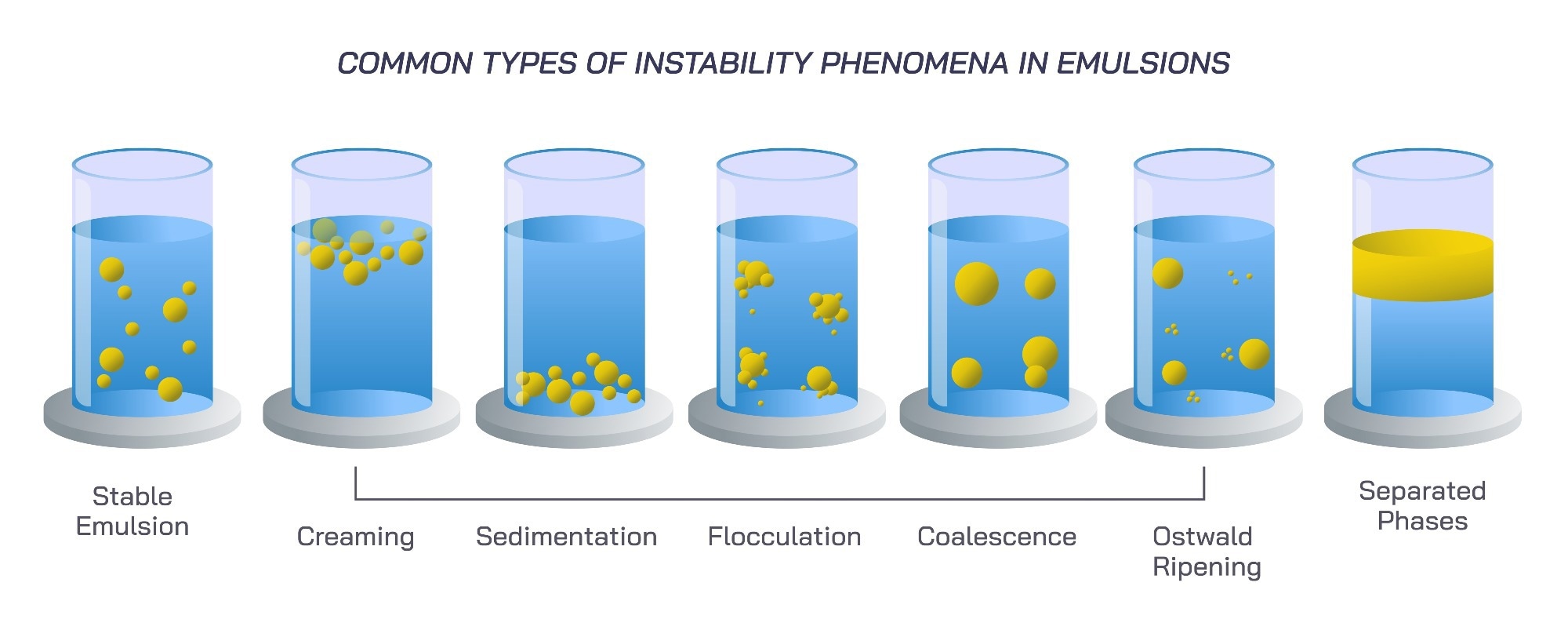
Image Credit: Anshuman Rath/Shutterstock.com
mechanisms deserve particular attention: sedimentation, creaming, flocculation, and coalescence. Although these processes can occur simultaneously, they represent two fundamentally different types of change.
Sedimentation and creaming are migration processes in which dispersed material travels through the continuous phase. By contrast, flocculation and coalescence change the condition or dimensions of the dispersed units themselves. 2,3 Understanding this difference is the first step toward effective troubleshooting.
Sedimentation: When Dispersed Material Moves Downward
Sedimentation takes place when particles or droplets denser than the surrounding continuous phase move downward under gravity. 4,5 It is especially important in solid–liquid suspensions found in paints, pharmaceuticals, agrochemical suspension concentrates, and battery-electrode slurries. 6,7 Dense droplets may also settle in emulsions, with water-in-oil systems being a common example. 4
For a spherical particle suspended in a dilute Newtonian liquid, Stokes’ law indicates that settling becomes faster with larger particles and larger density differences between particle and liquid, while higher viscosity slows settling.
In concentrated suspensions, particle interactions can modify the settling rate, and non-Newtonian behavior can reduce the accuracy of the simple Stokes model. In practice, rapid settling may signal an excessively large effective particle size, a major density mismatch, or inadequate continuous-phase viscosity. 5,8
Practical sedimentation assessment can combine sediment height or volume and settling-rate measurements with concentration profiling, redispersibility testing, rheology, and particle-size analysis.
A large sediment volume is not automatically undesirable: loose flocs may settle relatively quickly but form a voluminous sediment that redisperses easily, whereas individually settling particles can sometimes compact into a dense cake that is difficult to redisperse. 1,9
Creaming: When Droplets Rise
Creaming is the upward movement of droplets that are less dense than the continuous phase. It occurs most often in oil-in-water emulsions, including many food, beverages, cosmetic, and pharmaceutical products.
As with sedimentation, the rate depends on droplet size, the density difference between phases, continuous-phase viscosity, and the rheological structure of the continuous phase. 2,3
Creaming in emulsions does not cause droplets to merge, so gentle mixing can frequently redistribute a cream layer. Even so, it creates non-uniformity, and concentrating droplets in one area raises the likelihood of flocculation or coalescence. 2,3 Measuring the growth of a cream layer captures the visible outcome but may overlook earlier concentration changes. Tracking the rate and spatial development of the concentration gradient can therefore provide earlier and more mechanistic insight.11
Flocculation: Clustering Without Fusion
Flocculation happens when particles or droplets gather into clusters while keeping their separate identities.2 It occurs when attractive forces overcome stabilizing electrostatic or steric barriers. Shifts in pH, ionic strength, surfactant or polymer concentration, and temperature can disturb this balance, while polymer bridging and depletion attraction can also promote clustering. 6
Flocculation is often reversible, though not always, and its practical impact depends on the formulation. Controlled flocculation can help prevent hard caking in suspensions, whereas uncontrolled flocculation can raise apparent particle or droplet size, speed gravitational migration, change viscosity, and keep emulsion droplets in prolonged contact. 2,6
Dependable detection of flocculation may combine microscopy and particle-size analysis with zeta-potential and rheological measurements. Monitoring whether clusters break apart during gentle agitation can help establish whether the flocculation is weak and reversible. Notably, an increase in apparent size by itself does not confirm flocculation, since coalescence and Ostwald ripening can also enlarge droplets.2,6
Coalescence: Droplets Merge Permanently
Coalescence takes place when the thin continuous-phase layer separating two adjacent droplets ruptures, allowing them to merge into a single larger droplet. In contrast with simple creaming, this process is usually permanent. As it continues, the droplet-size distribution shifts toward larger droplets, may become broader, and can ultimately result in full phase separation.2,4
Weak interfacial protection or an inappropriate emulsifier can increase the risk of coalescence. Measuring and assessing it generally requires tracking changes in droplet-size distributions over time using approaches such as microscopy or laser diffraction, often alongside rheology or multiple-light-scattering measurements. Because coalescence and other mechanisms can both enlarge measured droplets, combining several methods yields more reliable evidence than relying on a single average-size measurement.4,10
Seeing Instability Before a Layer Appears
Although visual checks still serve a purpose, they depend on human judgment, provide little quantitative information, and usually reveal migration only once a concentration gradient has become large enough to see. Microscopic clustering or early droplet growth may already be underway even when the sample looks unchanged.
Static multiple light scattering (SMLS), used in TURBISCAN dispersion stability analysis, addresses this blind period by repeatedly measuring transmitted and backscattered light along the sample height. These signals depend on the size and concentration of the dispersed phase. Changes concentrated near the top and bottom of the cell point to migration patterns consistent with creaming or sedimentation, while changes across a larger portion of the sample can indicate evolving particle or droplet size.10,11
TURBISCAN conducts these measurements on native samples without routine dilution or mechanical stress. Its temperature-controlled cell operates from 4 °C to 80 °C, enabling testing at chosen storage temperatures or through carefully designed thermal acceleration.
The TURBISCAN Stability Index (TSI) summarizes overall profile change into a comparative value for ranking formulations or batches. As a result, early destabilization can be identified up to 1,000 times faster than by visual observation. 12
Effective stability analysis therefore involves more than deciding whether a suspension or emulsion remains stable. By establishing whether the dispersed phase is moving, clustering, enlarging, or separating – and how quickly each process occurs – formulators can make targeted changes before product quality is compromised.
References and Further Reading
- Rong, Di, et al. (2026). Multimodal assessment of sedimentation and flocculation in spray-dried injectable peptide suspensions. International Journal of Pharmaceutics, 694, p.126734. DOI:10.1016/j.ijpharm.2026.126734. https://www.sciencedirect.com/science/article/pii/S0378517326001821?via%3Dihub
- Xiao, T., et al. (2025). Advances in emulsion stability: A review on mechanisms, role of emulsifiers, and applications in food. Food Chemistry: X, 29, p.102792. DOI:10.1016/j.fochx.2025.102792. https://www.sciencedirect.com/science/article/pii/S259015752500639X?via%3Dihub
- Kelmer Müller, F. and Costa, F.F. (2025). Innovations and stability challenges in food emulsions. Sustainable Food Technology, 3(1), pp.96–122. DOI:10.1039/d4fb00201f. https://pubs.rsc.org/fb/article/3/1/96/850425/Innovations-and-stability-challenges-in-food
- Kupikowska-Stobba, B., Domagala, J. and Kasprzak, M.M. (2024). Critical review of techniques for food emulsion characterization. Applied sciences, 14(3), pp.1069–1069. DOI:10.3390/app14031069. https://www.mdpi.com/2076-3417/14/3/1069
- Pal, R. (2019). Modeling of Sedimentation and Creaming in Suspensions and Pickering Emulsions. Fluids, 4(4), p.186. DOI:10.3390/fluids4040186. https://www.mdpi.com/2311-5521/4/4/186
- Tadros, T.F. (2017). Suspension concentrates. DOI:10.1515/9783110486872. https://www.degruyterbrill.com/document/doi/10.1515/9783110486872/html
- Ouyang, L., et al. (2020). The effect of solid content on the rheological properties and microstructures of a Li-ion battery cathode slurry. RSC Advances, 10(33), pp.19360–19370. DOI:10.1039/d0ra02651d. https://pubs.rsc.org/ra/article/10/33/19360/701423/The-effect-of-solid-content-on-the-rheological
- Whorton, J., Jones, T.J. and Russell, J.K. (2025). Particle settling in a shear-thinning, viscoelastic fluid in the presence of wall effects. Scientific Reports, 15(1). DOI:10.1038/s41598-025-87742-w. https://www.nature.com/articles/s41598-025-87742-w
- Woldu, G., Brhane, T. and Demoz, G.T. (2024). Physicochemical characterization and evaluation of the suspending properties of boswellia papyrifera gum in metronidazole benzoate suspension. BioMed Research International, 2024(1). DOI:10.1155/2024/8899359. https://onlinelibrary.wiley.com/doi/10.1155/2024/8899359
- Santos, J., et al. (2017). Assessing differences between Ostwald ripening and coalescence by rheology, laser diffraction and multiple light scattering. Colloids and Surfaces B: Biointerfaces, 159, pp.405–411. DOI:10.1016/j.colsurfb.2017.08.015. https://www.sciencedirect.com/science/article/abs/pii/S0927776517305301?via%3Dihub
- Mengual, O., et al. (1999). Turbiscan mA 2000: Multiple light scattering measurement for concentrated emulsion and suspension instability analysis. Talanta, 50(2), pp.445–456. DOI:10.1016/S0039-9140(99)00129-0. https://www.sciencedirect.com/science/article/abs/pii/S0039914099001290?via%3Dihub
- Microtrac (2024). TURBISCAN LAB Stability Analyzer. Available at: https://www.microtrac.com/products/static-multiple-light-scattering/turbiscan-lab/

This information has been sourced, reviewed, and adapted from materials provided by Microtrac.
For more information on this source, please visit Microtrac.