Sponsored by MicrotracReviewed by Louis CastelNov 20 2026
Stability in dispersions is often treated as a simple yes-or-no question: either a sample remains visually unchanged, or it separates. In reality, stability changes over time. ISO/TR 13097 characterizes it through alterations in one or more physical properties across a defined period.1 A meaningful test should therefore determine which property is changing, the pace of that change, and whether it has consequences for product performance.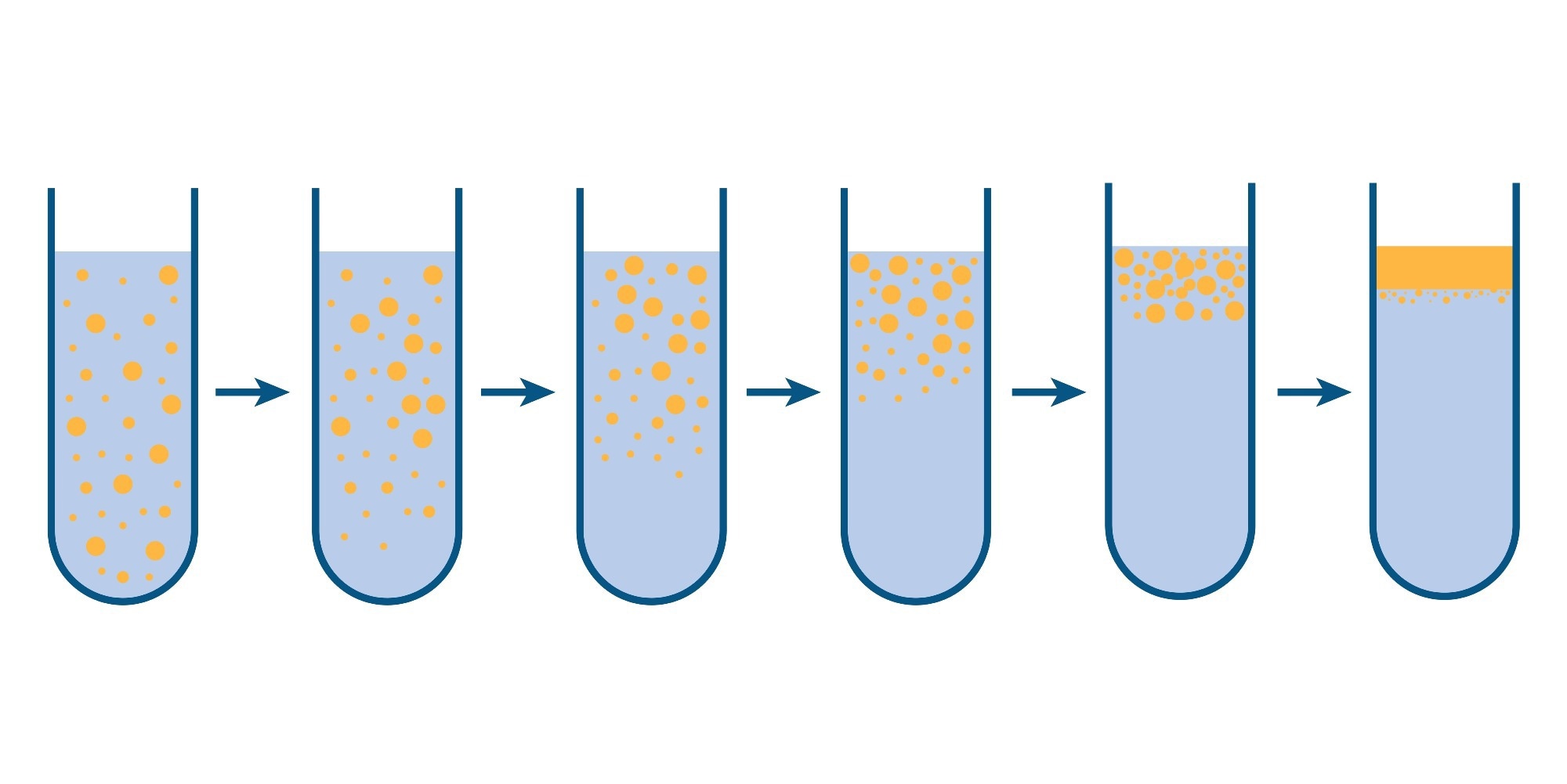
Image Credit: Dream01/Shutterstock.com
The distinction is essential because suspensions and emulsions can destabilize in different ways. Particles or droplets may move downward through sedimentation or upward through creaming; flocculation and aggregation create larger assemblies; and coalescence occurs when droplets combine.2 These mechanisms can overlap and may eventually create layers that look alike, yet each calls for a different formulation response.
Mistake 1: Waiting Until Instability Becomes Visible
Visual inspection is still the easiest and least costly way to document obvious separation. Even so, it is open to interpretation and cannot reliably detect opaque boundary layers or microscopic changes. Subtle concentration gradients and early coalescence may progress while the sample still appears homogeneous. A photograph taken only at the beginning and end of a study also says little about when destabilization started or how quickly it developed.2,3
A better approach is to retain visual checks while adding quantitative data collected over time. Depending on the material and the question, suitable methods may include multiple light scattering, microscopy, particle-size analysis, or rheology. Early SMLS research using TURBISCAN demonstrated that changes in particle or aggregate size and migration could be identified in concentrated dispersions before they became visible to the naked eye.3
Mistake 2: Altering the Sample Before Measurement
Concentrated emulsions and suspensions often require dilution or mechanical stress before conventional characterization, but either step can modify the sample’s physical condition and internal structure.
In one study of submicron water-in-oil emulsions, dilution concentration had a strong effect on dynamic light scattering results. As droplet concentration increased, the measured diffusion coefficient decreased, a result consistent with interactions among droplets. Heavy dilution may also allow water droplets to dissolve into the dilution medium during storage or measurement.4,5
Reliable results therefore depend on carefully controlling the dilution medium’s water saturation, evaporation, and headspace. Whenever possible, measuring a formulation in its original concentrated form minimizes this source of disturbance.4,5
Mistake 3: A Single Measurement May Not Tell the Whole Stability Story
Because different techniques reveal different features of dispersion behavior, the measurement method should reflect the suspected failure mechanism. Particle-size analysis does not capture migration processes such as sedimentation or creaming. A mean particle-size value can also conceal changes across the full size distribution, and particle-size data alone may not separate growth due to flocculation from growth due to coalescence.
Tracking the height of a separated layer can quantify creaming or sedimentation, but it cannot identify other instability pathways.
For these reasons, researchers should select - and where appropriate combine - methods according to the property and mechanism being studied.2,6
Mistake 4: Using Inconsistent or Irrelevant Test Conditions
Small differences in procedure can hide real differences between formulations. Temperature, vibration, light exposure, test-cell dimensions, sample volume, mixing history, equilibration time, and the delay between preparation and measurement can each influence the result.
Samples should be compared under identical loading, conditioning, and measurement conditions; a freshly mixed sample and one left overnight have not been treated equivalently.7,8
Accelerated testing also needs caution. Elevated-temperature storage, centrifugation, or freeze-thaw cycling can yield useful screening information, but the stress should hasten a destabilization pathway relevant to normal storage rather than create changes that would not occur otherwise.
No single stability protocol suits every formulation. Test methods, specifications, and conditions must be chosen and justified based on the product and its expected storage and use.8
Mistake 5: Measuring Too Infrequently or Reducing the Study to One Number
Taking measurements only at the start and end of a study can miss both the beginning of instability and its progression over time.
Time-resolved data can reveal early aggregation or particle migration and show how the stability profile develops, while an endpoint measurement captures only the condition at that single moment.
Measurement frequency and total study duration should therefore be chosen to resolve the relevant destabilization kinetics.1,7
A summary value such as the TURBISCAN Stability Index can simplify formulation ranking, while the underlying transmission and backscattering profiles show where and how the sample is changing.5,7
TURBISCAN was the first patented technology to provide tools for accelerated aging tests on unstressed products. Its SMLS technology records transmitted and backscattered light across the sample height at repeated points during aging. Because these signals depend on the size and concentration of the dispersed phase, the resulting profiles can follow concentration changes linked to sedimentation or creaming, as well as size changes linked to aggregation, flocculation, or coalescence.3,5
When the necessary optical information is available, mean particle diameter can be calculated from the signals using Mie theory. Samples can be analyzed in their native concentrated state without dilution, and repeated scans can reveal early instability, reducing the time spent waiting for macroscopic separation to become visually apparent.3,5,7
Building a More Reliable Stability Test
Before testing begins, a protocol should define the relevant product requirements, stability metrics, acceptance criteria, and likely destabilization mechanisms.
Formulation, filling, handling, storage, instrument settings, and measurement timing should be standardized, with replicates and appropriate visual records included where useful.
Ultimately, stability testing should identify what changes, how rapidly it changes, and which physical mechanism is probably responsible - not merely label a formulation “stable” or “unstable.”
Time-resolved methods such as TURBISCAN help meet this goal by monitoring size and concentration changes throughout an undiluted sample and detecting emerging instability before visible separation occurs.
When paired with consistent handling and careful interpretation, these data can strengthen reproducibility and troubleshooting, giving teams greater confidence when comparing formulations and selecting candidates for further development.
References and Further Reading
- International Organization for Standardization (2013). ISO/TR 13097:2013: Guidelines for the characterization of dispersion stability. Available at: https://www.iso.org/standard/52802.html
- Mcclements, D. J. (2007). Critical review of techniques and methodologies for characterization of emulsion stability. Critical Reviews in Food Science and Nutrition, 47(7), 611–649. DOI:10.1080/10408390701289292. https://www.tandfonline.com/doi/full/10.1080/10408390701289292
- Mengual, O., et al. (1999). Turbiscan mA 2000: Multiple light scattering measurement for concentrated emulsion and suspension instability analysis. Talanta, 50(2), 445–456. DOI:10.1016/S0039-9140(99)00129-0. https://www.sciencedirect.com/science/article/abs/pii/S0039914099001290?via%3Dihub
- Balcaen, M., et al. (2020). Effect of dilution on particle size analysis of w/o emulsions by dynamic light scattering. Journal of Dispersion Science and Technology, 42(6), 869–879. DOI:10.1080/01932691.2020.1712216. https://www.tandfonline.com/doi/full/10.1080/01932691.2020.1712216
- Microtrac (2025). Static Multiple Light Scattering (SMLS). Available at: https://www.microtrac.com/products/static-multiple-light-scattering/
- Hu, Y.-T., et al. (2017). Techniques and methods to study functional characteristics of emulsion systems. Journal of Food and Drug Analysis, 25(1), pp.16–26. DOI:10.1016/j.jfda.2016.10.021. https://www.sciencedirect.com/science/article/pii/S1021949816301831?via%3Dihub
- Shen, H., et al. (2026). Development and validation of a static multiple light scattering (SMLS) method for real-time colloidal stability assessment in nanoparticle formulations. Journal of Pharmaceutical Analysis, 16(3), p.101396. DOI:10.1016/j.jpha.2025.101396. https://www.sciencedirect.com/science/article/pii/S2095177925002138?via%3Dihub
- International Organization for Standardization (2018). ISO/TR 18811:2018: Cosmetics - Guidelines on the stability testing of cosmetic products. Available at: https://www.iso.org/standard/63465.html

This information has been sourced, reviewed, and adapted from materials provided by Microtrac.
For more information on this source, please visit Microtrac.