Decreasing VOCs or eliminating PFAS from coatings, adhesives, or sealants is rarely a straightforward substitution exercise.

Image Credit: Toa55/Shutterstock.com
Replacing a solvent, surfactant, binder, or additive can impact viscosity, adhesion, cure behavior, gloss, stability, and price. Such substitutions can also create additional production or supply-chain limitations. The key challenge is to develop formulations that satisfy evolving specifications while preserving the performance that makes a product viable for its intended application.
Many CASE teams must complete this work despite limited lab capacity, incomplete historical data, and an increasing number of client, regulatory, and raw-material requirements. AI-guided formulation workflows offer a more systematic approach to managing these trade-offs.
Moving Beyond One-Variable-at-a-Time Testing
Conventional formulation development frequently depends on assessing changes individually. While this method can identify valuable improvements, it loses effectiveness when several ingredients, process conditions, and performance targets interact.
AI-guided iterative learning offers an alternative approach by combining historical formulation records, raw-material characteristics, process conditions, and test findings with formulator expertise. The team determines which properties to optimize and which constraints must be maintained. The AI model then identifies potential candidates for the next round of experiments.
After lab results are added, the model updates its predictions and highlights where additional assessment is most likely to enhance understanding, creating a closed learning cycle:
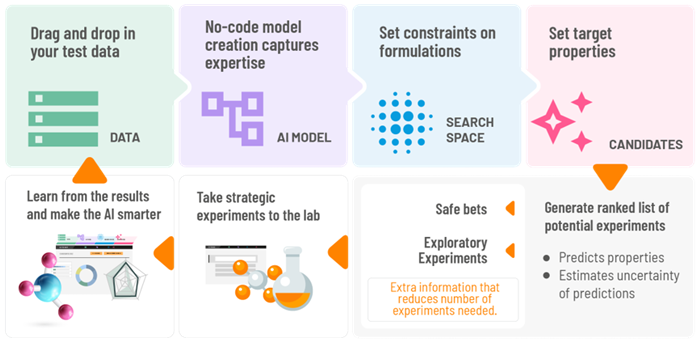
Image Credit: Citrine Informatics
Rather than replacing scientific judgment, the objective is to assist formulators in directing laboratory effort toward both technically promising and informative experiments.
Making the Most of Existing Formulation Knowledge
A useful starting point does not necessarily need a complete, perfectly structured dataset. Even when historical records are inconsistent or sparse, they can still provide insight into the relationships between ingredients, processing conditions, and performance.
Formulator expertise plays a crucial role in determining which records are comparable, which data is reliable, and which requirements are non-negotiable. They can also define practical search boundaries, including approved raw materials, permissible processing conditions, cost limitations, and producibility requirements.
This ensures that the suggested formulations are relevant to real product development decisions.
Balancing Performance and Uncertainty
For instance, a lower-VOC coating may need to preserve adhesion, gloss, dry time, and water resistance. Adhesives or sealants may need to satisfy PFAS-free and VOC-related specifications while ensuring sufficient tack, peel strength, cure speed, cohesion, and application viscosity.
In addition to quantifying uncertainty, AI models can predict the likely performance of untested candidates across this complex space. This distinction is important because candidates with strong predicted performance may still need testing if the model has limited evidence in that region of the formulation space.
Taking both anticipated performance and uncertainty into account allows researchers to choose a manageable experimental batch instead of attempting to assess every possible combination.
A Practical Route to PFAS-Free Reformulation
This strategy can be particularly useful when evaluating alternative raw materials. Screening replacements only by product name or broad chemistry class may overlook ingredient properties that impact performance in a specific formulation.
In one adhesive reformulation program, a global materials company sought to exclude PFAS while ensuring required performance. Using AI, the team assessed millions of possible ingredient combinations, narrowed the options to 30 viable candidates, and discovered a breakthrough candidate in four months. This was estimated to save two years of work in a project that would otherwise have required approximately five years.
Laboratory verification remained critical throughout. The value of the workflow was its ability to focus testing on a smaller, better-informed set of candidates.
Building a Capability That Lasts Multiple Projects
A successful reformulation program can leave behind a reusable technical asset. The dataset, models, search spaces, and decision criteria can be retained and adapted when requirements evolve, a supplier is no longer available, or another product team faces a similar challenge.
For CASE organizations, an effective initial AI project is often bounded and critical, requiring an established product family, a defined application, measurable performance specifications, and experienced formulators capable of guiding the work. Lower-VOC and PFAS-free reformulation is often ideal for this strategy.
The most useful outcome is a viable formulation alongside a faster, more repeatable approach to learning across complex formulation decisions.
Acknowledgments
Produced from materials originally authored by Hannah Melia from Citrine Informatics.

This information has been sourced, reviewed, and adapted from materials provided by Citrine Informatics.
For more information on this source, please visit Citrine Informatics.