The MICROFAGO project, coordinated by the Plastics Technology Centre, focuses on identifying the most active microorganisms and testing their performance at different scales (laboratory, pilot and industrial).
The initiative will optimise the treatment of compostable bioplastics without the need for changes to existing facilities.
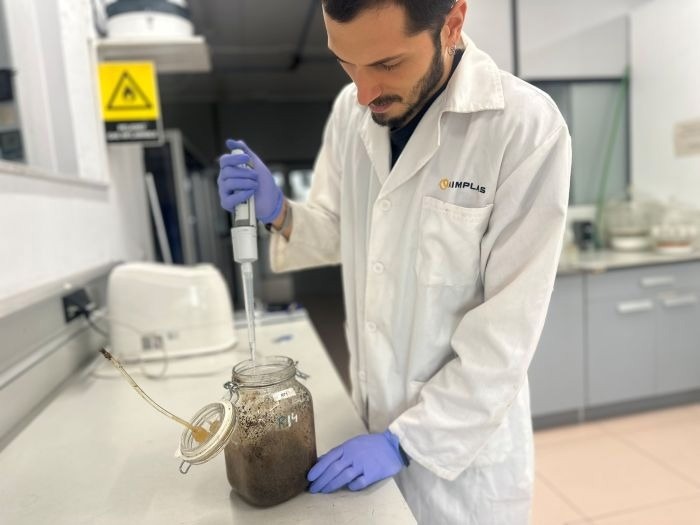 Image Credit: AIMPLAS
Growing concern about plastic waste management and the need to reduce dependence on fossil fuels has driven the development of bioplastics, whose global production capacity will reach 5.7 million tons in 2029, according to the European Bioplastics association. However, the current configuration of some composting and anaerobic digestion plants does not always ensure that these materials are completely degraded, which poses a challenge for the environment and for waste recovery.
To respond to this challenge, AIMPLAS, the Plastics Technology Centre, is coordinating the MICROFAGO project, in which the Department of Plant Biology of the Faculty of Pharmacy at the University of Valencia, Darwin Bioprospecting Excellence, Evolving Therapeutics and the company Gestión Integral de Residuos Sólidos (Girsa) are participating. The initiative proposes an innovative solution: accelerating the decomposition of compostable bioplastics in organic waste treatment processes through the combined use of microorganisms and natural viruses (phages) that promote faster and more effective biodegradation.
AIMPLAS has highlighted that this project represents a step forward in ensuring that bioplastics truly fulfil their sustainable function. ‘MICROFAGO will allow us to improve the treatment processes of compostable bioplastics without the need to modify existing facilities, which is key to facilitating their implementation,’ said Giovanni Gadaleta, a researcher at the Biodegradability and Compostability Laboratory at AIMPLAS.
An Innovative and Accessible Solution
The project's approach is simple: on the one hand, phages will be used, which act on bacteria that hinder degradation, thus favoring the work of beneficial microorganisms. And, on the other hand, the presence of microorganisms that actively help to break down bioplastics will be enhanced by introducing them into the process to reinforce biodegradation.
In Gadaleta's words, ‘the key is to identify the most active microorganisms and ensure that they are present in sufficient quantities for the biological decomposition process to be truly efficient.’ He also pointed out that the effectiveness of these techniques will be evaluated on different scales - laboratory, pilot and industrial - and compared with biodegradation or fragmentation tests regulated by current legislation.
Benefits for Businesses and the Environment
The project not only has a positive environmental impact, but also great practical value for businesses and waste management plants. In this regard, Giovanni Gadaleta explained that ‘thanks to this approach, we can integrate the biodegradation of compostable bioplastics into current processes without making large investments in new infrastructure. It is a solution that generates immediate benefits for the sector.’
The expected outcome of the project is the development of an innovative process that accelerates the biodegradation of compostable bioplastics in an environmentally safe manner. All of this is in line with the principles of the circular economy, promoting the recovery of waste, both in the form of material and energy, and contributing to reducing the impact of plastics on the environment.
This project is funded by the Valencian Institute of Competitiveness and Innovation (IVACE+i), through the Strategic Cooperation Projects program in its 2024 call for proposals, and ERDF funds.