Inescop and AIMPLAS are leading this initiative, which seeks to replace conventional treatments with fluorinated compounds, guaranteeing advanced features such as liquid repellence, stain resistance, and non-stick properties.
The project develops silicon-based functional coatings applied using atmospheric plasma, offering a clean, effective, and environmentally friendly solution.
This research is funded by the Valencian Institute of Competitiveness and Innovation (IVACE+i) through ERDF funds.
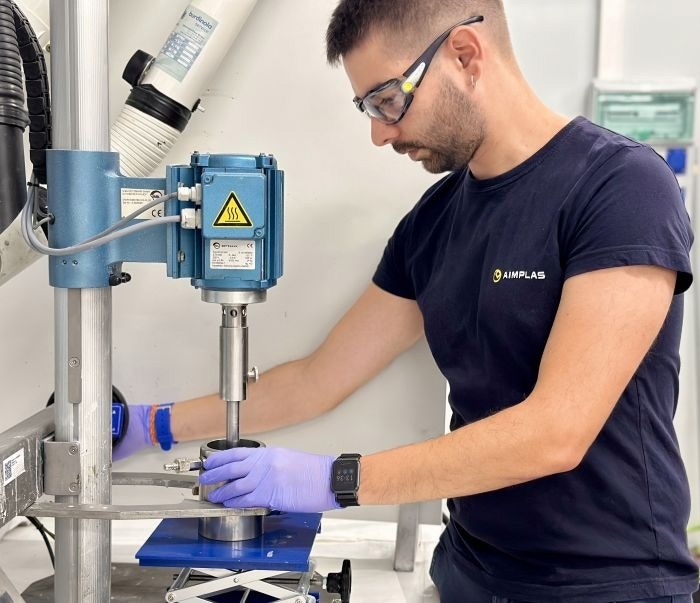 Image Credit: AIMPLAS
In sectors such as packaging, leather, and textiles, the use of functional coatings that provide properties such as water repellence, stain resistance, or non-stick effects is common practice. However, many of these treatments are based on PFAS compounds (perfluoroalkyl and polyfluoroalkyl substances), which are currently in the process of being regulated and banned in the European Union due to their environmental persistence, toxicity, and ability to accumulate in living organisms.
In response to this situation, the PLASRECO project has been launched, proposing the development of PFAS-free, silicon-based functional coatings applied using atmospheric plasma technology. This technique allows the deposition of nanometric layers, significantly reducing the use of chemicals and improving the sustainability of the process. In addition, it is compatible with a wide variety of materials, including porous and flexible surfaces such as leather, textiles, and paper.
The project is being carried out in collaboration with Inescop, the Footwear Technology Centre, and AIMPLAS, the Plastics Technology Centre, both of which have extensive experience in surface treatment and the formulation of functional coatings, respectively. Their joint work will enable this technology to be transferred to the industrial sector, offering a viable and scalable alternative to conventional PFAS treatments in these productive sectors.
“Atmospheric plasma technology allows us to apply functional coatings to different surfaces, reducing the use of chemicals and improving the sustainability of the process”, explained Víctor Serrano, researcher in Advanced Materials and Adhesives at Inescop. “In addition, its compatibility with porous and flexible materials such as leather, paper, and textiles opens up new possibilities for industrial sectors such as footwear that are looking for alternatives to PFAS without compromising performance,” added Serrano.
The main objective of PLASRECO is to obtain a system of advanced coatings that maintains the desired technical properties without compromising safety or the environment. To this end, work is being done on the development of new organosilicon monomers specifically designed for application using atmospheric plasma, guaranteeing the durability, stability, and reproducibility of the treatment even under demanding conditions such as abrasion, humidity, or thermal changes.
AIMPLAS coatings researcher Blai López emphasized that “our challenge is to design specific silicon-based monomers that, when combined with plasma, will enable us to obtain durable, resistant, and environmentally friendly coatings. PLASRECO represents a firm step towards the elimination of hazardous substances in industry, in line with European regulatory requirements.”
PLASRECO is thus aligned with European sustainability and chemical safety objectives, positioning the Valencian Community as a benchmark in the development of clean technologies for the surface treatment of materials. The results of the project will contribute to improving the competitiveness of companies, reducing environmental impact, and ensuring regulatory compliance in key sectors of the economy.
The companies Tempe, part of the Inditex fashion, footwear, and accessories group; the footwear brand Pikolinos; Acatex, a company specializing in textile finishing; Pies Cuadrados Leather, dedicated to the tanning and finishing of cowhide leather; and Lisart, a company that manufactures and markets paper packaging for food use, are participating in various activities involving technical advice and support, the supply of materials, and the validation of coatings and industrial processes.
The PLASRECO project is part of the call for grants aimed at technology centers in the Valencian Community for R&D projects in collaboration with companies for the year 2025 by the Valencian Institute of Competitiveness and Innovation (IVACE+i), with funding from the ERDF.