Zurich Instruments, a leader in research instrumentation and quantum computing control systems, has launched the VHFLI Very High Frequency Lock-in Amplifier, an instrument designed to make advanced signal analysis accessible for every research lab, accelerating scientific discovery across a range of fields. Covering applications in optics and photonics, sensor and electronic device development, nanotechnology, scanning probe microscopy, surface and materials science, the VHFLI Lock-in Amplifier delivers high-performance signal analysis and control from DC up to 200 MHz.
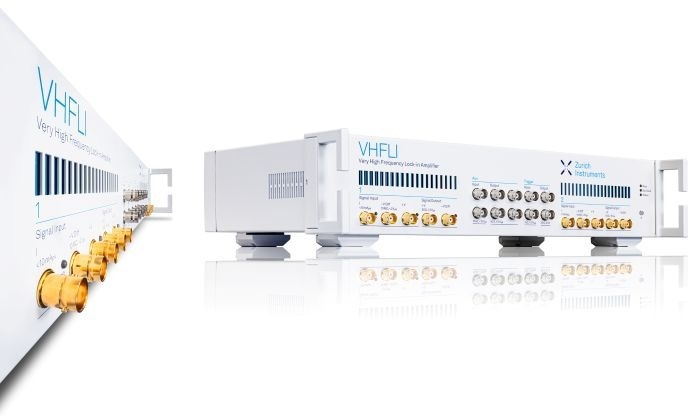 Image Credit: Zurich Instrument
The VHFLI is multipurpose and versatile, allowing researchers to consolidate multiple functions on a single instrument. In addition to being an industry-leading lock-in amplifier, it features tools such as Scope, Sweeper, Spectrum Analyser, and advanced processing modules that run simultaneously, allowing scientists to gain multiple perspectives on their signals in real-time. This capability enables labs to do more with less: accelerating experiments, reducing setup complexity, freeing up bench space, and ultimately giving researchers more freedom to innovate.
With the VHFLI comes the new LabOne Timeline Module, an innovative tool for the unified orchestration of experiments, allowing researchers to design and implement continuous-wave and pulsed measurement sequences, coordinate pulses, triggers, and measurements, and automate workflows that previously required multiple synchronized instruments. This simplifies setups, improves reproducibility, and lets scientists focus on analysis and discovery rather than hardware management.
A Legacy of Lock-in Innovation
Zurich Instruments has been a pioneer in lock-in detection for over 17 years, introducing digital lock-in amplifiers with integrated feedback loops, multi-frequency operation, sideband analysis, and arbitrary waveform generation. The VHFLI continues this tradition, offering higher bandwidth, lower noise, and best-in-class analog performance, making advanced signal analysis more accessible than ever before. Starting at €15,300, a lower price point than lock-in amplifiers with comparable features, the VHFLI reflects the company’s commitment to providing a high-end yet affordable instrument, suited to the needs of a wide range of labs.
“Many research labs struggle with complex setups, multiple instruments, and time-consuming recabling, which slows down experiments and limits focus on innovation and breakthroughs,” said Andrea Orzati, CEO of Zurich Instruments. “The VHFLI addresses these challenges by consolidating multiple capabilities into a single, versatile, and affordable platform. It enables labs to do more with less – running complex experiments more quickly, gaining deeper insights, and giving researchers the freedom to focus on the science and discoveries that matter most.”
With the VHFLI Lock-in Amplifier, Zurich Instruments aims to make high-end signal analysis more accessible to researchers pushing the boundaries of scientific discovery and innovation.
VHFLI Lock-in Amplifier
Video Credit: Zurich Instrument
Freedom to Innovate in Scientific Research with the VHFLI Lock-in Amplifier
Video Credit: Zurich Instrument