Secondary Ion Mass Spectrometry is a surface analysis technique known for high sensitivity and excellent depth resolution in the analysis of solid materials. It is frequently used to monitor impurities like dopants in semiconductors and contamination at interfaces in the production of thin films, such as solar cells. In these applications different elements are monitored.
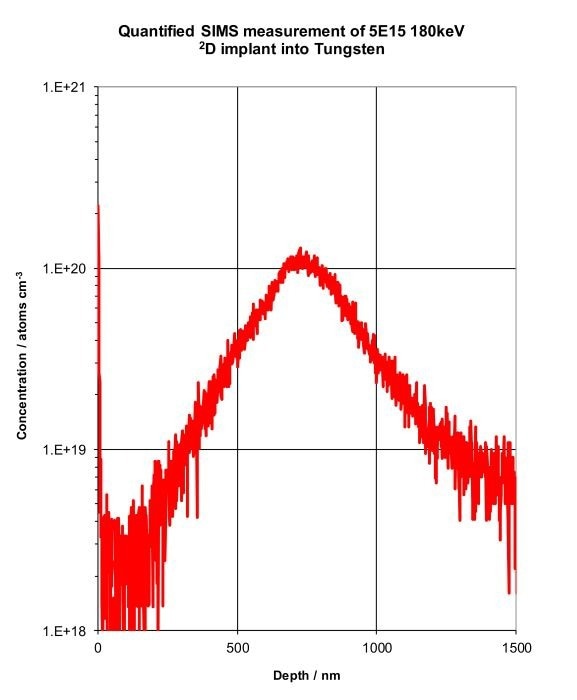 Deuterium (a rare isotope of hydrogen) is ideal to study hydrogen transport in the tungsten wall of a fusion reactor. Image Credit: Hiden Analytical
However, because it is a mass spectrometry technique, SIMS is capable of monitoring different isotopes of the same element, making it one of the few methods that can investigate atomic movement in solids. Many elements possess a number of stable isotopes, for instance lithium has two, lithium-6 and lithium-7, so if one is introduced into the other as part of a battery charging investigation, it is possible to study the movement and reactions of lithium. In a similar way, oxygen-18 and deuterium (a rare isotope of hydrogen) can be used to study the workings of fuel cells, the transport of hydrogen in fusion reactors and the progression of corrosion in critical materials.
Hiden’s Principal Scientist, Dr Graham Cooke, said, “Secondary Ion Mass Spectrometry combined with isotopically pure materials provides an unparalleled means to study diffusion and material transport, especially in the field of emerging energy technology.”
Hiden produces a range of SIMS tools that can be used in R&D through to production, from the highly flexible SIMS Workstation Series for advanced analysis to the smaller AutoSIMS, capable of unattended operation with non-expert users.