Hiden Analytical highlights the application of Secondary Ion Mass Spectrometry, SIMS, for isotope ratio analysis in enriched solid target materials used in medical radioisotope production research and development.
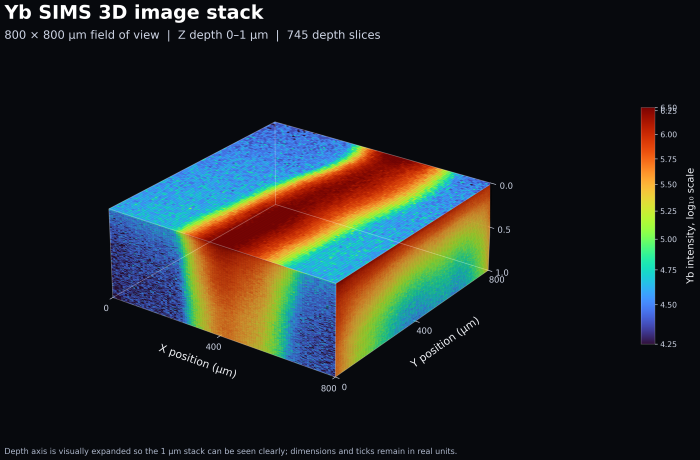 Yb-174 SIMS 3D image stack: Depth-resolved SIMS image of a 200 µm-wide line of Yb-174 deposited on a stainless- steel substrate. The measurement area is 800 × 800 µm, with a total analyzed depth of 1 µm. Image Credit: Hiden Analytical
Many medical radioisotopes are produced by neutron irradiation of stable isotope targets. In these processes, the isotopic composition of the starting material can directly influence activation yield, radionuclidic purity and downstream radiochemical processing. Enriched targets are therefore used to maximize production of the required radionuclide while reducing unwanted activation products.
SIMS offers a valuable analytical route because it measures solid samples directly, with very small material consumption and without the need for full sample dissolution. This is particularly useful for enriched materials that are scarce, high value, difficult to dissolve or required for further process development.
A key advantage of SIMS is its ability to preserve spatial and depth information. While bulk isotope analysis provides an averaged composition, SIMS can show how isotope distribution varies across a surface, through a deposited layer or within a depth profile. This makes it especially relevant for thin deposits, collected enrichment products, laser enrichment studies, plasma or vapor deposition processes, and target quality assessment before irradiation.
“Enriched isotope targets are often valuable, limited in quantity and highly application-specific,” says Graham Cooke, Principal Scientist at Hiden Analytical. “SIMS provides a direct way to examine isotope distribution in the solid material itself, while retaining the spatial and depth information that can be lost in bulk measurements.”
In the example data, SIMS was used to analyze a 200 μm-wide line of ytterbium-174 deposited on a stainless-steel substrate. The 3D image stack covers an 800 × 800 μm measurement area with a total analyzed depth of 1 μm, visualizing the Yb signal through the deposited feature. The accompanying mass spectrum shows the Yb isotopes normalized to the m/z 174 peak, with approximately 1 ng of material removed from the solid sample during measurement.
For laboratories developing enriched solid targets, Hiden Analytical’s AutoSIMS offers a compact and automated route to routine SIMS analysis. Rather than positioning SIMS only as a large, specialist-facility technique, AutoSIMS is designed as a self-contained platform for repetitive surface analysis, thin-film measurements, depth profiling and 3D characterization. Its automated operation, spreadsheet-defined parameters and small footprint make it well suited to repeatable measurements on deposited or scarce materials, including enriched isotope target layers.
For this application, AutoSIMS helps make isotope distribution, surface composition and depth-resolved assessment more accessible to laboratories that need meaningful SIMS data without the complexity typically associated with large, research-center-scale SIMS instrumentation.
For deposited enrichment products, this type of depth-resolved measurement can help assess whether isotope composition remains stable through the collected layer or changes with process time. With appropriate standards, calibration and correction methods, SIMS can support isotope ratio comparison alongside surface composition analysis, contamination checks and investigation of localized variation, substrate mixing or interfacial effects.
This makes SIMS a strong complementary technique for enriched medical isotope target development, helping researchers assess whether the correct isotope has been enriched, whether the material is homogeneous, and whether unwanted isotopic or chemical contributions are present before irradiation.