Sponsored by InterpowerReviewed by Ify IsiborApr 15 2026
Artificial intelligence (AI) sits at the heart of what many call the Fourth Industrial Revolution. As of March 2026, companies are approaching it in different ways – some are leaning in quickly, while others are more cautious, worried about what it could mean for jobs. At the same time, many believe AI will not only reshape existing roles but also open the door to entirely new industries.
What’s clear is the sheer scale of what AI can do. It processes and connects information across the digital world at incredible speed, turning vast amounts of data into something usable. That naturally raises bigger questions, especially around which country might emerge as the global leader in AI, and what that kind of influence could mean in practice.
These ideas aren’t new. Popular culture has explored them for decades, from Star Trek to 2001: A Space Odyssey, Terminator 3: Rise of the Machines, and Specter – often imagining intelligent systems as powerful forces that humans struggle to control.
So where does that leave us? Should we fully embrace AI, move forward carefully, or find a balance between the two? Even industries like entertainment and gaming (think Las Vegas) are already starting to explore how far these technologies can go. There’s no shortage of questions, and the answers are still taking shape.
As of March 2026, AI can describe how coffee tastes and even explain how people tend to feel about its flavor, texture, and the mood it creates. But it still can’t actually experience any of it.
For all its vast memory and convincingly empathetic responses, those sensations remain out of reach. Chalk that up as a small win for the humans.
The Growing Prominence of IEC 60320 Appliance Couplers
So, how are IEC 60320 appliance couplers, like connectors, plug connectors, inlets, outlets, and jumper cords, faring in this era of near-instant computing? In a word: very well.
Wherever mains power is available, IEC 60320 components are typically close by, often connected through accessory power strips (APS) or power distribution units (PDUs) to support multiple devices across industries such as medical, manufacturing, gaming, food service, and test and measurement.
Nearly everything produced today, whether a product or a service, relies on AC power or on converting AC to DC power. For example, a surgical robot operator’s panel may begin with AC power from a wall socket, but at some point within its electrical design, that power is converted to DC.
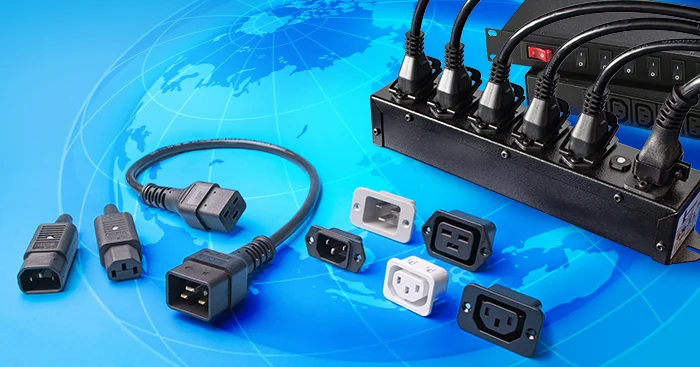
Image Credit: Interpower
Depending on the manufacturer, this conversion can occur at the panel itself or elsewhere within the system architecture.
Another advantage of IEC 60320 standardization is how effectively it enables scalable power distribution. When a country-specific cord set is terminated with a C13 or C19 connector, it can be plugged directly into a corresponding IEC 60320 inlet (C14 or C20) on an accessory power strip (APS) or power distribution unit (PDU).
These units typically feature 4–12 parallel IEC Sheet F or Sheet J outlets.
From there, multiple IEC 60320 jumper cords can be used to distribute power to equipment. These jumper cords are fitted with molded plug connectors (Sheet E or Sheet I) that connect to the APS or PDU outlets, while their opposite ends are terminated with C13 connectors for direct connection to device inlets.
This setup allows several devices to be powered from a single wall socket without the need for reconfiguration. It is particularly useful in environments where wall outlets are limited, such as offices or production facilities, but multiple machines need to operate simultaneously.
IEC 60320 Connector Growth and Trends
A significant area of growth for IEC 60320 connectors has been observed in the Asia-Pacific area, which accounted for approximately 40 % of its global revenue in 2023, making it the largest regional contributor, while North America was responsible for 30 % of global connector revenue in ’23.
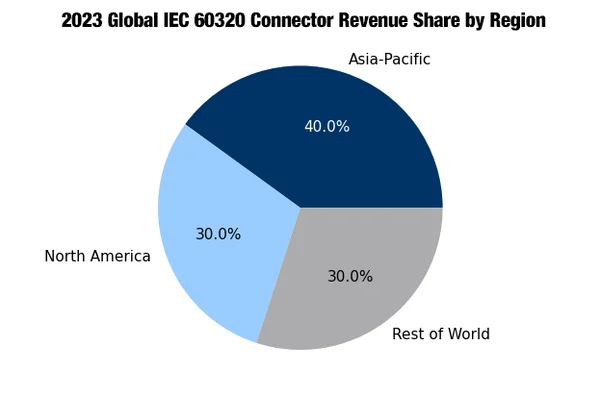
Image Credit: Interpower
Within the “power entry” category (connectors and inlets), the 2025 Asian global share was 38.6 %, with China accounting for 22.4 %.
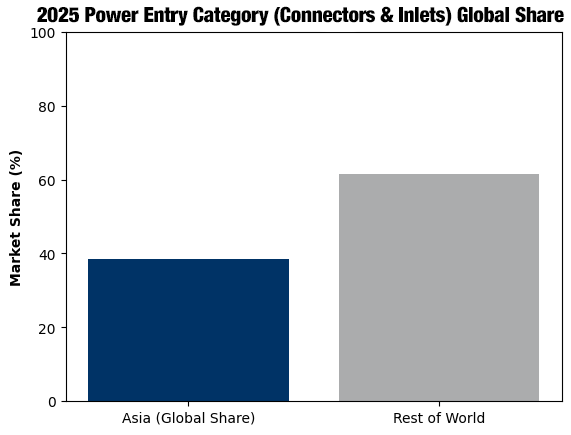
Image Credit: Interpower
Leading manufacturers of IEC 60320 connectors in the Asia-Pacific region include China, India, South Korea, and Taiwan. Demand for IEC 60320 connectors is strongest in industries such as IT hardware, power supplies, and consumer appliances, all of which rely heavily on the IEC 60320-1 standard.
A common example can be seen in large televisions and other audio-visual equipment, where the power inlet is typically an IEC 60320 C14. The accompanying country-specific power cord usually features a C13 connector on the opposite end of the wall plug. This configuration is widely used and recognized across global markets.
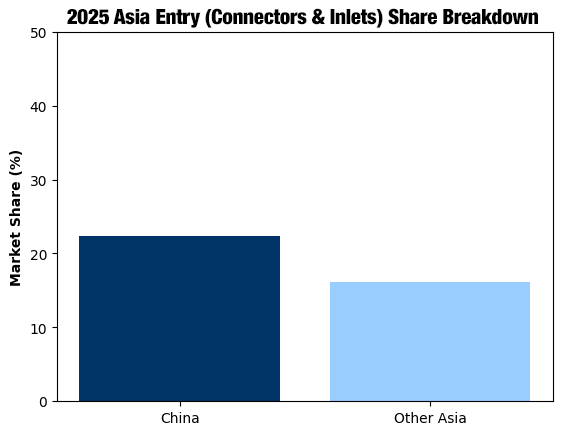
Image Credit: Interpower
The connector industry has also seen growing demand for IEC C19 connectors and C20 inlets, alongside the widely used C13/C14 combination, as increasing server loads continue to drive IT infrastructure expansion.
The key difference between these pairs lies in their power capacity.
C13/C14 connectors are typically rated at 10 A internationally and up to 15–16 A in North America, while C19/C20 connectors are rated at 16 A internationally and up to 20 A in North America. Although both operate within similar voltage ranges (typically 100–240 V) and share a temperature rating of 70 °C, they are not interchangeable.
According to Verified Market Reports, the IEC connectors market is projected to grow from $12.5 billion in 2024 to $18.7 billion by 2033, representing a compound annual growth rate (CAGR) of 5.9 %.
However, this estimate predates the recent push toward domestic manufacturing and increased foreign investment in infrastructure. With many newly announced and reshored factories from early 2025 expected to come online between 2026 and 2027, this growth rate may increase.
In addition, the continued rise of smart homes is expected to further drive demand for IEC components, particularly those with ingress protection (IP) ratings, to ensure reliable performance in environments exposed to moisture, dust, and other external factors.
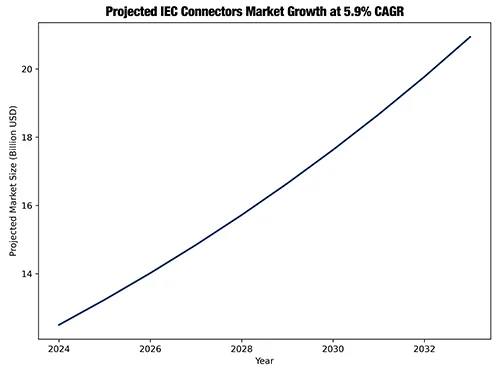
Image Credit: Interpower
Distinguishing NEMA Plugs & IEC 60320 Connectors
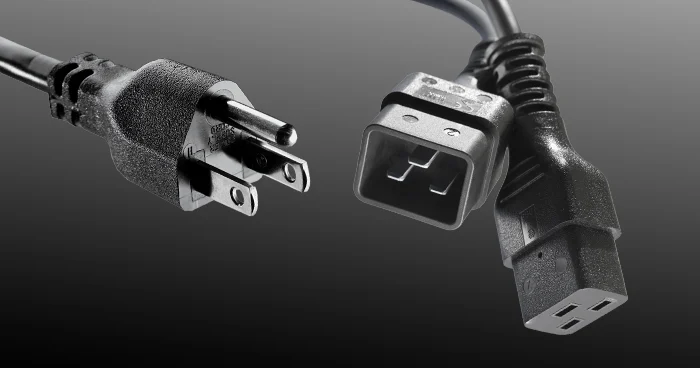
Image Credit: Interpower
So, what are some of the key differences between North American (NEMA) plugs and IEC 60320 plugs and connectors? The distinctions are less about overall quality, which can be subjective, and more about function and design.
As wall plugs, NEMA devices tend to feel heavier and more robust. This is largely due to their solid blades and pins, compared to IEC 60320 connectors, which typically use thinner, stamped-and-formed metal contacts that rely on spring-like tension for secure connections.
That said, larger IEC types, such as Sheet E and Sheet I plug connectors, are by no means lightweight and offer substantial build quality of their own.
In terms of durability, NEMA plugs may have a slight advantage under frequent use, as repeated unplugging and reinsertion can lead to wear in IEC connectors over time. However, when IEC connectors are secured with locking mechanisms, this difference becomes minimal, and both systems offer comparable longevity. Their position in an electrical design also differs.

This information has been sourced, reviewed and adapted from materials provided by Interpower.
For more information on this source, please visit Interpower.