Sponsored by InterpowerReviewed by Olivia FrostApr 9 2026
While many countries outside the continental United States use North American plugs, and many beyond Europe use European ones, plenty still rely on their own designs, shaped by national standards and safety requirements. This sounds complicated, but it can be more straightforward than it first appears.
Image Credit: Interpower
A country's standards typically include mains power terminology: voltage, amperage, frequency, plug, and other features.
Safety agency standards typically establish requirements for electrical components, including the types of plastic used in plugs and sockets, flame-retardant or overheating ratings for components such as plugs and sockets, conductor wire insulation, cord jacket dimensions, and material properties.
A great example of agency standards can be obtained by browsing UL's iQ website. Standards are typically published by regional or global safety agencies such as UL and VDE, and they are critical for power cord and power cord component manufacturers for country-specific product approvals and certifications. I.e., which resins have been approved by safety agencies through testing?
This saves manufacturers time by allowing them to allocate resources to ensure that goods fit exact specifications and dimensions – within published minimal tolerances – for components such as plugs, sockets, blade and pin lengths, conductor wire crimp height, and so on.
Image Credit: Interpower
While plugs and sockets follow national and regional regulations, most also meet international requirements, as many manufacturers export their products. Of course, they will also have to meet with standards such as the IEC 60320 for power cord sets.
While practically every other safety organization publishes power cord set requirements, testing techniques, and test results, the IEC publishes standards but does not test goods in labs, as UL, VDE, JET, and other safety authorities do.
Plugs can be classified as Class I (grounded) or Class II (ungrounded), which are the two most common types. Class III appliances are very low-power and designed to run at a safety extra-low voltage (SELV) of no more than 50 V AC or 120 V DC. They are used in electric shavers, toys, and other small gadgets.
Additionally, plugs can be molded or rewired. Molded plugs cannot be adjusted after being taken from a molding die. Rewireable plugs can be dismantled by removing the screws for inspection or repair, then rewired onto new or existing cable.
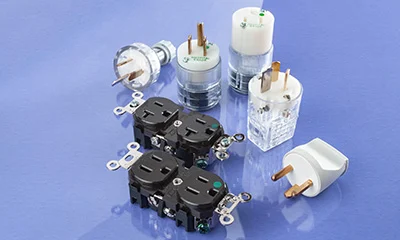
Image Credit: Interpower
Plugs, Sockets, and the LEGO Effect
As stated, the IEC 60320 line of accessory power components is a must-have for exporting power cords, particularly when attempting to save your country-specific cord sets for a limited number of wall sockets in inconvenient locations. It includes inlets, outlets, plug connectors, connectors, and jumper cords to make exportation simple while conserving your country-specific plugs.
Users in practically every industry can power up to 12 pieces of equipment or devices with just one country-specific power wire and a 4-12 outlet accessory power strip (APS).
In a society where business and leisure move at the speed of electricity or even light, power cable customers undoubtedly anticipate unboxing their cord sets and connecting them to the wall socket without any additional hardware configuration.
In most cases, it works like this: the country-specific plug goes into the wall socket, while the other end of the cord – fitted with an IEC 60320 C13 connector – plugs into the C14 inlet on the accessory power strip, which typically features between four and 12 Sheet F outlets.
Now, IEC 60320 jumper wires with IEC 60320 Sheet E plug connectors can be plugged into the APS' row of Sheet F outlets. Finally, the opposite end of the Sheet E jumper wires is terminated with C13s, allowing them to be plugged directly into equipment via the built-in C14 inlets.
Common Plug Patterns Available Online at Interpower
Interpower's Guide to Worldwide Plug and Socket Patterns and Power Mains (Single-Phase) is available in the "Guides, Charts, and Brochures" section of its website to help consumers select the appropriate plug design. The book includes a comprehensive list of country-specific plug patterns and corresponding sockets to ensure global compatibility.
The website contains product details for all of the plugs and sockets offered by Interpower, including drawings and dimensions, amperages and voltages, proper wiring instructions, flammability ratings, and maximum current ratings. And more.
All Interpower products have received agency approvals and certifications. Interpower also gives information on cord set safety regulations, which affect not only the selection of plugs and sockets, but also complete electrical designs. However, this is only a small portion of the power cable and component content available on Interpower's website.

This information has been sourced, reviewed, and adapted from materials provided by Interpower.
For more information on this source, please visit Interpower.