Sponsored by InterpowerReviewed by Olivia FrostApr 9 2026
What IEC Does and Does Not Do
The International Électrotechnical Commission (IEC), formerly the Commission Électrotechnique Internationale, is an international standards body based in Geneva, Switzerland that develops and publishes international standards. Today, most nations have embraced IEC standards.
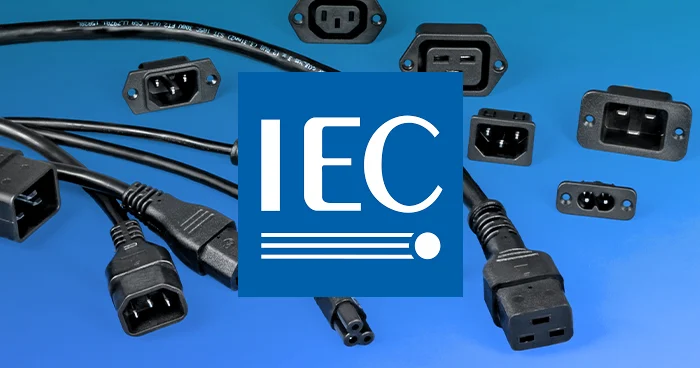
Image Credit: Interpower
Unlike safety agencies such as UL or VDE, the IEC does not test or certify its IEC 60320 electrical components; the safety agencies do that.
While the IEC does not codify or enforce the standards, the agencies that represent nations worldwide, such as those mentioned above, can require manufacturers to comply with the IEC standards.
In Europe, IEC standards account for 80 % of all European and electronic standards.
An Updated Standards Body
The IEC traces its roots to the International Electrical Congress, which first met in Paris in 1881 at the Palais de l’Industrie on the Champs-Élysées, as part of the International Exposition of Electricity.
Approximately 250 people attended the electrical congress, with the goal of internationalizing electrical nomenclature to make it easier to exploit the world's latest marvel.
The Exposition of Electricity saw exhibitors and guests disembark from ships and trains from the United States, United Kingdom, Germany, France, Italy, and the Netherlands, among other countries.
A flurry of scientific papers on electrical theory was published, including proposals for uniform definitions of electrical units such as the ampere, ohm, and volt.
Bright Future
Terminology for electricity units, like electromotive force (volt) or the number of electrons passing points in a circuit per second (ampere), was required for safety limits, such as not running too high or too low current, and for concepts such as expanding the distribution of mains power in cities, as well as ensuring that units of electrical measurement held the same value for everyone.
This was significant for electrical scientists and subsequent electrical manufacturers, but it also emphasized the "immortality" of the innovators who championed them: Hertz, Gauss, Kelvin, Watt, Ampere, Coulomb, Ohm.
Just as today's society honors its tech titans, the turn of the twentieth century honors its innovators and engineers whose names are eternally linked to units of electrical measurement.
The introduction of electricity and the years that followed are commonly referred to as the second industrial revolution (1860-1920).
In the early 1900s, hundreds, if not thousands, of assembly lines began rolling out mass-produced sockets, switches, bulbs, copper wire, and ultimately power lines and power cords at different points along the electrical timeline.
And this new industrial revolution was, incredibly, communicated via telegraph, handwritten letters, and out-of-date newspapers. Its leaders worked on experiments using candlelight and oil lamps. There were no electronic calculators, e-mails, text messages, artificial intelligence, online classes, or YouTube channels.
Regardless of how they imagined their eventual place in history at the time, the legacy they would leave behind would be a safer one than when they began, one that could slow or speed up the flow of electricity; it would manipulate switches, resistors, and capacitors to begin controlling this incredible new power that would change how people lived in nearly every aspect.
The previous International Electrical Congress held the following sessions in Chicago (1893), Paris (1900), and St. Louis (1904).
Numerous electrical conferences and other international congresses were held at the same time: Paris in 1882, 1884, and 1889; Frankfurt in 1891; Edinburgh in 1892; Geneva in 1896; London in 1908; Turin in 1911; and, having survived the great earthquake, the rebuilt city of San Francisco was scheduled to host in 1915 but was canceled due to WWI.
During the past two centuries, American electrical luminaries such as Michael Faraday, Nikola Tesla, Henry Carhart, and Thomas Edison have collaborated with their European counterparts.
Today’s IEC
The International Electrotechnical Commission (IEC), founded in 1906, was an extension of the earlier International Electrical Congress.
The new IEC opened its doors in London, England, and conducted its inaugural meeting on June 26, 1906, at the Hotel Cecil, with Alexander Siemens serving as chairman. To its credit, the new IEC has never looked back, thanks in part to its European roots. The European Union was created in November 1993, and its roots have grown deeper.
Beyond Bureaucracy – Electrical LEGOs
The IEC and safety authorities continue to develop and update electrical standards. However, anybody who has read a standard knows that, while useful and necessary, they can be quite dry reading - even for bureaucrats.
What is not dry are the electric accessory power system components for which the IEC developed standards, allowing manufacturers to deploy worldwide electrical designs on any continent with just one country-specific cable set hooked into the mains power.
After connecting an Interpower® accessory power strip with 4-12 outlets to your country-specific cord, your design is set for IEC connectors, plug connectors, inlets, outlets (IEC 60320 Appliance and Interconnection Couplers), and jumper cords to create a single complete design that can power up to 12 machines or devices.
With the addition of popular IEC 60320 Sheet F or Sheet J outlets, as well as one IEC 60320 C14 or C20 inlet, you can now power many devices with 12 jumper wires from the APS. Popular jumper-cord alternatives feature a Sheet E or Sheet I on one end and a C13 or C19 connector on the other to connect to machines.
While plug and socket layouts vary worldwide, IEC 60320 components let you unbox cable sets and plug them in without any reconfiguration.
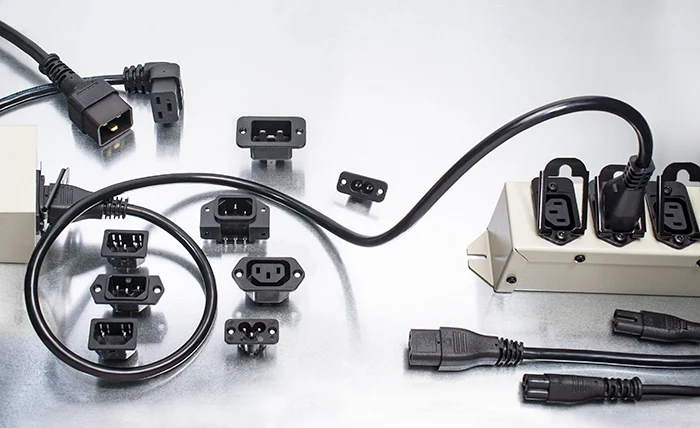
Image Credit: Interpower
This is IEC's legacy: how to create electrical components for export and convenience with only one country-specific cable set, one APS, and a few IEC 60320 parts.

This information has been sourced, reviewed, and adapted from materials provided by Interpower.
For more information on this source, please visit Interpower.