Cosmetic use is deeply rooted in human history, with its origins dating back tens of thousands of years. The earliest cosmetic practices are believed to have originated during the Stone Age, involving the grinding of natural minerals.
These traditions are vividly illustrated by archaeological discoveries from ancient Egypt, as seen in the iconic eyeshadow and eyeliner depicted on the Bust of Nefertiti.
Makeup in that period served purposes beyond aesthetic enhancement. It was used to represent social status, spiritual significance, and even protective power.
Women commonly applied lead-based powders to whiten their complexion and drew their eyebrows with water-dispersed pigments in ancient China, particularly during the Tang dynasty.
Such practices persisted until the late 19th century, despite the toxicity of some materials. Modern cosmetic formulations then began to take shape, with a growing emphasis on personal appearance driving cosmetics towards constituting a multi-billion-dollar global industry.
Many cosmetics are either powder-based or formulated as dispersed systems, such as emulsions and suspensions, meaning that particle size analysis and stability evaluation are key to their performance and development.
The Critical Role of Particle Size and Stability in Cosmetics
Particle size plays a defining role in the performance and safety of cosmetic products. When the size of active ingredients does not meet formulation requirements, issues such as poor skin texture or reduced product efficacy can arise.
Inappropriate particle size in liquid foundations may trigger an uneven finish or caking, while it can lead to an unpleasant tactile sensation and uneven oil film in moisturizing creams.
Inadequately formulated cosmetic products may pose health risks in more extreme cases. For example, excessively large particles in mud masks have the potential to increase mechanical friction on the skin, potentially triggering inflammation, irritation, or allergic reactions, especially in individuals with sensitive skin.
Optimizing particle size can considerably improve the performance of a diverse array of cosmetic products. For example:
- The use of smaller titanium dioxide particles in sunscreens provides more uniform coverage and enhanced UV protection.
- The use of active ingredients with well-controlled particle sizes in exfoliating or scrub creams minimizes skin roughness while improving cleaning efficiency.
- Ensuring an appropriate pigment particle size and size distribution in color cosmetics such as eyeshadows contributes to uniform color payoff.
- The particle size of glitter flakes directly impacts sparkle intensity and overall visual appeal.
Particle size analysis is, therefore, a key component of formulation development, quality control, and manufacturing throughout the cosmetic industry, because it directly determines product performance and consistency.
Dispersion stability is as essential as particle size for liquid and semi-solid formulations, because it influences shelf life and re-dispersibility as well as product performance.
Good stability in cream-based cosmetics is reflected in well-dispersed active ingredients, a prolonged shelf life, and a smooth and lightweight texture. Poorly designed formulations may exhibit unstable phenomena, however, including creaming, coalescence, or phase separation, ultimately compromising both consumer experience and product quality.
Bettersizer 2600 Plus: A Versatile Particle Size Solution for Cosmetics Analysis
Laser diffraction based particle sizing is a widely employed analytical technique that is ideal for use with cosmetic products. Laser diffraction applies Mie scattering theory to describe the relationship between particle size and any resulting light scattering patterns.
The Bettersizer 2600 Plus is a brand-new model in the Bettersizer series. This high-performance particle size analyzer leverages laser diffraction and features a modular design suitable for a range of sample types.
It also features an innovative, patented optical system able to improve measurement accuracy and extends sizing range, offering high reproducibility, repeatability, and user-friendly operation via intuitive software and simple maintenance.
The optional imaging module PIC-1 can also be integrated into the analyzer, allowing particle shape to be characterized via dynamic image analysis. This technique is especially sensitive to coarse particles, thereby compensating for laser diffraction’s limitations when measuring millimeter-scale materials.
The Bettersizer 2600 Plus’s modular design also enables seamless switching between different dispersion units for dry and wet measurements.
Dry dispersion is typically used in cosmetic particle size analysis when working with powder-based products such as powder foundations and loose powders. Wet dispersion measurement, on the other hand, is used for liquid and semi-solid formulations, including BB creams, liquid foundations, sunscreens, and clay masks.
This flexibility is key to facilitating comprehensive particle size characterization across a wide range of cosmetic formulations while employing a single analytical platform.
Particle Sizing of Eyeshadows
The Bettersizer 2600 Plus was used to measure two different commercially available eyeshadow products: a matte eyeshadow and a glitter eyeshadow.
Water was initially selected as the dispersion medium for both samples, but there was considerable agglomeration observed when dispersing the matte eyeshadow in water.
To address this, the matte eyeshadow sample was prepared using a surfactant solution containing sodium dodecyl benzene sulfonate (SDBS), which effectively enhanced particle dispersion. The resulting particle size distributions are shown below.
As anticipated, the glitter eyeshadow exhibited a typically larger particle size versus the matte eyeshadow. These differences reflect the distinct formulation and functional design of the two product types.
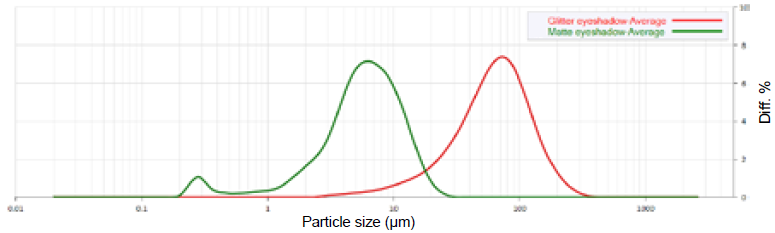
Image Credit: Bettersize Instruments
As expected, glitter eyeshadows contain relatively coarse particles designed to achieve a sparkling visual effect. These include shimmer components or glitter flakes. Contrastingly, matte eyeshadows are formulated with finer pigments, delivering more uniform color payoff on the skin and a smoother texture.
Where further characterization is required, it is possible to apply dynamic image analysis alongside laser diffraction to directly observe shimmer particles or glitter flakes.
Image-based methods facilitate the detailed evaluation of particle shape, enabling improved measurement accuracy for non-spherical or coarse particles and delivering complementary insights into eyeshadow performance and formulation.
Analyzing Glitter Eyeshadow by Combining Laser Diffraction and Image Analysis
Laser diffraction based particle size measurements work by using an optical system to collect the total scattered light signal generated by all particles within the sample.
Glitter flakes generally represent just a small fraction of the total particle population in glitter eyeshadow formulations, meaning that the light scattering produced by these coarse glitter flakes is comparatively weak, and risks being easily masked by the stronger scattering contributions from the greater numbers of fine particles.
The signals from glitter flakes may be incorrectly classified as noise in some cases, prompting them to be removed during data processing and potentially leading to an underestimation of particle size.
The PIC-1 imaging module provides a complementary analytical approach, designed to overcome this limitation. Using this approach, individual glitter flakes can be directly visualized, identified, and analyzed by using cameras to capture particle images.
The powerful combination of laser diffraction and image analysis ensures that there is no risk of overlooking information from a limited number of coarse particles. This integrated approach also enhances the accuracy of particle size measurement across a wide size range while offering useful morphological insights that are especially relevant to glitter-containing cosmetics’ visual performance.
For example, the red curve in the particle size distribution results shown below represents results obtained by combining laser diffraction and image analysis, while the green curve reflects data that was solely generated via laser diffraction.
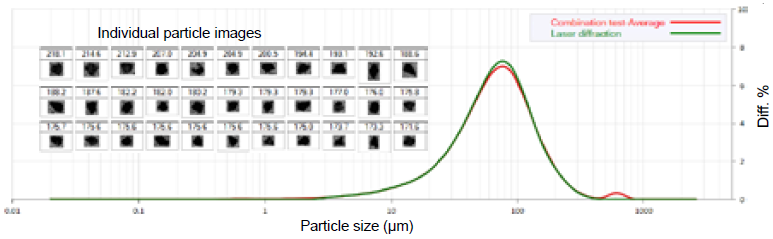
Image Credit: Bettersize Instruments
Particle Sizing of Clay Masks
The Bettersizer 2600 Plus was used to analyze two commercially available clay mask products. The samples were dispersed in ethanol, which was used as a dispersion medium to reduce the agglomeration that can occur in water while also ensuring good particle wetting.
Next, the prepared suspensions were introduced into the BT-80N Pro anti-corrosive wet dispersion unit. This unit has been specifically developed for use with corrosive samples or media, enabling fully automated particle size measurements. The results showed that in this instance, clay mask one exhibited a smaller particle size than clay mask two.
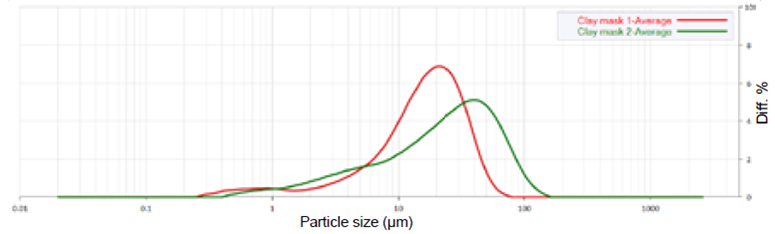
Image Credit: Bettersize Instruments
Qualitative and Quantitative Stability Analysis Using BeScan Lab
Clay masks are generally formulated as highly concentrated pastes. Initial product performance is centered around particle size, but dispersion stability is also key to preserving performance throughout the product’s shelf life.
It is possible to perform effective stability analysis using the static multiple light scattering technique (SMLS). This method works by periodically scanning the sample along its vertical axis and monitoring variations of transmitted and backscattered light intensity. Smaller variations in light intensity reveal a more stable dispersion system.
Evaluating both the magnitude and evolution of these changes allows SMLS to qualitatively identify destabilization mechanisms and quantitatively assess dispersion stability. Clay mask sample are opaque, so backscattered light signals were used for the stability analysis.
From a qualitative perspective, clay mask one exhibits creaming behavior, as evidenced by a decrease in backscattering at the bottom of the sample cell and a corresponding increase at the top. This indicates the upward migration of particles over time. A slight overall increase in backscattering in the middle region also suggests particle size changes within the bulk of the formulation.
Clay mask two shows a pronounced positive peak in backscattering at the bottom of the sample cell, however, indicating an increasing particle concentration in that region over time. The downward migration of particles under the influence of gravity is characteristic of sedimentation.
Variations in backscattering intensity noted in the middle zone suggest changes in structure or particle size during storage, highlighting the likelihood of ongoing destabilization processes within the formulation.
Theoretically, dispersions made up of smaller particles typically exhibit higher stability. Despite exhibiting a smaller average particle size, clay mask one displays a higher instability index (IUS) value. The IUS is calculated from temporal variations in light intensity during measurement time: this quantitative parameter is employed in the assessment of dispersion stability.
A higher IUS value indicates greater fluctuations in light intensity, resulting in lower dispersion stability. Dispersion stability is impacted by multiple interacting factors beyond particle size, including density differences between phases, interparticle forces, temperature, and formulation viscosity.
Stability evaluation based on particle size alone can be misleading, because overall stability reflects the combined influence of these factors.
The BeScan Lab provides a reliable, comprehensive approach for characterizing the stability behavior of dispersed cosmetic systems by integrating particle size measurement with stability evaluation.
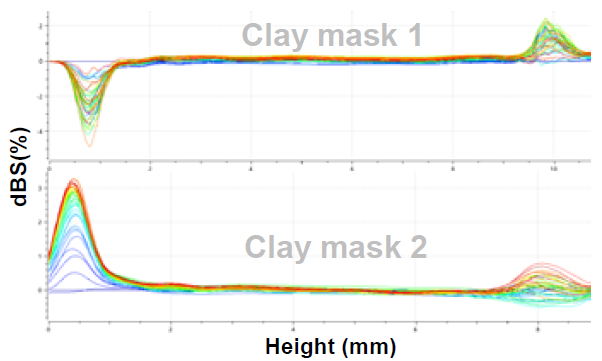
Image Credit: Bettersize Instruments
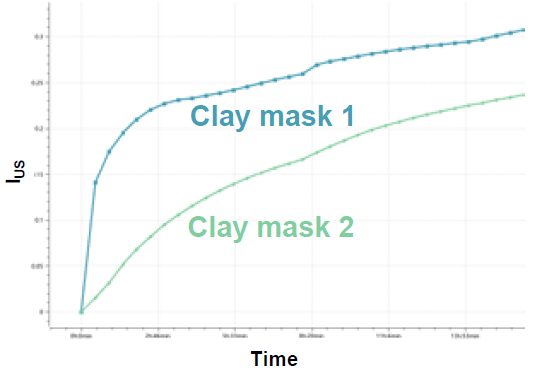
Image Credit: Bettersize Instruments
A Comprehensive Insight into Cosmetic Formulations
Laser diffraction is a highly effective technique that is well suited to particle size analysis in cosmetic applications.
The Bettersizer 2600 Plus delivers reliable and accurate particle size measurements across a diverse range of cosmetic formulations. This powerful instrument can also be seamlessly integrated with the PIC-1 dynamic imaging module in order to perform particle shape characterization and extend its measurement range.
Employing a combined analytical approach ensures that even a small proportion of large particles, for instance, glitter flakes in eyeshadows, can be accurately detected and quantified.
Dispersion stability is also a critical quality attribute for cream- and paste-based cosmetics. The SMLS technique facilities both the quantitative assessment of dispersion stability over time and qualitative identification of destabilization phenomena.
Results acquired from clay mask analysis measurements showcase how formulation stability is affected not just by particle size, but also by factors such as formulation properties and interparticle interactions.
The combination of analytical capabilities offered by the Bettersizer 2600 Plus and BeScan Lab provides a comprehensive solution for particle size and stability evaluation, supporting the development of high-quality cosmetic formulations, quality control, and process optimization.
Acknowledgments
Produced from materials originally authored by Wenjian Zhou from Bettersize Technologies.

This information has been sourced, reviewed and adapted from materials provided by Bettersize Instruments.
For more information on this source, please visit Bettersize Instruments.