Utilities can be categorized as either process systems or process support systems depending on their use.
Any utilities that do not impact product quality or patient safety are usually referred to as process support systems (e.g., HVAC).

Image Credit: VectorMine/Shutterstock.com
All utilities in contact – directly or indirectly – with critical materials or the product, and utilities in contact with components such as piping, valves, or pumps are process systems. As such, they are deemed critical because they can have a major influence on the quality or effectiveness of the final product.
Compressed gas plays a key role in numerous processes and can be applied at many phases of a process; the utility of compressed gas is therefore considered to be a process system. Compressed gas systems include, for example:
- Air
- Carbon dioxide
- Gaseous hydrogen
- Nitrogen
Documentation of the design and use of compressed gas process systems must be provided, and the system's criticality must be demonstrated in a GMP environment (e.g., using a risk-based approach).
As detailed in the utilities section of Annex 1, compressed gases and other utility systems should be appropriately designed, qualified, maintained, and monitored to protect the product quality from contaminants while maintaining stability and efficacy.
How Does a Compressed Gas System Work?
A compressed gas system uses a compressor to reduce gas volume; as the volume decreases, the pressure increases. Furthermore, increasing the quantity of the gas also leads to an increase in pressure (i.e., degree of compression).
A compressor is essentially a machine that converts mechanical energy into pneumatic energy or compressed power, which can be released at a specific sampling point via distribution piping and filters.
Compressed air systems are commonly used by pharmaceutical companies and are a prime example when describing system design and functionality.
Compressed Air System
A complete system configuration for compressed air consists of:
- A compressor
- A compressor condensate separation system or oil-water separator system
- A water-separation system
- Particulate and coalescing filters
- Refrigerator dryers
- Tanks
- Sample valves (e.g., ball, bellows, diaphragm valves)
- Sampling points
A compressed air system can be assembled on site or supplied by a qualified supplier in various containers (e.g., portable tanks). Whether assembled on site or externally supplied, air is captured and pressured by a compressor. The air is then discharged on site at high temperatures and loaded with water vapor.
The compressed air is fed into an after-cooler unit, which cools the air, triggering condensation of air moisture and hydrocarbon vapors, which are then automatically extracted through automated drain valves.
The compressor is considered the heart of the entire compressed air system, but tanks, valves, and filters, are also necessary for this utility distribution.
Tanks store compressed gas, making the utility continuously available. Valves facilitate the movement of compressed air within the system (e.g., between separation chambers); when installed at the point-of-use near a sterilizing grade filter, this helps minimize any contamination of the compressed air flow.
Filter systems are just as vital for ensuring the system functions properly as they allow for the removal of oil vapors, solid particles, and aerosols from the compressed air system. This means it is important to ensure that filters are carefully selected, tested, and maintained.
Compressed air is typically used in packaging, filling, and bottling applications to clean and remove moisture from packaging, bottles, tubes, and primary containers. Depending on the product, compressed air can also be used during the equipment manufacturing process for pneumatic transport.
This utility is also used in the manufacturing of tablets, capsules, ointments, creams, gels, and syrups. For each of these processes, the product and air come into direct or indirect contact.
For instance, when manufacturing tablets and capsules, compressed air is applied at almost every stage of the process: mixing and granulation, drying, pressing, coating, and packaging.
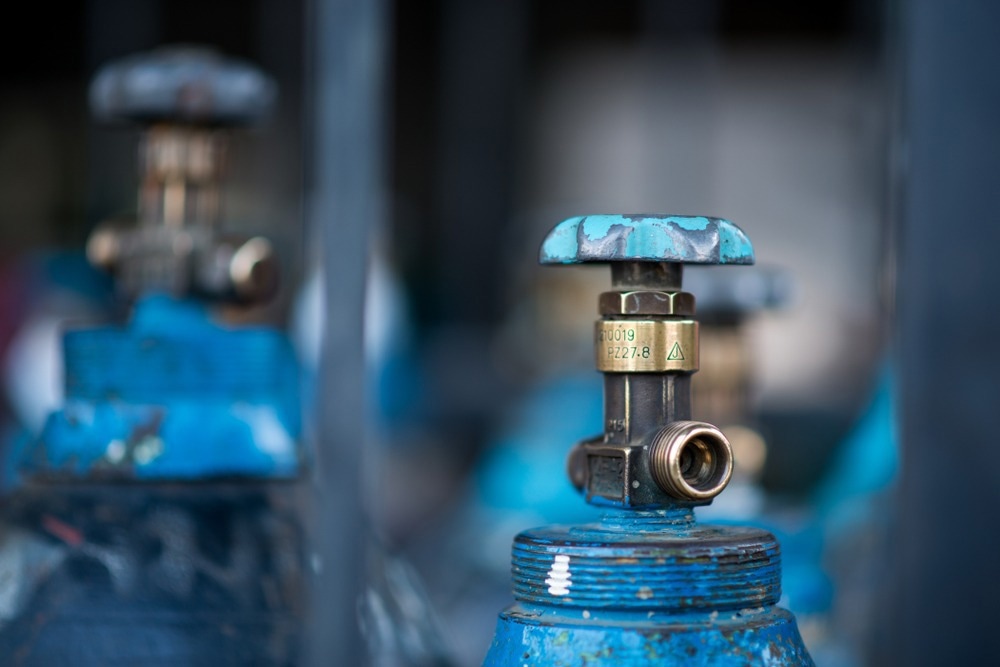
Image Credit: antpkr/Shutterstock.com
Guidelines for Control of Compressed Gas Systems
Compressed air is used across an array of manufacturing processes. When near or in direct contact with products, good management of utility cleanliness is critical.
The purity class of the compressed air must be determined after establishing which construction materials, the function of each subsystem, the distribution process, the temperature, and other system design parameters. To do this, system contaminants must be understood.
A compressed air system is typically maintained in a dry state with a low dew point that dramatically reduces the risk of microbial growth. However, solid particles, water, and oil, which are amongst the main contaminants in a compressed air system, can negatively impact the compressed air quality. For each contaminant, concentration levels must be determined to ensure they fall within specified regulatory ranges.
FDA regulations state that the compressed gas must have purity, microbiological content, and particle content (post-filtration) levels equal to or better than those of the environment in which it is used. The EU GMP Annex 1 regulation states that gases must be of suitable quality, with all relevant parameters and contaminants detailed.
The installation quality, and thus the quality of the compressed air, must be verified during the qualification phase, so that the limits for particle and microbial concentration, moisture, liquid water, and total oil meet expectations.
When first installing the system and verifying plant quality, sampling points must be identified for quality control or process purposes. Their locations must be determined through a risk analysis to avoid excluding any potential contaminants (including cleaning agents).
Sampling points for compressed air and other gases should be easily accessible but located away from sampling points for other utility systems to prevent cross-contamination. Each point should also be clearly and uniquely identified.
Therefore, the sampling point should correspond with the quality of the compressed air at the point of use. If a sterile filter has been fitted to the pipeline, the sampling point should be installed before it.
Risk analysis tools can support decisions around monitoring frequency. It should be noted that frequent monitoring of the compressed air system is recommended to ensure that the air has no negative effects on the environment or the product.
A reduction in monitoring is only possible if there is sufficient trend analysis data to perform a statistical analysis. The data set must be analyzed within a risk analysis and must not clash with what is established/reported in the Contamination Control Strategy (CCS).
Acknowledgments
Produced using materials originally authored by Irene Maccagli from Particle Measuring Systems.

This information has been sourced, reviewed and adapted from materials provided by Particle Measuring Systems.
For more information on this source, please visit Particle Measuring Systems.