By combining crystal-inspired lattice design with synchrotron X-ray imaging, researchers demonstrate that triply twinned architectures can strengthen lightweight metamaterials while revealing how defects trigger fracture.
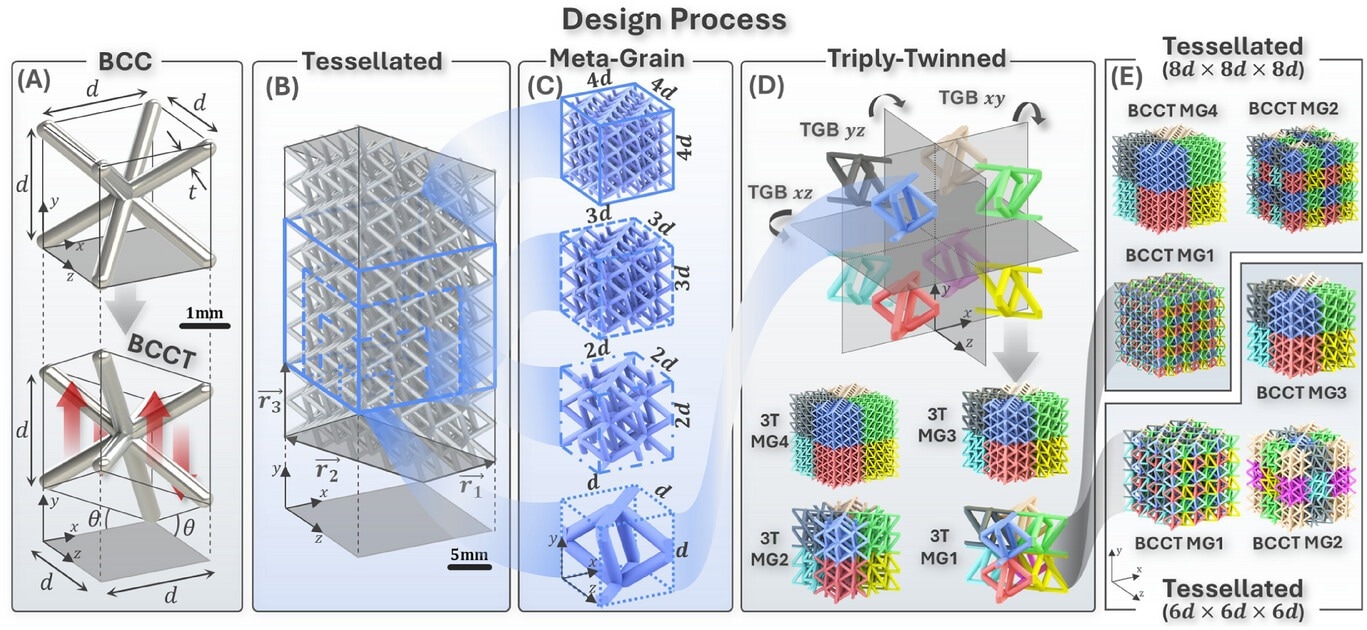
Research: Triply-Twinned Metamaterials: Unraveling the Mechanics and Failure Pathways Through High-Resolution XCT
A recent study published in the journal Advanced Materials introduces triply-twinned metamaterials, a new architectural strategy for strengthening lightweight lattice structures produced through additive manufacturing.
The researchers show that triply twinned body-centered cubic (BCCT) lattices can use three orthogonal twinning planes to shift strut-scale deformation from bending to stretching. The work demonstrates how advanced lattice design, combined with high-resolution X-ray imaging and computational modeling, can guide improvements in the strength, reliability, and manufacturability of next-generation architected materials.
Engineering Meta-Crystal Architectures for Enhanced Mechanical Performance
Architected lattice materials offer high strength-to-weight ratios, making them attractive for aerospace structures, biomedical implants, and energy absorption systems. However, conventional lattice architectures often rely on bending-dominated deformation and remain highly sensitive to manufacturing defects. These limitations reduce their stiffness, strength, and long-term mechanical reliability.
The researchers developed a new family of triply twinned body-centered cubic lattices inspired by twinned crystal structures in metals. Earlier studies showed that twin boundaries can strengthen lattice architectures, but the majority of previous designs used only dual-plane twinning. They also provided limited insight into how twinning redistributes strain energy and alters deformation pathways.
The study addressed an important research gap involving the interaction between additive manufacturing defects and twinned lattice architectures during deformation and fracture. Conventional XCT methods often lack the resolution required to accurately capture small defects. By combining high-resolution synchrotron XCT with image-informed modeling, the researchers directly linked lattice architecture, defect distribution, and fracture behavior across multiple length scales.
Advanced Manufacturing, Imaging, and Simulation Approaches
The researchers fabricated the BCCT lattices by applying controlled shear transformations to conventional body-centered cubic unit cells. They introduced three orthogonal twinning planes in the xy, yz, and xz directions to create triply twinned meta-grain structures with different twin boundary densities and meta-grain sizes. This design enabled the team to investigate how lattice architecture influences deformation behavior and mechanical performance.
The researchers prepared polymeric lattices from Rigid 4K resin using stereolithography and metallic lattices from Ti-6Al-4V powder using laser powder bed fusion. They carefully adjusted the geometric parameters to maintain consistent relative density across all lattice configurations and produced multiple samples to ensure reproducibility.
The team performed quasi-static uniaxial compression testing and measured stress-strain response, stiffness, strength, and failure pathways to evaluate mechanical behavior. Interrupted compression testing combined with X-ray computed tomography enabled direct observation of fracture evolution inside the metallic lattices during deformation. The study used high-resolution synchrotron XCT at the European Synchrotron Radiation Facility. It achieved a voxel size of 2 µm, corresponding to a resolvable resolution of about 6 µm, and identified internal porosity, surface roughness, lack-of-fusion defects, and crack-propagation pathways in detail.
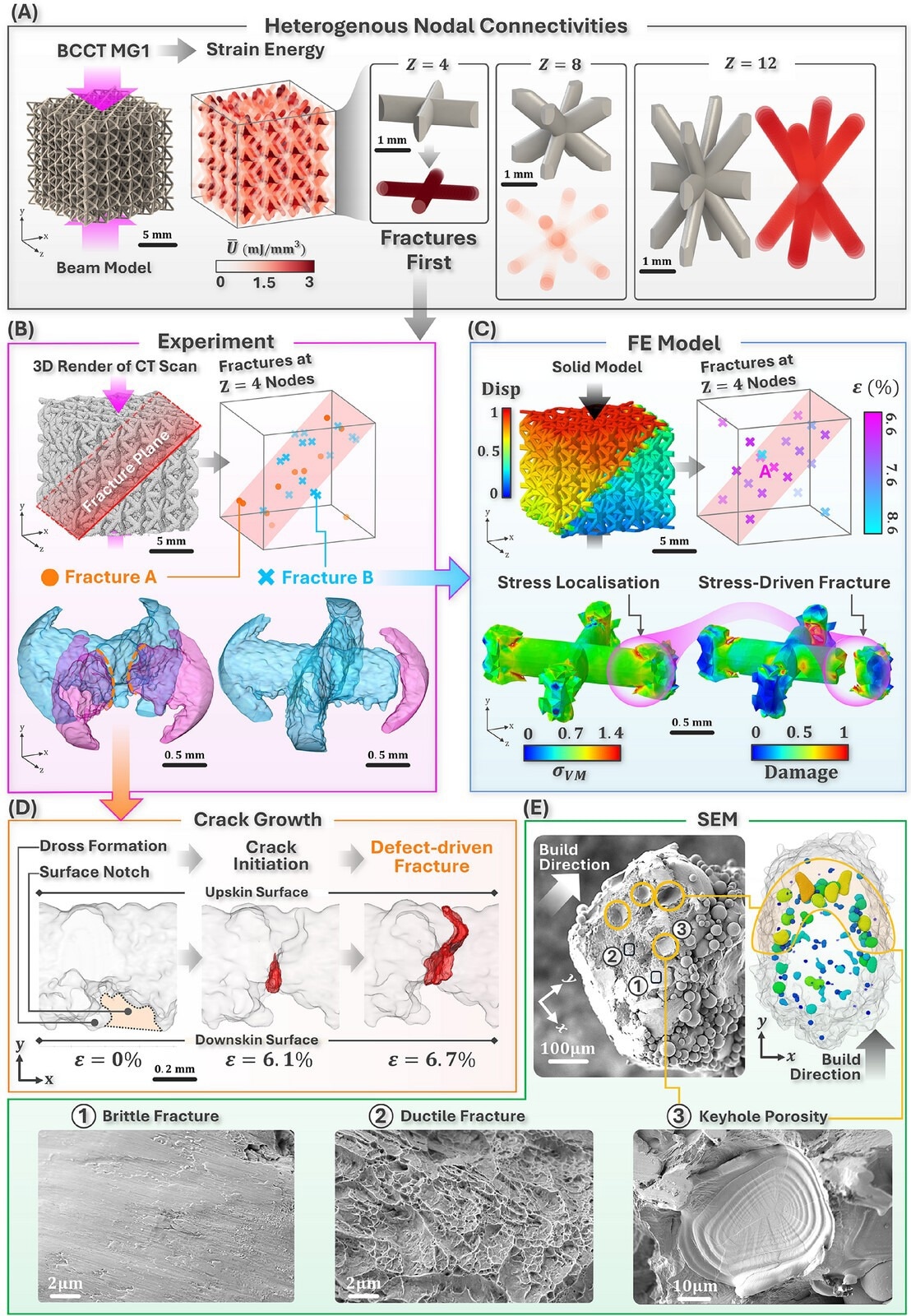
Local deformation behavior of the Ti-6Al-4V BCCT MG1 lattice. (A) 3D maps of strain energy stored in struts intersecting at nodes of different nodal connectivities, Z; (B) As-built BCCT MG1 lattice fails by formation of diagonal shear band along which fractures, categorised as Type A (defect-driven) and Type B (geometry-driven), occur around Z = 4 nodes; (C) FE simulations predict shear band formation along the plane on which fractures occur around Z = 4 nodes where geometric stress concentrators exist coincident with Type B fractures; (D) Type A fractures initiate at Lack Of Fusion (LOF) defects on the downskin surfaces of struts and propagate upward to full fracture. (E) SEM images of the fracture surface reveal keyhole porosity co-localized with regions of high defect concentration identified via CT and adjacent regions of both ductile and brittle fracture morphologies.
Stretch-Dominated Behavior Unlocks Major Property Improvements
The triply twinned lattice architecture shifted the deformation behavior from bending-dominated to stretch-dominated loading. This transition significantly increased stiffness and strength in both polymeric and metallic lattice systems because axial stretching transfers loads more efficiently than bending. Overall, the BCCT architecture produced stiffness gains of up to 380% and strength gains of up to 279% compared with conventional BCC lattices.
In the Rigid 4K polymer lattices, reducing the meta-grain size increased the density of twin grain boundaries and promoted greater axial load transfer through the struts. As a result, the proportion of axial strain energy increased from 61% in larger meta-grain lattices to 90% in the finest triply-twinned structure. This progressive change produced a steady increase in both stiffness and strength as the meta-grain size decreased.
The Ti-6Al-4V metallic lattices showed similar mechanical trends. The smallest BCCT lattice achieved a 270% increase in stiffness compared with the conventional BCC lattice. However, the metallic structures also developed pronounced shear bands and post-yield stress collapse because Ti-6Al-4V exhibits lower ductility and greater sensitivity to additive manufacturing defects.
High-resolution synchrotron XCT combined with finite element simulations revealed how fractures initiated and propagated through the lattices. In the finest triply-twinned structures, low-connectivity nodes accumulated the highest strain energy density and acted as the primary fracture initiation sites. The researchers identified two dominant fracture mechanisms. The first involved a geometry-driven fracture at node intersections caused by local stress concentration. The second involved a defect-driven fracture initiated by dross formations and surface defects located on downskin struts.
The study demonstrated that build orientation strongly influences defect-driven failure. By rotating the lattice orientation during printing, the researchers eliminated critical dross formations from highly stressed struts. This strategy reduced the proportion of defect-driven local fractures by 50% without altering the overall shear band failure pathway. However, the rotated build also produced modest reductions in stiffness, strength, and specific energy absorption because of altered elliptical strut cross-sections. These findings show that lattice architecture governs the global failure mode, while manufacturing defects mainly control the local fracture initiation process.
Using synchrotron XCT, the researchers further quantified internal defect populations across the metallic lattices. They identified several pore types, including gas porosity, keyhole pores, and lack-of-fusion defects. Larger irregular pores concentrated near the upskin surface, typically within 3 to 5 build layers, indicated local thermal instabilities during the printing process. Pyrometry measurements also revealed a strong negative correlation between local thermal energy and pore volume fraction, suggesting that insufficient remelting promotes defect formation.
Together, these results provide a detailed multi-scale understanding of how lattice geometry, material behavior, and additive manufacturing defects interact to control mechanical performance, deformation pathways, and structural reliability. Defect-free finite element models still predicted the main shear-band pathways, indicating that the BCCT architecture primarily governed global failure, while manufacturing defects primarily served as local fracture-initiation sites.
Broader Implications for Architected Materials and Additive Manufacturing
The study establishes triply twinned lattice architectures as an effective strategy for developing stronger, more reliable metamaterials. The work shows that the lattice architecture governs the global mechanical behavior even in the presence of additive manufacturing defects.
The researchers directly linked manufacturing conditions, defect populations, and fracture mechanisms by combining high-resolution synchrotron XCT with image-informed simulations. The findings further highlight the importance of building orientation and process optimization to control defect-driven failures.
The design principles introduced in the study could support the development of hierarchical metamaterials, with potential applications in lightweight aerospace structures, biomedical implants, and energy-absorbing systems. Overall, the research provides a scalable framework for designing high-performance architected materials with improved manufacturability and reliability.
Download your PDF copy by clicking here.
Disclaimer: The views expressed here are those of the author expressed in their private capacity and do not necessarily represent the views of AZoM.com Limited T/A AZoNetwork the owner and operator of this website. This disclaimer forms part of the Terms and conditions of use of this website.