Understanding how materials function and ultimately fail requires insight across an extraordinary range of length scales. From the macroscopic architecture of a full device down to atomic-scale interfaces, the relationships between structure, chemistry, and performance are rarely straightforward.
Increasingly, researchers are finding that answering these questions demands not only powerful instrumentation but also integrated workflows that seamlessly connect information across scales and material types. In this context, the U.S. Department of Energy’s National Lab of the Rockies (NLR) has emerged as a leading example of how advanced microscopy can be leveraged to solve complex, real-world problems.
Under the leadership of Dr. Katherine Jungjohann, the Microscopy, Imaging, and Characterization (MICRO) group has developed a highly flexible, workflow-driven approach that combines Thermo Fisher Scientific electron microscopy platforms with deep scientific expertise. The result is a research environment capable of addressing both fundamental scientific questions and applied challenges from industry partners.
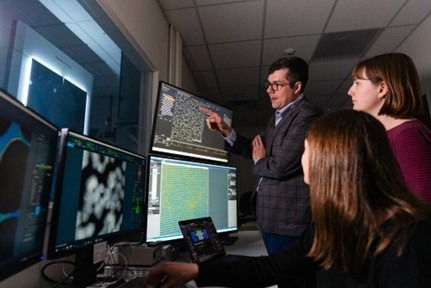
Autonomous microscopy lab environment. Image Credit: NLR
A Laboratory in Transition: Expanding Scope and Capability
Over the past five years, the NLR microscopy group has undergone a significant transformation. Originally focused on photovoltaics, the group has broadened its capabilities to encompass a wide range of applications, including batteries, fuel cells, polymers, membranes, catalysts, power electronics, sensors, high-temperature energy storage materials, and semiconductor systems. This expansion reflects both the evolving priorities of materials research and the growing demand for advanced characterization techniques.
This transition has been enabled by a combination of strategic hiring and investment in cutting-edge instrumentation. New team members have brought expertise in areas such as cryo-electron microscopy, multiscale diffraction, low-dose techniques for polymers, and in-situ experimentation. “We’re not specialized in one type of research - we’re trying to use new tools to answer a wide range of questions,” explains Dr. Jungjohann. This interdisciplinary mindset allows the group to respond quickly to new scientific challenges while maintaining depth in core areas of expertise.
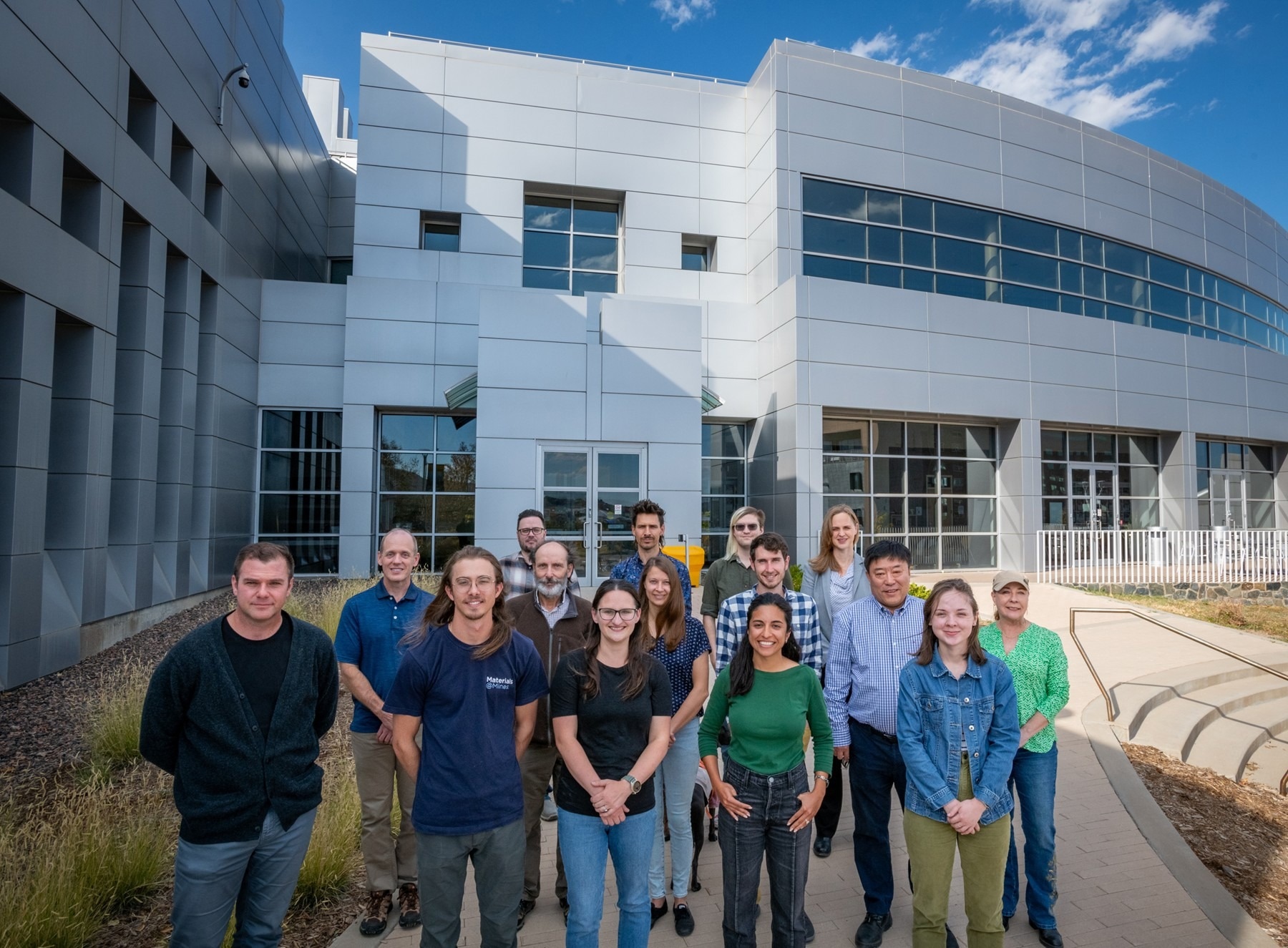
The NLR MICRO group. Image Credit: NLR
Bridging Length Scales: From Device-Level Context to Atomic Insight
A defining strength of the NLR team lies in its ability to connect observations across multiple length scales within a single, coherent workflow. Rather than focusing exclusively on high-resolution imaging, the group emphasizes a hierarchical approach that begins with large-scale characterization and progressively narrows to nanoscale and atomic-level analysis.
“All of the mechanisms are happening at these heterogeneous interfaces,” says Jungjohann. “It’s critical for us to get statistical information at [a] large scale and then zoom in to the exact regions that answer our scientific questions.”
This approach is particularly important in energy materials, where local variations in structure and chemistry can have an outsized impact on performance. By combining large-area imaging with targeted, high-resolution analysis, the team generates insights that are both detailed and representative.
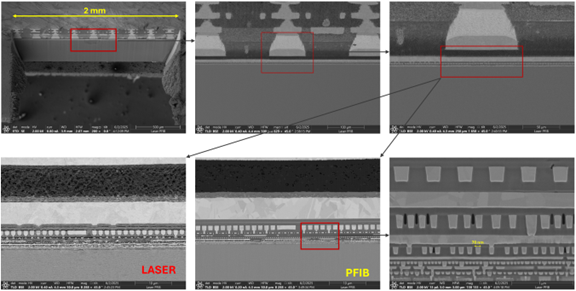
Laser and PFIB-SEM dataset of a transistor. Image Credit: NLR
Advanced FIB-SEM Workflows for Challenging Materials
Central to enabling these multiscale workflows is the Thermo Scientific Helios Hydra plasma FIB-SEM, which integrates multi-ion plasma sources with a femtosecond laser in a single TriBeam platform. This system allows researchers to rapidly access buried features, prepare high-quality cross-sections, and perform detailed imaging and analysis without transferring samples between instruments. For the NLR team, this level of integration has fundamentally changed how experiments are designed and executed.
The addition of the femtosecond laser is particularly impactful. Unlike traditional ion milling, which relies on sputtering, the laser enables ultrafast material ablation, dramatically increasing removal rates while minimizing thermal damage. This is especially valuable when working with heterogeneous materials such as battery electrodes, where metals, polymers, and voids coexist in complex geometries.
“These materials can be incredibly challenging; you might have a metal next to a polymer next to a semiconductor. The laser allows us to remove material evenly and efficiently without introducing artifacts.”
Dr. Katherine Jungjohann
In practice, the Helios Hydra system enables a seamless transition from large-volume excavation to nanoscale refinement. Researchers can rapidly expose regions of interest using the laser, then switch to plasma FIB milling for precise polishing and preparation. The coincident geometry of the TriBeam system ensures that imaging and analysis can be performed immediately, preserving context and improving accuracy. This not only accelerates workflows but also enables the collection of more statistically meaningful datasets, which is critical for understanding complex, heterogeneous systems.
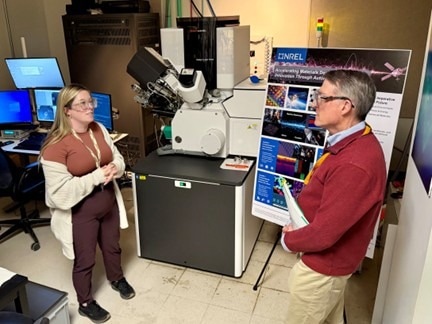
NLR Helios Hydra TriBeam. Image Credit: NLR
Technical Sidebar: What is a TriBeam System?
A TriBeam system combines three complementary beams - a scanning electron beam, a focused ion beam, and a femtosecond laser - into a single integrated platform. Each beam plays a distinct role within the workflow, enabling a seamless transition between different stages of sample preparation and analysis.
The laser enables rapid, high-volume material removal, allowing researchers to access deeply buried structures in minutes rather than hours. The focused ion beam then refines these areas with nanometer precision, producing high-quality cross-sections suitable for detailed analysis. Finally, the electron beam delivers high-resolution imaging and analytical data, including compositional and structural information.
By integrating these capabilities at a single point of coincidence, TriBeam systems significantly enhance throughput, reduce sample-handling risks, and enable true multiscale characterization workflows.
Capturing Dynamic Processes Through Cryogenic Approaches
In addition to structural characterization, the NLR team is advancing cryogenic workflows to capture transient states in dynamic materials systems. By rapidly freezing samples during or immediately after a reaction, researchers can preserve intermediate structures that would otherwise be difficult or impossible to observe.
“With cryo, you can essentially lock in a moment during a reaction and study it in detail,” Jungjohann explains. This approach is particularly powerful for electrochemical systems, where reactions occur at complex interfaces and evolve rapidly over time. When combined with advanced FIB-SEM preparation and high-resolution TEM analysis, cryogenic techniques provide a unique window into the processes that govern performance and degradation.
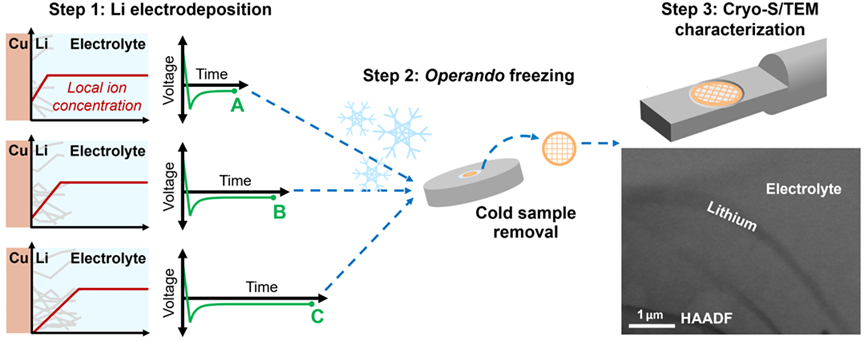
Operando cryo-transfer workflow. Image Credit: Dutta, Nikita S., et al. ACS Energy Letters 9.5 (2024): 2464. Dutta, Nikita S., et al. Microscopy and Microanalysis 30.5 (2024): 844
Toward Intelligent Microscopy: Automation and AI Integration
The integration of automation and artificial intelligence is another key focus for the group. By leveraging programmable control systems and advanced image analysis techniques, the team is developing workflows that can operate with minimal supervision while maintaining high levels of precision and reproducibility.
“We’re moving toward a future where the instrument can run complex experiments while we focus on interpreting the data."
Dr. Katherine Jungjohann
Automation is particularly valuable for long-duration experiments such as 3D volumes, where maintaining consistent conditions is critical. The use of AI-driven analysis also enables faster identification of features and patterns within large datasets, accelerating the overall pace of discovery.
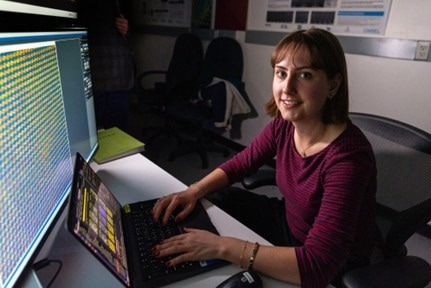
Undergraduate automation workforce. Image Credit: NLR
Extending Impact Through Industry and Academic Collaboration
A key aspect of the NLR group is its strong engagement with external partners. The group works closely with both industry and academic collaborators to address real-world challenges, ranging from failure analysis in energy systems to the development of new materials.
To facilitate these interactions, the lab has introduced a Micro Services Agreement that allows external users to access specialized microscopy workflows with minimal administrative overhead. “Our goal is to get people the data they need as quickly as possible,” Jungjohann notes. This approach enables faster decision-making for partners while expanding the lab’s impact.
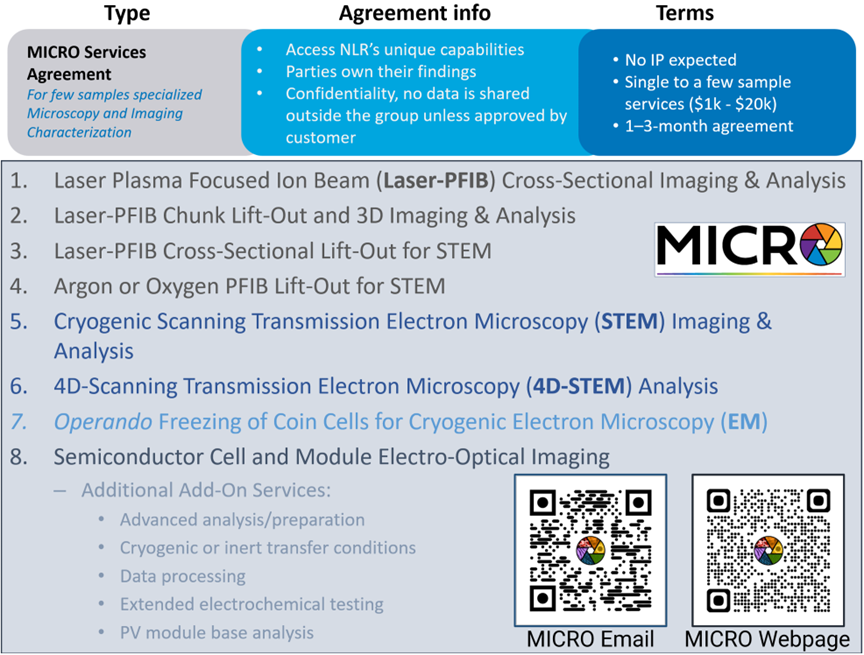
Details of the MICRO Services Agreement for an external company. Image Credit: NLR
Conclusion
At the National Lab of the Rockies, advanced microscopy is a platform for discovery that connects disciplines, scales, and communities. By integrating Thermo Fisher Scientific FIB-SEM systems, cryogenic workflows, and automation, the team has developed a model for addressing some of the most complex challenges in modern materials science.
“These tools have made a dramatic difference in what we can achieve,” concludes Jungjohann. As materials systems continue to evolve, approaches that combine flexibility, precision, and collaboration will be essential for driving the next generation of scientific and technological breakthroughs.

This information has been sourced, reviewed, and adapted from materials provided by Thermo Fisher Scientific – Electron Microscopy Solutions .
For more information on this source, please visit Thermo Fisher Scientific – Electron Microscopy Solutions .