In this interview, industry expert Rohit Ramnath explains how low-outgassing adhesives prevent contamination in vacuum, optical, aerospace, and satellite applications, while supporting reliable long-term performance.
What is outgassing, and why is it a concern for adhesives?
Outgassing is the release of chemical compounds over time from a fully cured adhesive. These released materials may include volatile organic compounds (VOCs), unreacted monomers or oligomers, residual solvents, or other constituents from the original formulation.
In sensitive applications, particularly those involving optics, vacuum systems, and space environments, outgassing can deposit residues on critical surfaces, cause fogging of lenses and sensors, alter pressure levels within sealed systems, and potentially affect electrical performance. Even if the adhesive bond remains structurally sound, contamination from outgassing can render the entire assembly unusable.
What applications require low-outgassing adhesives?
Low-outgassing adhesives are essential in space and satellite systems, where vacuum exposure and sensitive instrumentation require contamination-free materials. Optical assemblies, including cameras, sensors, telescopes, and laser systems, require low outgassing to prevent fogging and maintain clarity.
High-vacuum scientific equipment, semiconductor manufacturing, and aerospace electronics also demand these materials. Any application where residue formation could interfere with measurements, optical transmission, electrical performance, or system pressure must consider outgassing characteristics.
Can heat curing make the difference between passing and failing outgassing specifications?
Yes, absolutely. In some cases, heat curing can push a product from failing to passing the NASA low-outgassing requirements. The degree of improvement depends on the specific chemistry, the temperature used, and the duration of heat exposure.
For applications where heat curing is not possible due to temperature-sensitive components, this can present a significant challenge. However, many formulations can achieve acceptable outgassing performance with relatively modest heat exposure: 175 °F (80 °C) is often sufficient to meaningfully improve results.
Are there trade-offs when formulating for low outgassing?
Interestingly, low-outgassing performance does not require sacrificing other properties. Master Bond offers low-outgassing products with glass transition temperatures exceeding 400 °F (204 °C). For applications where structural strength is critical, formulations with lap shear strengths greater than 4000 psi on aluminum (Al) are also available.
The primary trade-off is often in processing rather than final properties: achieving optimal outgassing performance typically requires heat curing, even for room-temperature curing chemistries. For applications where heat exposure is not feasible, this can be a limitation. However, there are formulations designed to achieve good outgassing performance with room-temperature cure alone.
What products does Master Bond offer for ultra-high vacuum applications?

Image Credit: Master Bond Inc.
For demanding applications including ultra-high vacuum systems, Master Bond EP30-2 and EP21TCHT-1 have been successfully used by customers in environments operating at 10-12 torr and have had their outgassing rates independently measured and validated.
While NASA's low-outgassing testing provides a useful guideline, customers working in ultra-high vacuum applications often perform their own testing under application-specific conditions. Master Bond's technical support team can help identify appropriate products based on specific vacuum levels, operating temperatures, and other application requirements.
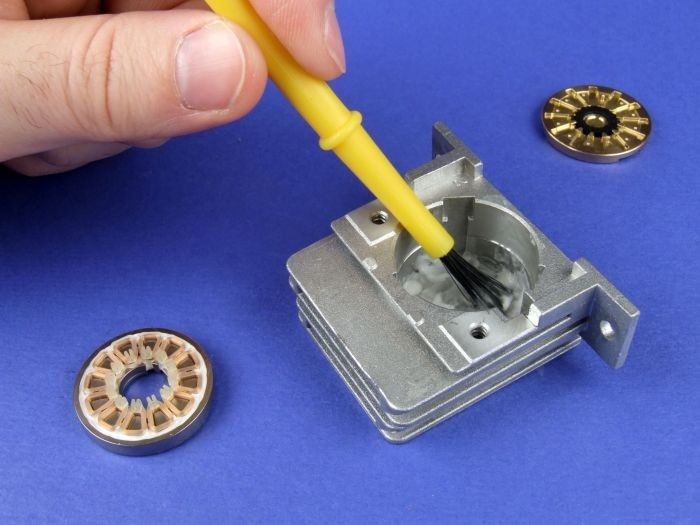
Image Credit: Master Bond Inc.
What environmental factors beyond temperature can affect outgassing in service?
Several factors can influence outgassing performance in actual service conditions. Higher operating temperatures will generally increase outgassing rates; if an application operates at 220 °C rather than the 125 °C test temperature, higher mass loss may occur. Vacuum level also matters significantly: outgassing that causes no issues at 10-3 torr may be problematic at 10-12 torr. Chemical exposure can also alter outgassing characteristics.
How can I tell if outgassing is causing problems in my assembly?
One indicator is visible contamination or residue forming on optical surfaces, sensors, or other critical components. This often appears as fogging or haze that develops over time during service. In vacuum systems, unexpected pressure changes or difficulty maintaining target vacuum levels may indicate outgassing.
Measurement drift in sensitive instruments can also suggest contamination from outgassed materials. If these symptoms appear and an adhesive is present in the assembly, switching to a NASA low-outgassing qualified product is recommended to minimize the risk of continued contamination.
About Rohit Ramnath 
Rohit Ramnath is a Senior Product Engineer with over 12 years of experience at Master Bond, where he manages new product development right from concept development to procurement to product launch via numerous marketing channels such as news releases and case studies.
He troubleshoots customer adhesive application challenges in the medical, aerospace, electronics, optical, OEM, and oil & gas industries. He co-authored ‘Breakthrough instruments and products: Biocompatible epoxies for medical device manufacturing’. He received a Master’s degree in chemical engineering from Carnegie Mellon University in 2011.
This information has been sourced, reviewed, and adapted from materials provided by Master Bond Inc.
For more information on this source, please visit Master Bond Inc.
Disclaimer: The views expressed here are those of the interviewee and do not necessarily represent the views of AZoM.com Limited (T/A) AZoNetwork, the owner and operator of this website. This disclaimer forms part of the Terms and Conditions of use of this website.