Sponsored by LuxorReviewed by Ify IsiborJun 24 2026
From the LUXOR website a four-part handbook titled “Introduction to Sputter Coating” can be downloaded. In Part 4 of this series "LUXOR A2 technology: SEM coating made smart and easy", we discuss how the fundamental principles and parameters of sputter coating have been applied to develop the LUXOR A2 technology.
In the following example of a manual sputter coating procedure gold is used as the sputtering material and argon as the inert gas. The process involves the following steps:
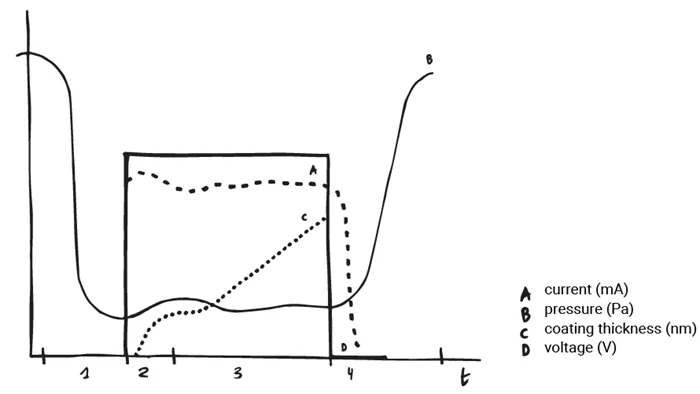
Image Credit: LUXOR
- Air is evacuated, and the chamber is filled with argon. Next, the vacuum pump brings the chamber to the preset target vacuum.
- When the vacuum is reached, a high voltage is generated, enabling the operator to manage the argon flow to create the sputtering current.
- The sputtering process begins with the predetermined argon flow for a designated time.
- The sputter coating process concludes when the preset time is reached, and the chamber is refilled with air.
It is clear that accurately managing a sputter coating process requires control of vacuum levels and sputtering current. Additionally, when the sputtering current can be maintained at a low level, the coating quality in terms of homogeneity, coverage, density, and grain size will be better.
Other parameters, such as the dimensions and configuration of the coating chamber and the target material, are fixed but must also be considered.
The fundamental flow of a manual sputter coating process, such as the one outlined above, is limited because no automatic system exists to regulate the balance between the applied vacuum and the injected process gas. Consequently, the sputtering current (determined by the injected process gas) cannot be adjusted throughout the coating procedure.
As a result, manual and semi-automatic sputter coaters must operate at relatively high sputtering currents to prevent plasma instability or failure during the coating process. And higher sputtering currents will result in less uniform coatings with coarser grain sizes.
What Does an Automatic Sputter Coating Process Look Like?
- Air is extracted from the sputtering chamber by the vacuum pump, and the chamber is filled with argon.
- The vacuum pump and high speed gas injection valve allow the chamber to reach the specified target vacuum.
- When the target vacuum is reached, the high voltage is generated. The combination of vacuum and voltage ignites the plasma, which initiates the coating current.
- The sputtering process begins, and argon flow is introduced to maintain a steady coating current.
- Once the requested coating thickness is reached, the coating process stops.
- The chamber is refilled with air and can then be opened.
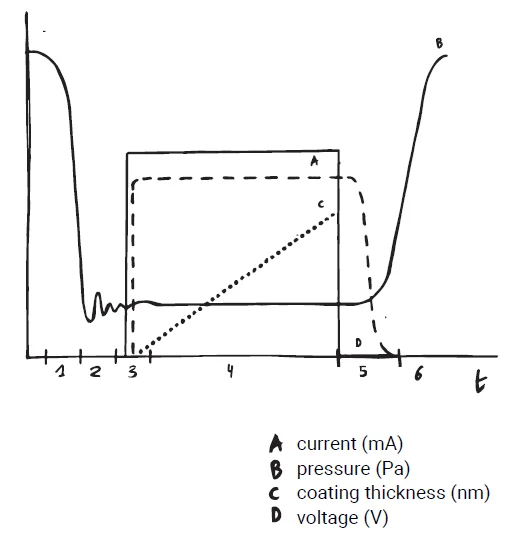
Image Credit: LUXOR
A2 Technology: What Is It All About?
In a LUXOR sputter coater equipped with A2 technology, once the initial target vacuum is reached, a tuning process begins, maintaining the target vacuum by rapidly dosing microquantities of process gas (typically argon or air).
The A2 algorithm controls the high speed gas injection valve to maintain a balance between the discharge from the vacuum pump and the supply through the valve (as shown in step 2 of the process graph). The initial target vacuum is set so the argon dosage produces the desired coating current when voltage is applied.
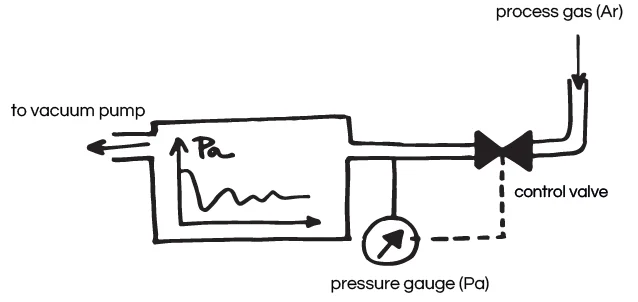
Image Credit: LUXOR
If the target vacuum remains within a designated tolerance for a specified duration, voltage is applied, initiating current flow, plasma generation, and sputtering.
During the early stage of sputtering, voltage and current may fluctuate. Once again, the A2 algorithm stabilizes the target current within a short timeframe. At this stage, the sputter current becomes the critical parameter, and the vacuum level might begin to vary to keep this value constant (step 3 in the process graph).
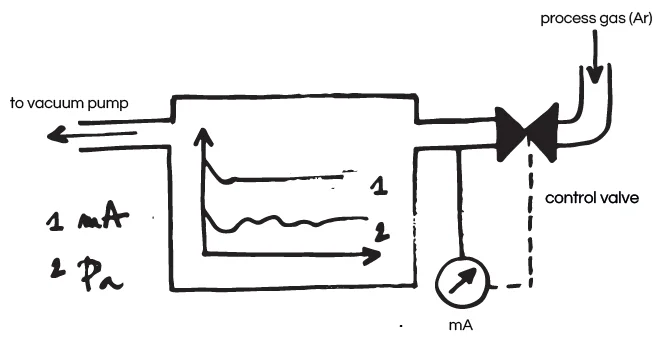
Image Credit: LUXOR
Maintaining a constant vacuum during this phase could negatively impact the sputter current, resulting in an uneven metal coating build-up. A2 Technology enables stable, low currents without plasma instability.
The above comparison between a manual and an automatic sputter coating process clearly demonstrates the advantage of a automatic control algorithm that monitors a low and constant coating current. This results in high-quality coatings in terms of homogeneity, coverage, density, and grain size.
This information has been sourced, reviewed and adapted from materials provided by LUXOR.
For more information on this source, please visit LUXOR.