Sponsored by MKS OphirReviewed by Olivia FrostJul 28 2026
Electric vehicles (EVs) powered by Li-ion battery packs are virtually everywhere. A battery pack’s charge capacity per weight (measured in kWh/kg) is one of its most important parameters, meaning that battery and car manufacturers aim to install as many ‘battery cells’ (the basic Li-ion unit that stores charge) as possible.
This must be achieved while working to eliminate superfluous components, for example, metal parts that house together a number of cells in a ‘module,’ or battery pack systems that feature several modules in a pack. In some cases, it is even prudent to remove the battery pack entirely by using a ‘cell-to-vehicle’ (C2V) approach.
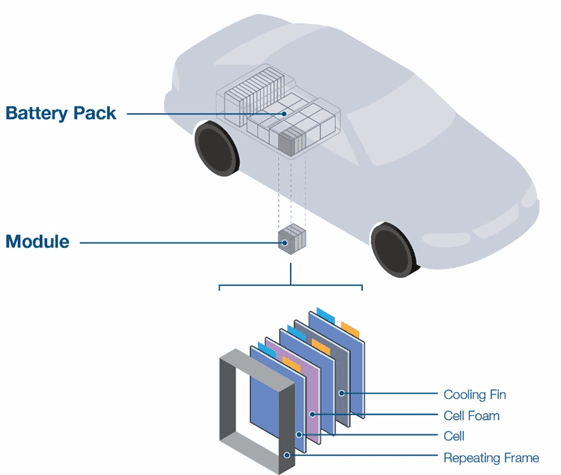
Image Credit: MKS Ophir
The Role of Lasers in EV Battery Manufacturing
Moving away from a modular approach makes servicing or repairing an EV battery virtually impossible. The battery’s safety, reliability, and structural integrity must, therefore, be exceptionally high, making laser processes highly valuable.
Lasers can be used to improve the throughput and reliability of several processes in battery pack manufacturing.
Cutting, Cleaning, and Welding at the Battery Cell Level
The battery cell comprises three thin foils: anode foil (typically aluminum (Al)), separator foil (polypropylene or polyethylene), and cathode foil (typically copper (Cu)).
The cathode and anode foils are coated with a mixture of a conductive agent, an active metal, and a binder. The foils are wound together to form the cell, positive and negative metal tabs are attached to the anode and cathode, and a liquid electrolyte is then poured into the cell.
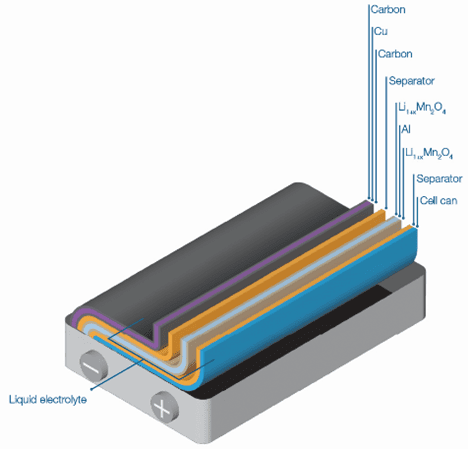
Image Credit: MKS Ophir
Contemporary Li-ion battery factories operate in a roll-to-roll process, for example, processing long rolls of the foils for coating, drying, and cutting prior to packing the foils into individual cells.
High-power (hundreds of watts) nanosecond-pulsed IR and UV lasers are typically employed for cutting foils, cleaning, and welding tabs to the anode and cathode.
These laser processes offer considerable benefits over other processes, generating smoother surfaces and edges that help mitigate the risk of lithium dendrite formation, a widespread cause of Li-ion battery failure.
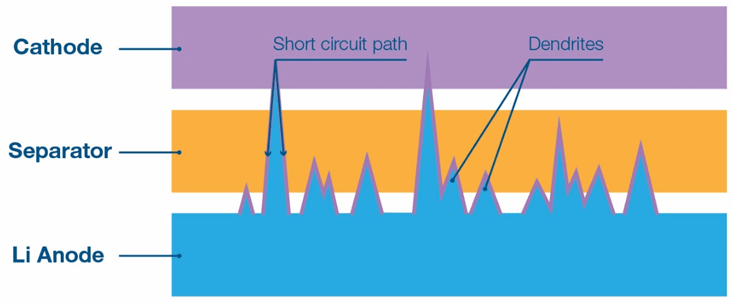
Image Credit: MKS Ophir
Welding the Battery Pack Frame and Power Harness
The battery frame holds the modules, cells, power harness, and coolant lines. This may be a part of the vehicle chassis when working with the C2V concept.
Laser welding has the potential to produce strong, reliable joints. Kilowatt-class fiber lasers operating at a wavelength of one micron are traditionally used. This wavelength is efficiently absorbed by steel and aluminum, but not by copper, which is used in the power connections.
Green (515–535 nm, frequency-doubled fiber lasers) and blue (450 nm, direct-diode lasers) high-power lasers are beginning to see more widespread use, improving the throughput of copper welding.
It is often difficult to ensure good welding of different metals. Controlling the shape of the laser spot represents a novel approach to this issue: for example, by using two spots of different sizes and powers.
Applications Currently in Development
Several applications are currently in development, in addition to current laser applications in battery manufacturing.
- Tabless Lithium-Ion Batteries: This method, patented by Tesla in 2020, employs a larger battery by removing the tab. This enables a shorter electron path length, offering more power output, larger energy capacity, and a longer range.
- All Solid-State Batteries: This method replaces the liquid electrolyte with a solid one (typically ceramic). This also acts as a separator, eliminating the separator foil from the battery construction and potentially resulting in safer construction as the battery no longer swells due to temperature changes or leaks. This approach can also lead to higher energy capacity.
- Using High-Power Ultrafast Lasers: Making use of high-power ultrafast lasers in the nanostructuring and texturing of electrode materials allows different electrode architectures (for example, three-dimensional, grids, holes, and lines) to be generated while also ensuring reduced mechanical tension during cycling, improved electrochemical performance, and improved lifetime.
Conclusion
Laser applications enable new technologies while offering superior throughput and reliability versus other methods.
The successful deployment of laser processes necessitates precise control of laser beam parameters, including beam profile and laser power. Ophir Photonics offers a range of instruments and systems designed to measure laser beam parameters and ensure consistently excellent performance.
Acknowledgments
Produced from materials originally authored by Dr. Efi Rotem from Ophir Photonic Group.

This information has been sourced, reviewed, and adapted from materials provided by MKS Ophir.
For more information on this source, please visit MKS Ophir.