Instead of removing every trace of cellulose from recycled PET, researchers tested what happens when the contamination stays in, and the material is processed under tightly controlled conditions.
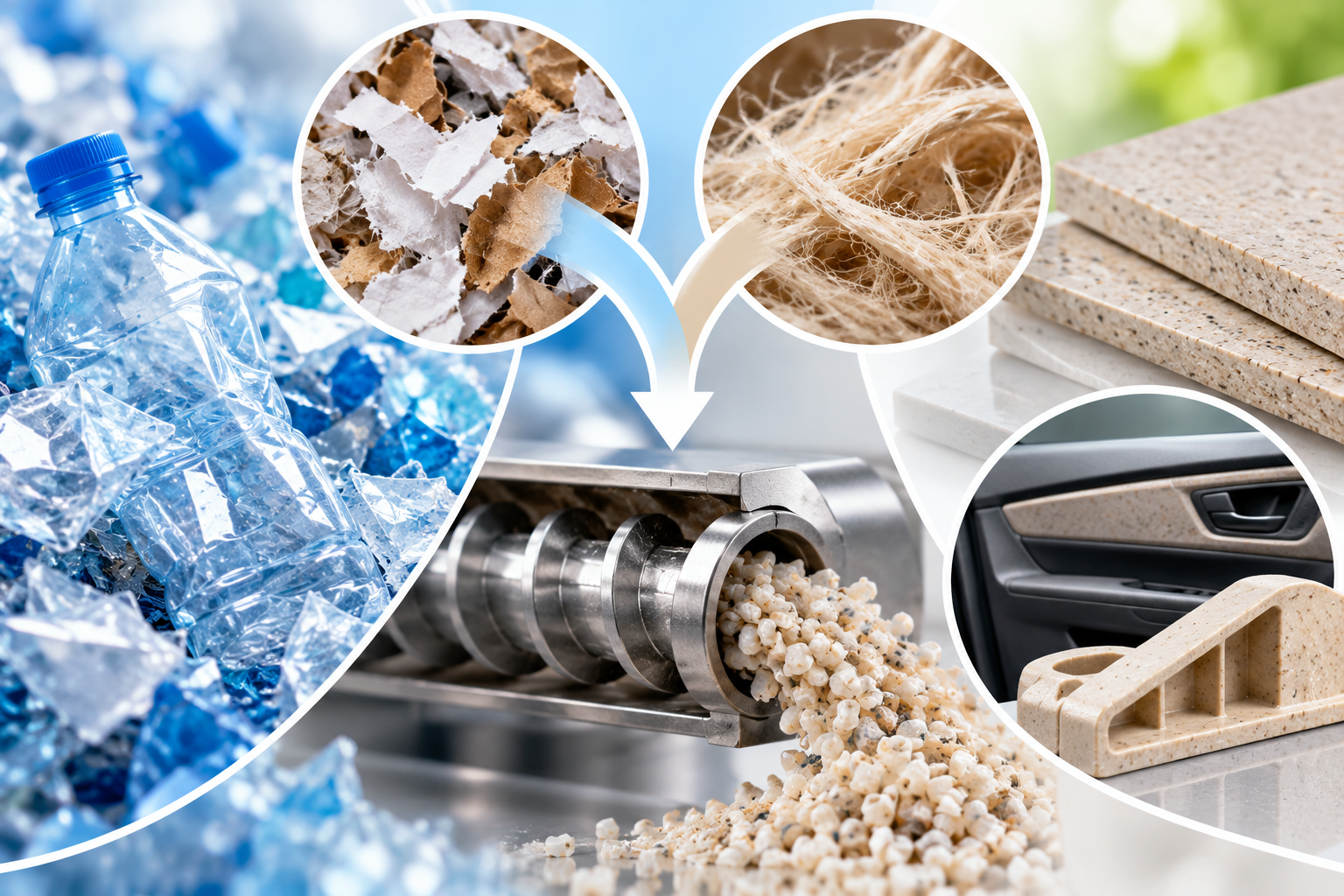
Paper: Contamination tolerant poly(ethylene terephthalate) composites from recycled feedstocks and cellulosic waste. AI-generated abstract conceptual image created using ChatGPT/OpenAI
In a recent research article published in the journal Communications Sustainability, researchers investigated contamination-tolerant composites made by incorporating cellulose-rich waste materials into recycled poly(ethylene terephthalate) feedstocks. The work tested whether these materials could remain in recycled PET while preserving useful material properties.
PET Recycling Challenges & Cellulose Integration
Poly(ethylene terephthalate) (PET) is a widely used plastic in packaging and textiles, with annual global production of about 60 million tonnes. PET is recyclable, but mechanical recycling faces major problems because degradation and contamination from mixed waste streams can lower material quality.
Cellulose-rich contaminants such as cotton fibers, paper labels, and other lignocellulosic materials can complicate recycling. These contaminants usually require separation and removal, which adds cost and can reduce the amount of material recovered for recycling.
Cellulose-based materials have high strength-to-weight ratios and come from renewable sources, making them attractive as reinforcement in polymer composites. Their limited thermal stability creates a problem for PET because PET is commonly processed at about 250 to 300 °C.
Previous studies have used chemical-intensive methods to separate PET from cellulose contaminants, raising sustainability concerns because they may remove or destroy potentially valuable cellulosic material.
Other studies have lowered PET/cotton processing temperatures with plasticizers, but reported poorer mechanical performance. Researchers still lack a clear picture of how recycled PET feedstocks with different additives, contamination levels, and processing histories behave when combined with cellulose-rich waste under conventional PET processing conditions without compatibilizers.
The study examined contamination-tolerant composites made from recycled PET and waste cellulose fibers (WCF). The researchers focused on limiting cellulose degradation during melt processing and on how feedstock composition, including TiO2 in one PET grade, related to composite performance.
Feedstock Preparation & Composite Fabrication
Three recycled PET feedstocks were chosen to model aspects of realistic recycling streams: (1) bottle flakes (BF), (2) thermoformed post-consumer clamshells (CS), and (3) a fiber-spinning grade (TO) containing an undisclosed amount of TiO2 and supplied as white pellets.
The cellulose-rich fraction consisted of pelletized waste cellulosic fibers from industrial paper and pulp processes. The material was ground into a mixture of fibers and fines, then dried to below 1 wt% moisture.
The PET feedstocks were also dried before extrusion to limit hydrolytic degradation. The researchers compounded the composites in a twin-screw extruder with a barrel temperature profile from 150 to 250 °C, within normal PET processing conditions.
The screw design combined material conveyance, shear melting, dispersive mixing, and a venting zone. An initial TO/WCF trial without vacuum venting produced poor strand consistency, so the researchers later processed composite formulations with vacuum venting to remove volatile products released during degradation.
The researchers used rheological measurements to assess melt viscosity and flow stability, thermogravimetric analysis to examine thermal degradation, differential scanning calorimetry to measure crystallinity, and tensile testing to measure elastic modulus, tensile strength, and elongation at break.
Scanning electron microscopy examined fiber dispersion, void formation, fiber wetting, and the interface between the PET matrix and cellulose. Photographs of molded specimens also showed color changes dependent on feedstock.
Thermal Stability and Mechanical Performance
Adding 10 wt% WCF increased elastic modulus by 19% for BF, 22% for TO, and 28% for CS. The added stiffness came with lower tensile strength and ductility in all three composites, and the size of those losses varied strongly by PET feedstock.
After WCF addition under vacuum-vented processing, PET intrinsic viscosity, a measure related to polymer molecular weight, fell by 20.6% for BF and 19.6% for CS, compared with 8.3% for TO. The BF and CS composites also showed more processing-related defects and poorer fiber wetting and interfacial integrity, which contributed to lower tensile strength and ductility.
The TO composite showed the smallest decline in tensile strength, about 15%, compared with 32% for BF and 57% for CS. It also retained more ductility than the other WCF composites.
SEM images showed fewer voids in TO, along with slightly better fiber wetting and fiber-matrix contact than in the other WCF composites.
The researchers linked TO's better performance partly to a stabilizing effect associated with its TiO2 content. TO also differed from BF and CS in feedstock origin, thermal history, initial molecular weight, and potentially other additives, so the experiments did not isolate TiO2 as the sole cause of the observed differences.
Consistent with that interpretation, the TO-based composite showed more stable melt rheology and smaller losses in strength and ductility than WCF composites based on BF and CS.
Mechanical performance reflected a balance among WCF reinforcement, PET crystallinity, and degradation during melt processing.
Feedstocks with greater thermal stability and stabilizing additives performed better with WCF when no compatibilizers were added. Vacuum venting helped preserve PET molecular weight by removing volatile degradation products, but it did not eliminate void formation. The study also did not apply the same vented-versus-non-vented comparison to WCF composites across all three feedstocks.
The results suggest that feedstock selection, together with controlled temperature, residence time, and venting, can permit the use of some cellulose-containing recycled PET streams in composite fabrication under conventional processing temperatures.
Thermal tests showed that WCF mass loss remained below about 4% at 260 °C over an extrusion-relevant residence time of roughly 158 seconds, while degradation was much greater at 300 °C. The finding points to a narrow processing window rather than broad tolerance of cellulose contamination.
Such processing may enable the use of lower-quality recycled PET in second-life products. The study did not measure sorting costs, recycling rates, life-cycle impacts, or service-life extension.
Contamination-Tolerant Composite Viability
The study shows that compatibilizer-free composites can be produced from the tested mechanically recycled PET feedstocks with a controlled 10 wt% addition of waste-derived cellulosic fibers. The approach could reduce the need for stringent sorting in some applications, but the experiments did not directly test unsorted mixed waste.
The WCF came from industrial paper and pulp processes and was deliberately prepared before compounding. The authors caution that it differs in morphology and surface chemistry from contaminants found directly in waste streams, such as adhesive-bearing paper labels or cotton lint. The findings should not be treated as a universal prediction for every form of cellulose contamination in PET.
The authors report that the TO-cellulose composite with the strongest results achieved approximately 80% property retention relative to high-purity recycled PET. The paper identifies automotive interiors and construction materials as possible uses, but it did not test these applications.
Long-term durability under moisture exposure and thermal cycling, industrial-scale processing, and the economic and environmental trade-offs between purification and contamination-tolerant recycling remain subjects for future research.
Source:
- Masembe P., Bowen N., et al. (2026). Contamination tolerant poly(ethylene terephthalate) composites from recycled feedstocks and cellulosic waste. Communications Sustainability 1, 163. DOI: 10.1038/s44458-026-00173-0, https://www.nature.com/articles/s44458-026-00173-0