Modern nanoindentation experiments increasingly require more than a single load-unload measurement. For materials such as polymers, thin films, and metallic glasses, mechanical behavior evolves over time under load. Capturing this response requires not only precise instrumentation, but also the ability to define experiments that directly probe time-dependent deformation.
The KLA Instruments™ InView™ Method Editor provides this capability by exposing the full structure of an indentation test. Rather than relying on fixed recipe templates, individual segments, such as approach, loading, holding, oscillation, and unloading, can be independently configured.
As a result, nanoindentation becomes a programmable mechanical test platform rather than a fixed, recipe-driven measurement, enabling experiments to be tailored to specific material behaviors. Figure 1 presents the conceptual flow diagram for using Method Editor to transform a standard nanoindentation test protocol to gain new material insights.
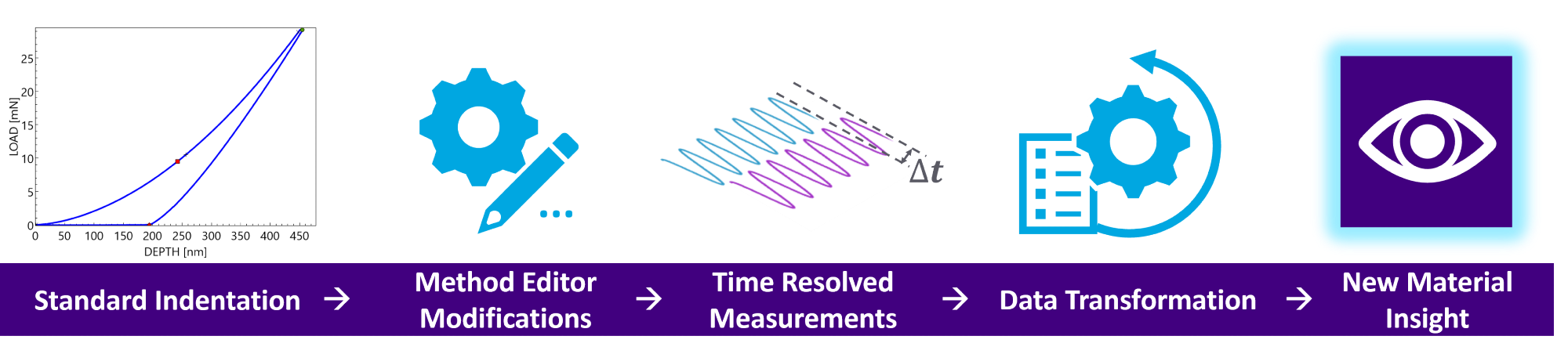
Figure 1. Conceptual flow for modifying a standard indentation test structure using Method Editor to evaluate time-dependent deformation and produce new material insights. Image Credit: KLA Instruments™
Extending Indentation to Time-Dependent Measurements
One of the key capabilities of the Method Editor is its integration with continuous stiffness measurement (CSM), which oscillates the probe during indentation to measure properties as a function of depth, force, time, or frequency. By combining user-defined test sequences with dynamic stiffness measurement, the system enables continuous tracking over time of:
- Contact stiffness
- Contact area
- Hardness
This capability is particularly important for materials exhibiting viscoplastic deformation and creep, where mechanical response depends on both deformation history and time under load. A standard load–hold–unload indentation test can therefore be extended to evaluate time-dependent behavior by introducing a longer hold segment and continuous measurement during that hold.
Under appropriate assumptions – most commonly that the elastic modulus remains constant during the hold– changes in hardness can be directly interpreted as time-dependent material responses, with stiffness variations mapped directly into hardness.
Designing a Time-Resolved Indentation Experiment
The starting point for this modification is a conventional dynamic nanoindentation method in which hardness and modulus are measured during loading under constant strain rate control. In its standard form, this test provides:
- Modulus and hardness measurement during loading
- A short hold period
- No direct measurement of property evolution during relaxation hold
To capture viscoplastic behavior, the experiment is modified as follows:
- Loading segment: Constant indentation strain rate to a defined peak load
- Hold segment: Extended dwell at peak load with CSM enabled
- Unloading segment: Controlled retraction of the indenter.
As shown in Figure 2, the key difference is the hold segment. During this period, the material undergoes relaxation while the instrument continuously measures stiffness, allowing hardness to be tracked over time.
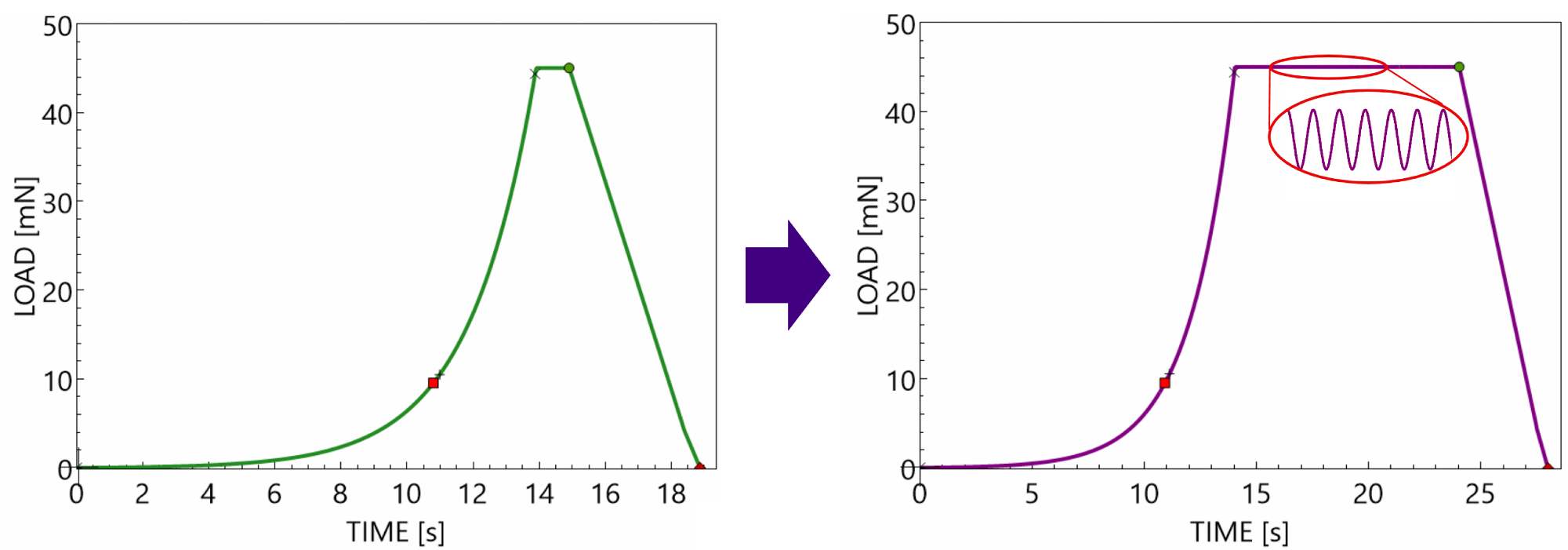
Figure 2. Modified indentation protocol for evaluation of viscoplastic relaxation. The experiment combines constant strain rate loading with a prolonged hold segment during which stiffness and hardness are continuously monitored. Image Credit: KLA Instruments™
Measurement Approach
During the hold segment, hardness is calculated using stiffness-based analysis:
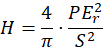
- P is load
- Er is reduced modulus
- S is contact stiffness
This formulation avoids reliance on depth measurements alone and improves stability for long-duration tests, particularly where thermal drift may otherwise introduce error: dwell times used to evaluate viscoplasticity can range from seconds to hours. To see a full derivation of H using a constant elastic modulus assumption, see Baral et al.1
Simultaneously, indentation strain rate is evaluated from the time derivative of indentation depth. Together, these signals allow construction of the log(H) vs. log(strain rate) relationship during the hold period. The slope of this relationship defines the apparent strain rate sensitivity,  :
:
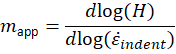
Unlike conventional high strain rate measurements, this parameter reflects relaxation behavior, not steady-state deformation.
Derived Calculations
Two key calculations are required to extract meaningful results from the test:
Reduced Modulus (Assumed)
The reduced modulus is calculated from indenter and sample properties and is used in stiffness-based hardness evaluation:
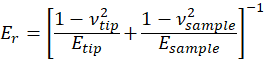
This formulation assumes that the elastic modulus remains constant during the hold segment.
Apparent strain rate Sensitivity ( )
)
The apparent strain rate sensitivity is calculated as the slope of the log–log relationship between hardness and indentation strain rate:
This parameter reflects viscoplastic relaxation behavior, rather than steady-state deformation under controlled strain rate.
Method Implementation Using InView
Implementation within Method Editor, as shown in Figure 3, involves defining three key elements:
- Sample Inputs
-
- Assumed elastic modulus (used for stiffness-based hardness calculation)
- Hold duration at peak load
- Derived Calculations
-
- Reduced modulus (from indenter and sample properties)
- Apparent strain rate sensitivity,
- User-Defined Data Channels
-
- Hardness: Calculated from stiffness and assumed modulus
- Log(Hardness): Used for linear fitting in log–log space
- Indentation strain rate: Determined from the time derivative of indentation depth
- Log(Strain Rate): Enables extraction of slope for
These elements enable continuous evaluation of material response during the hold segment and provide the basis for extracting .
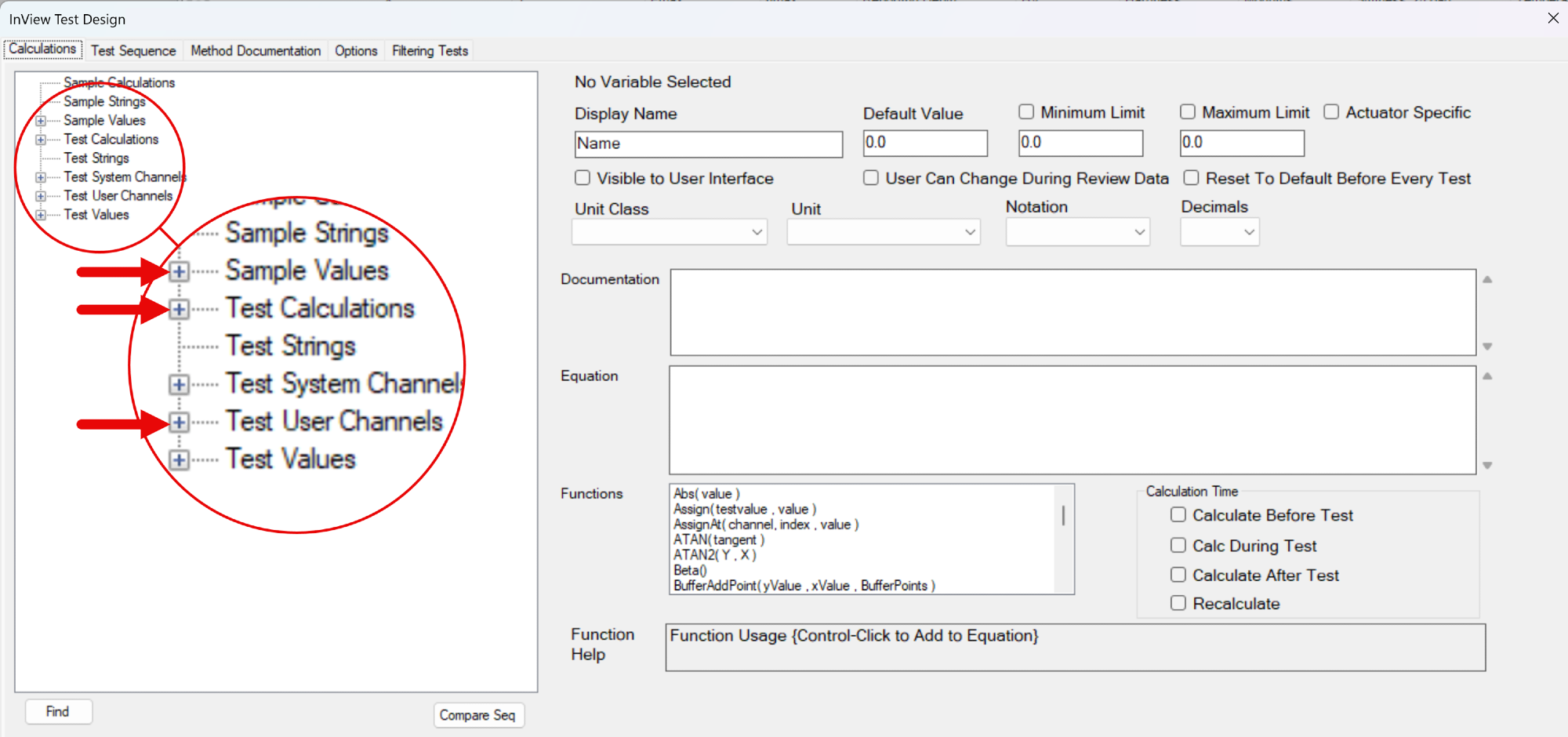
Figure 3. InView Method Editor interface highlighting the principal components used to construct the custom experiment. Sample inputs, derived calculations, and user-defined channels collectively define the measurement and analysis workflow. Image Credit: KLA Instruments™
Method Assembly and Execution
The complete method is constructed by combining the defined inputs, calculations, and data channels into a single test sequence. The workflow follows an iterative process:
- Begin with a validated base indentation method
- Define calculations for stiffness-based hardness and strain rate
- Add data channels for time-resolved analysis
- Compile and validate the method
This approach enables incremental development while preserving test stability and interpretability.
Case Study: Automotive Clear Coat
The modified method was applied to a polymer automotive clear coat to evaluate viscoplastic relaxation behavior. A series of replicate indentations was performed using a Poisson’s Ratio of 0.4, an assumed elastic modulus of 1.27 GPa, a target load of 900 mN, and a target depth of 3000 nm. Each test consisted of:
- Constant strain rate loading
- A 10-second hold period
- Controlled unloading
The resulting depth versus time response for the automotive clear coat is shown in Figure 4. During the hold segment:
- Indentation depth increased rapidly at first
- The rate of increase slowed over time
- The system approached a steady relaxation condition
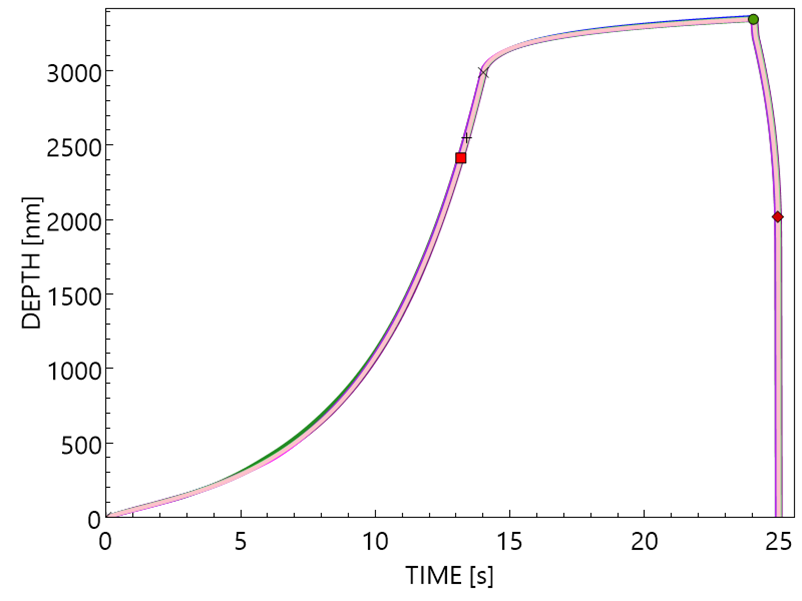
Figure 4. Depth versus time response for replicate indentation tests. The hold segment provides a controlled period for observing relaxation behavior under constant load. Image Credit: KLA Instruments™
The corresponding log(H) vs. log(strain rate) relationship, shown in Figure 5, produced a well-defined, repeatable linear trend; individual test results for m_app are provided in Table 1 with the average measured result:

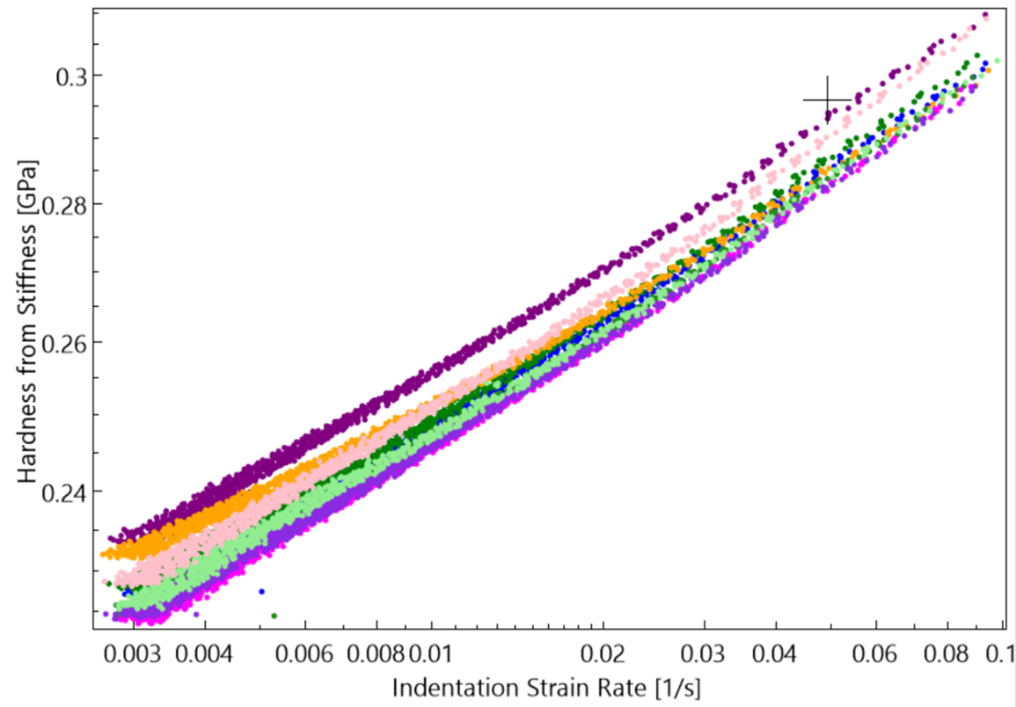
Figure 5. Log–log relationship between hardness and indentation strain rate during the hold segment. The slope of the least-squares fit defines the apparent strain rate sensitivity,  . Image Credit: KLA Instruments™
Table 1. Apparent strain rate sensitivity, , calculated for each test shown in Figure 5. Source: KLA Instruments™
| Test |
m_app |
| 1 |
0.081 |
| 2 |
0.080 |
| 3 |
0.079 |
| 4 |
0.071 |
| 5 |
0.082 |
| 6 |
0.082 |
| 7 |
0.081 |
| 8 |
0.080 |
| 9 |
0.083 |
| Average |
0.080 ± 0.003 |
Interpreting Apparent strain rate Sensitivity
The apparent strain rate sensitivity measured during relaxation provides insight into post-deformation behavior rather than into deformation under controlled loading.
In practical terms:
- Higher indicates greater molecular mobility and a stronger relaxation response
- Lower indicates limited recovery and slower relaxation processes.
This distinction is particularly important in polymer systems, where:
- Deformation resistance (measured during loading) and
- Recovery behavior (measured during relaxation) may be governed by different mechanisms.
Method Editor as an Experimental Platform
InView Method Editor transforms nanoindentation from a fixed measurement technique into a flexible experimental platform. By exposing both the structure of the test and the underlying calculations, it enables:
- Systematic variation of test conditions
- Direct evaluation of time- and rate-dependent behavior
- Rapid development of new measurement approaches.
All assumptions - including modulus values, strain rate definitions, and analysis methods - are explicitly defined, meaning the resulting measurements are both transparent and physically interpretable. This approach supports a workflow in which experiments are:
- Designed to probe specific mechanisms
- Validated through controlled measurement
- Refined based on observed material response.
Summary
InView Method Editor enables the development of custom indentation protocols that extend beyond conventional hardness and modulus measurement. By integrating controlled test sequences with continuous stiffness measurement, it becomes possible to:
- Quantify viscoplastic relaxation
- Separate deformation and recovery behavior
- Evaluate time-dependent material response within a single test
In this role, nanoindentation becomes not only a measurement tool, but a platform for experimental design, providing critical insight into how materials respond under realistic loading conditions.
References
- Baral, P., et al. (2019). A new long-term indentation relaxation method to measure creep properties at the micro-scale with application to fused silica and PMMA. Mechanics of Materials, 137, p.103095. DOI: 10.1016/j.mechmat.2019.103095. https://www.sciencedirect.com/science/article/abs/pii/S0167663619301255.
- KLA (2024). InView Method Editor: Part 1. KLA Instruments Webinars. Available at: https://iuniversity.kla.com/videos/ac90d1b3181eeecc25/inview-method-editor-part-1.

This information has been sourced, reviewed, and adapted from materials provided by KLA Instruments™.
For more information on this source, please visit KLA Instruments™.