What the Madeira Study Found
Potential Contamination Points During Bottling
Why Flavored Waters Show Higher Levels
Are Filtration Systems Designed to Remove Microplastics?
Variation in Water Bottle Brands
The Regulatory Landscape
A Challenge for the Water Industry
References and Further Reading
Microplastics are typically discussed as an environmental pollution problem, entering rivers, oceans, and food chains after plastic waste breaks down. However, growing evidence suggests bottled water production, packaging, and transport introduce microplastics into sealed bottles. Recent research from Madeira Island offers valuable insight into how microplastics may be introduced throughout drinking water supply chains through likely contamination and what this means for consumers and the water industry.1
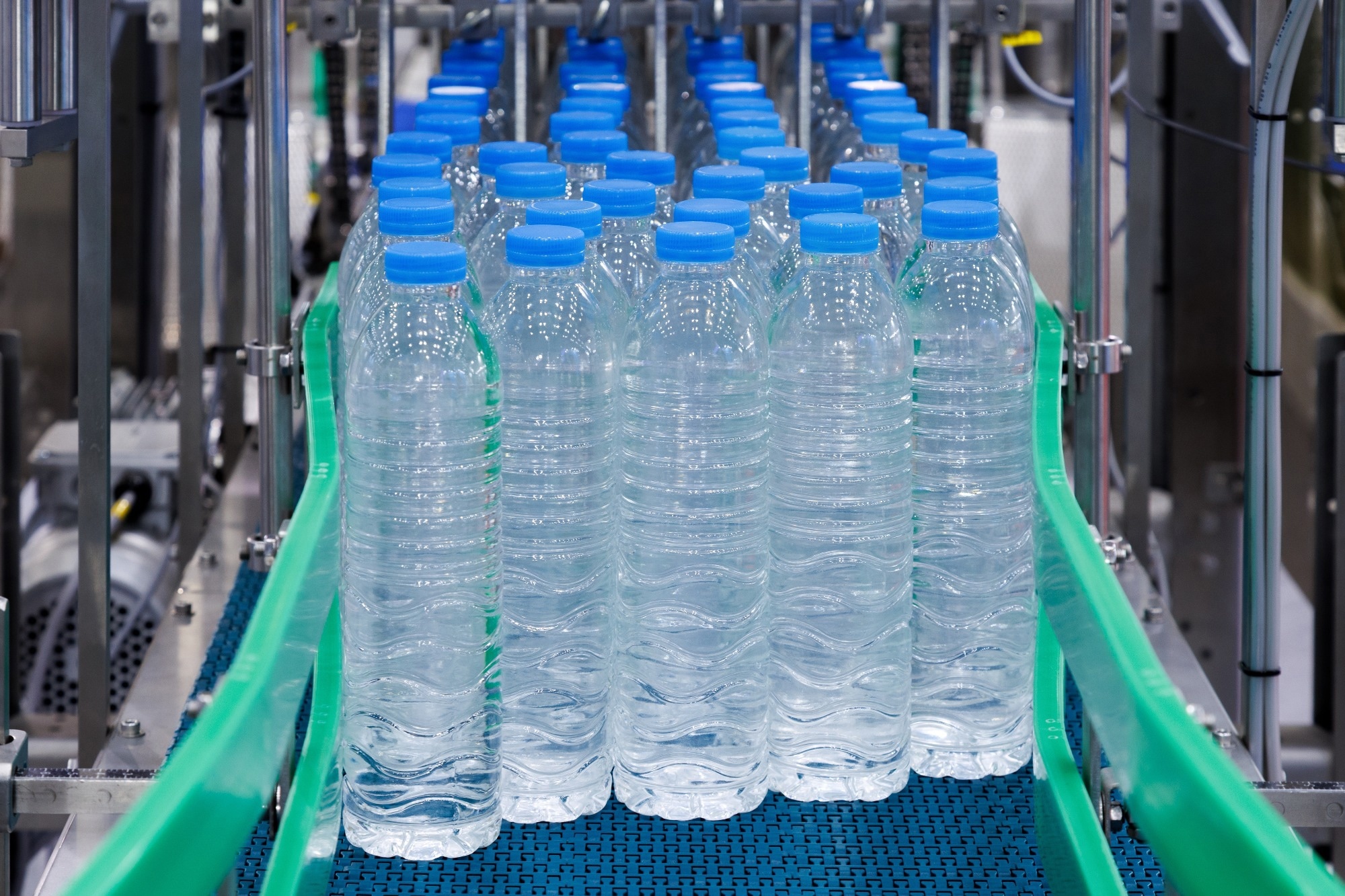
Image Credit: Gumpanat/Shutterstock.com
What the Madeira Study Found
Researchers analyzed bottled and tap water samples using stereomicroscopy and micro-Fourier transform infrared spectroscopy (µ-FTIR). Microplastics were detected in both water sources, with concentrations ranging from 0.5 to 6 microplastic particles per liter (MPs/L).1
Flavored bottled water contained the highest average concentration, at 2.0 MPs/L. Tap water averaged 1.3 MPs/L, while mineral water showed the lowest contamination, averaging 0.59 MPs/L.1
The researchers also found that bottled water was dominated by polyethylene terephthalate (PET), polypropylene (PP), and polyethylene (PE), polymers commonly used in beverage packaging.
Want to save for later? Click here.
Potential Contamination Points During Bottling
Bottled water passes through several stages such as filling, capping, and conveyor handling, which can abrade plastic parts and release particles, suggesting contamination may occur during bottling rather than at the source.
Bottles made from PET, PP caps, PE liners, and sealing rings are all possible sources. The Madeira study found polymer profiles matched packaging materials, indicating production and packaging introduce contamination.1
Mechanical stress can create contamination during capping by repeated twisting and sealing, which can shed small fragments. Contact with plastic conveyor components, transfer pipes, and filling equipment can also lead to contamination.
Previous bottled water investigations have similarly identified PET and PP as dominant microplastics, suggesting packaging materials are likely major contributors.2 Storage conditions can further influence contamination as plastic aging accelerates with temperature fluctuations. Long storage periods make particles more likely to shed from packaging.
Why Flavored Waters Show Higher Levels
Flavored bottled waters showed higher contamination. Researchers observed both higher concentrations and more varied polymer types compared with mineral waters.1 Flavored products typically require adding flavors, mixing, carbonating, and more complex filling operations. Each additional step introduces extra machine contact points, creating more opportunities to shed particles.
Importantly, the study does not prove that all detected particles originated from the bottling process. Environmental and airborne contamination, storage conditions, source water, and packaging could all play a role. More research is needed to better understand the connection between processing complexity and higher microplastic concentrations. Future studies should evaluate each stage of processing to pinpoint sources of contamination and guide the development of effective control strategies.
Are Filtration Systems Designed to Remove Microplastics?
Advanced filtration systems are widely used in bottling facilities to improve water quality by removing sediments and microorganisms. However, because microplastics are not always targeted, smaller particles may evade filtration despite the effective removal of larger contaminants.
Research by Pivokonsky et al. (2018) demonstrated that microplastics can still be detected after drinking water treatment, highlighting the difficulty of achieving complete removal. As concern about microplastics grows, manufacturers will evaluate filters for polymer-capture efficiency and standard water-quality performance.
Variation in Water Bottle Brands
The Madeira study found considerable variation between water bottle brands. Some brands contained minimal contamination, while others contained up to six particles per liter. This suggests that production methods, equipment condition, packaging design, and quality control procedures can significantly influence outcomes.1
Many bottlers already monitor particulate contamination through routine quality programs. Testing of microplastics remains less standardized than traditional chemical and microbiological methods. Contamination levels are strongly influenced by factors such as production processes, equipment maintenance, packaging, and quality-control procedures. The research highlighted inconsistencies in analytical methods as a significant barrier to evaluating microplastic contamination in drinking water.3
The Regulatory Landscape
Regulatory attention on microplastic contamination is continuing to increase. The European Union has developed a harmonized methodology for the analysis of microplastics in drinking water, providing standardized guidance on sampling, sample preparation, detection, and polymer identification.1 Although microplastics have been detected in human blood and various tissues, their long-term health implications and safe exposure thresholds remain uncertain.4 Consequently, researchers continue to advocate for improved monitoring protocols, more comprehensive exposure assessments, and robust frameworks for evaluating potential risks.
A Challenge for the Water Industry
The presence of microplastics in bottled water does not necessarily indicate a direct health risk, nor does it suggest that contamination arises solely during the bottling process. However, a growing body of evidence indicates that microplastics can be introduced at multiple stages across the production chain, including water treatment, processing, packaging, handling, and storage.
The Madeira study highlights the importance of examining bottling-facility operations alongside external environmental sources when assessing contamination risks. As a result, the water industry must ensure that purification and production processes are carefully managed to minimize the introduction of particulate contaminants. Such efforts are essential for maintaining product quality, reinforcing consumer confidence, and driving continuous improvements in water safety and quality standards.
References and Further Reading
- Silva, M., et al. (2026). Distribution, Polymer Composition, and Exposure Risks of Microplastics in Bottled and Tap Water Distribution. Molecules, 31, 2237. https://doi.org/10.3390/molecules31132237
- Mason, S.A., et al. (2018). Synthetic Polymer Contamination in Bottled Water. Frontiers in Chemistry, 6, 407. 10.3389/fchem.2018.00407
- Pivokonsky, M., et al. (2018). Occurrence of Microplastics in Raw and Treated Drinking Water. Science of the Total Environment, 643, 1644–1651. https://doi.org/10.1016/j.scitotenv.2018.08.102
- Leslie, H.A., et al. (2022). Discovery and Quantification of Plastic Particle Pollution in Human Blood. Environmental International, 163, 107199. 10.1016/j.envint.2022.107199
Disclaimer: The views expressed here are those of the author expressed in their private capacity and do not necessarily represent the views of AZoM.com Limited T/A AZoNetwork the owner and operator of this website. This disclaimer forms part of the Terms and conditions of use of this website.