As demand for high-performance batteries continues to grow, understanding the materials, structures, and processes that influence battery performance, safety, and lifespan has become increasingly important. From raw material purity and electrode manufacturing to battery aging and recycling, advanced analytical technologies are helping researchers and manufacturers improve quality, efficiency, and sustainability across the entire battery value chain.
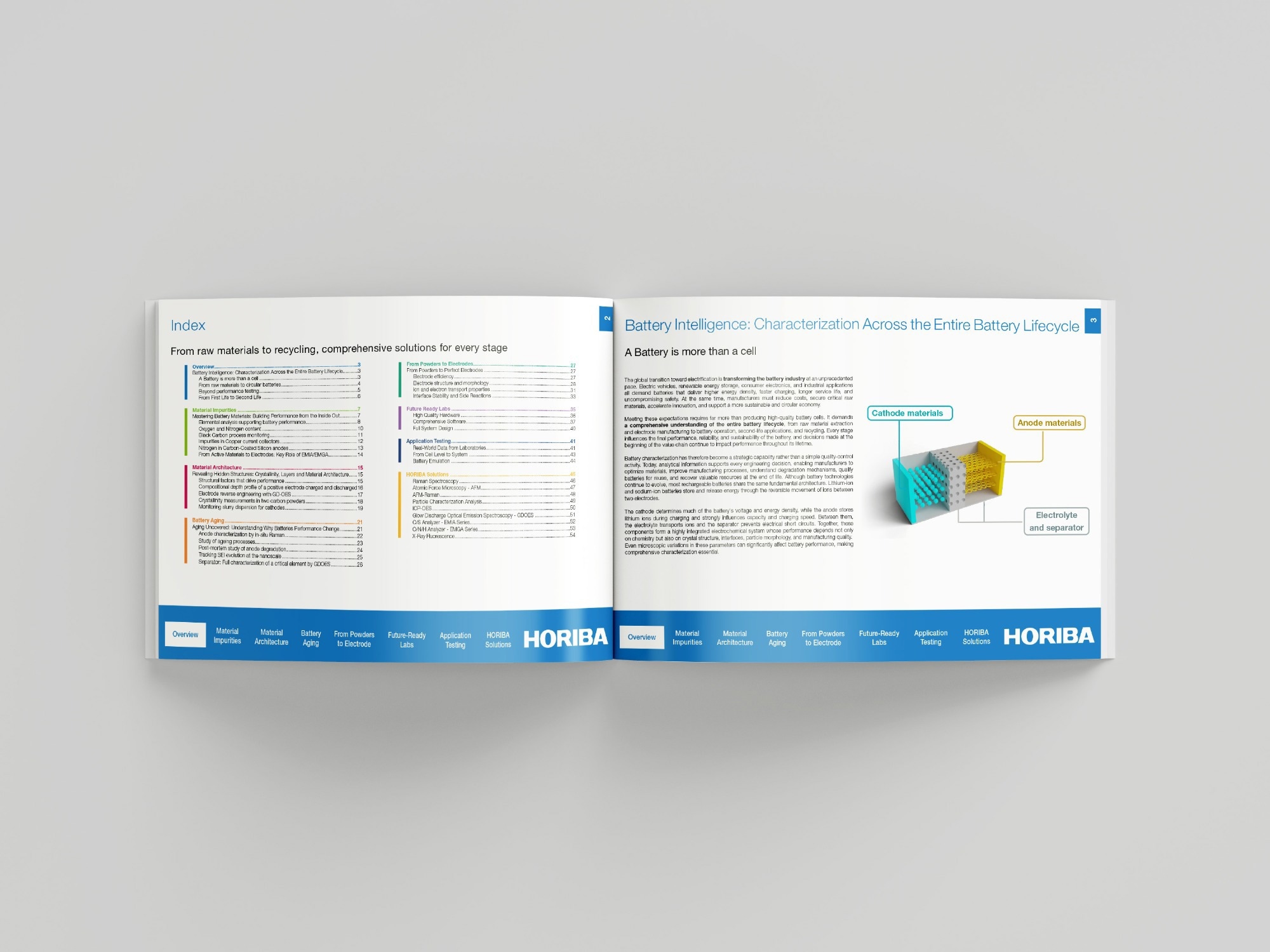
This new eBook entitled, “Empowering the Battery Value Chain: From Raw Materials to Recycling,” developed by HORIBA, brings together comprehensive insights into the analytical techniques and characterization technologies supporting modern battery development. The collection explores elemental analysis, material architecture, electrode optimization, degradation mechanisms, and battery testing, highlighting the importance of reliable analytical data at every stage of the battery lifecycle.
Battery chemistries and manufacturing processes are becoming increasingly complex, making precise material characterization essential. This edition examines how techniques including ICP-OES, ETV-ICP-OES, micro-XRF, and GD-OES can identify trace impurities, assess elemental composition, and investigate material distribution. It also explores how EMIA and EMGA analyzers support accurate measurement of carbon, sulfur, oxygen, nitrogen, and hydrogen in battery materials.
Beyond elemental analysis, the eBook considers how Raman spectroscopy, atomic force microscopy (AFM), and particle characterization techniques provide deeper insight into electrode structures, material stability, and battery aging.
From monitoring slurry dispersion and identifying degradation mechanisms, to evaluating interfaces and improving electrode performance, these approaches help connect material properties with battery reliability and lifespan.
The collection also highlights the importance of comprehensive battery testing, laboratory technologies, and integrated analytical workflows. Looking across the full battery lifecycle, it examines how characterization can support manufacturing quality, second-life applications, and recycling, helping recover valuable materials and advance a more circular battery economy.
Whether you work in battery research, materials science, electrochemistry, manufacturing, or energy storage development, this eBook provides an overview of the analytical technologies and practical approaches helping improve battery performance, strengthen quality control, and support the development of safer, longer-lasting, and more sustainable batteries.

This information has been sourced, reviewed, and adapted from materials provided by HORIBA.
For more information on this source, please visit HORIBA.