Oxford Instruments announces the release of AZtecCrystal 4.0, the next generation of its Electron Backscatter Diffraction (EBSD) analysis software.
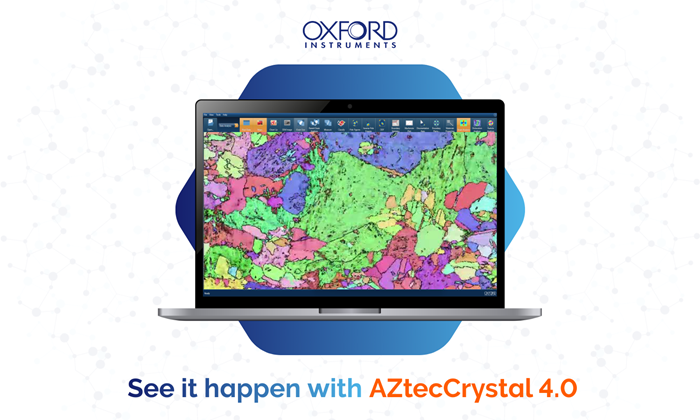 Image Credit: Oxford Instruments
AZtecCrystal 4.0 introduces two features, Crystal Batch and Crystal Compare, that transform researchers’ ability to evaluate and visualize EBSD experiments. For the first time, scientists can synchronize EBSD metrics with external experimental parameters and evaluate and visualize full stacks of datasets within one streamlined workflow.
Crystal Batch enables users to link a set of external parameters across data stacks so that key metrics can be measured and reported for the entire batch. This is ideal for multi-site and multi-sample workflows, 3D focused ion beam (FIB) slices, and in-situ experiments that, for example, measure grain size, or phase proportion changes during heat treatment.
Crystal Compare provides an intuitive way to visualize dynamic changes across datasets. Users can seamlessly switch between analysis and reporting, instantly compare data stacks, and create time-lapse imagery.
As Jack Donoghue, Senior Technical Specialist at The University of Manchester, says, “The visual representation of the data in graphs is a great way to quickly view the results to assess the quality and investigate the critical events in the timeline of an in-situ experiment.”
AZtecCrystal 4.0 is particularly well suited to core facility use, structural materials research, and quality control and failure analysis environments in which speed, reproducibility, and thorough reporting are essential.
“Through integration and automation, AZtecCrystal 4.0 reduces manual data handling and keeps the focus on interpreting microstructural change, which offers immediate and enduring value to researchers”, says AZtecCrystal Product Manager Mark Coleman. “With this next-generation EBSD processing software, we reaffirm our commitment to delivering innovative tools that empower scientists to obtain insights more quickly and precisely.”
Explore AZtecCrystal 4.0