Every year, hundreds of thousands of spectators gather for some of the world’s most iconic endurance races organized by the Fédération Internationale de l’Automobile (FIA). Beyond the spectacle of high-speed competition, these events also provide a unique opportunity to study something largely invisible: airborne particle emissions.
TOFWERK deployed its mipTOF technology trackside during an endurance race to measure metal concentrations in airborne particulate matter (PM) in real time, in collaboration with researchers from Imperial College London’s Environmental Research Group and FIA via Imperial Projects, with funding from the FIA Foundation. The campaign aimed to use high-performance motorsport as a real-world laboratory for studying airborne particulate emissions during a large-scale event with extreme driving conditions. The goal of this campaign is to help researchers better understand how similar emission processes may occur in everyday road transport and during similar large-scale events.
Motorsport as a Laboratory
Motorsport environments are characterized by continuous high-speed driving, repeated heavy braking, rapid acceleration, intense mechanical stress, and concentrated vehicle activity. Non-exhaust metal-containing particles, such as those from brake, tire and road surface wear, are released dynamically as the race cars accelerate and decelerate rapidly. In addition, other non-race-derived sources of particles, including spectators at the event (for example using BBQs and bonfires) contribute to the overall particle load. Together, these conditions create an ideal real-world laboratory for investigating non-exhaust emissions under extreme operating conditions.
Unlike traditional air quality monitoring approaches that rely on long averaging times, the mipTOF technology enables second-by-second quantification of airborne element concentrations and particle-by-particle element composition determination. This capability is particularly important in motorsport environments, where emission patterns can change within seconds throughout the multi-hour endurance events.
Measurements were conducted across multiple phases of the event, including pre-race periods, training sessions, marquee-event racing, post-race periods, and periods when the track was open to ordinary road vehicles. Differences in emissions patterns were recorded, with particular emphasis on non-exhaust emissions associated with the event, spanning the full range of particle sources.
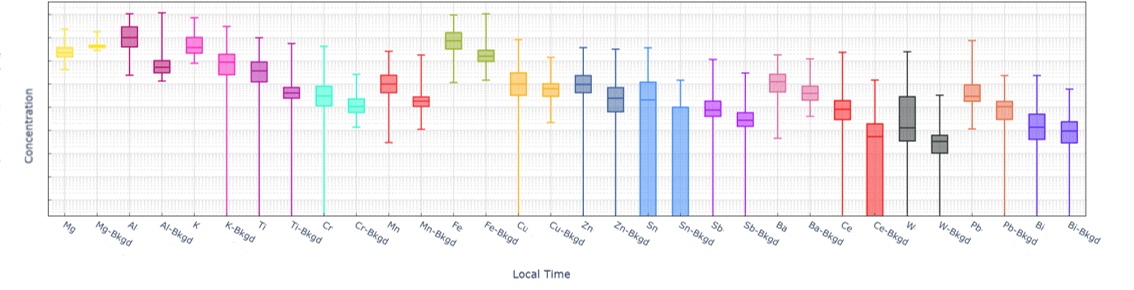
Figure 1. Distributions of elemental concentrations during the background period and the event period, shown as box-and-whisker plots. Concentrations were averaged over 10-minute intervals. Most elements show higher concentrations during the event, with the largest increases observed for Al, Ti, Sn and Ce. Mg is the only element with a higher median concentration in the background period. Image Credit: TOFWERK
The measurements showed that the average elemental concentrations for all elements (apart from Mg) are larger during the race time compared to a site background period with the largest increases in median concentration observed for Al, Ti, Sn and Ce (Figure 1). In Figure 2, the relative abundances of elements in the air (i.e. the element fingerprints) of the during-race and background periods are compared. In the background period, the magnesium abundance dominates, which indicates that particles from natural sources, such as mineral dust and sea-salt spray, dominate the PM composition. On the other hand, during the race, the PM composition shifts to predominantly Al, Fe, and K, but with a significantly larger fraction of elements rarely measured in background periods, such as Cr, Mo, Sb, Sn, and W.
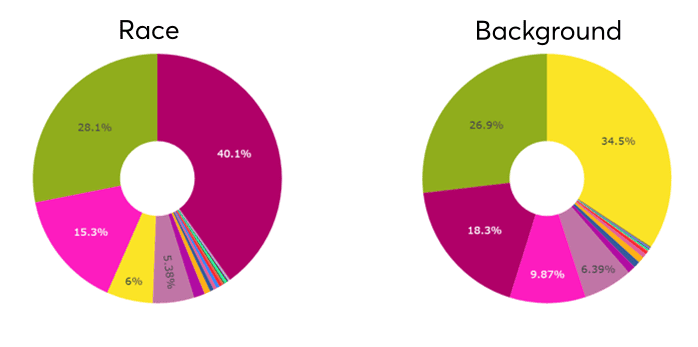
Figure 2. Occurrence-normalized bulk elemental concentrations during the race event compared with background conditions. Average concentrations are higher during the 24 hr of the event for all elements except Mg compared to a 24 hr period prior to the race. Image Credit: TOFWERK
The high temporal resolution of the mipTOF technology allows for measurements of short-lived metal-particle emission spikes to be captured in real time, for example emission profiles during individual laps (Figure 3). These short transient events are often missed by conventional filter-based sampling methods, which average measurements over longer periods and cannot resolve the rapid fluctuations associated with highly dynamic driving conditions. By directly linking particle composition to specific driving activities, the mipTOF technology provides unique insight into how emissions evolve on a second-by-second basis.
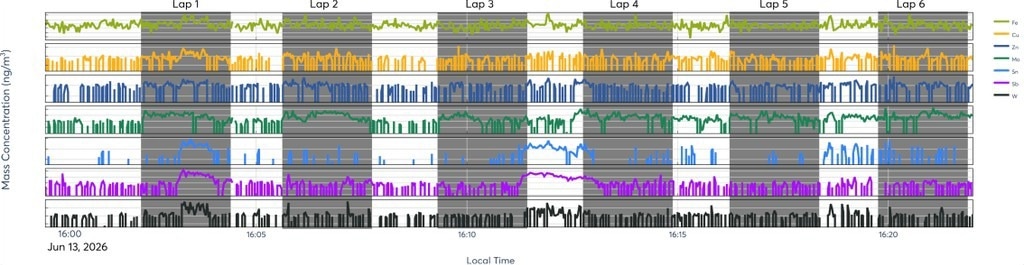
Figure 3. Time series of selected elemental concentrations at 2 s resolution. Elements that are elevated during lap periods are shown. Mo and Zn are clearly separated in time from Cu, Sn, Sb, and W, which may reflect different vehicle types or different particle-generation processes. Image Credit: TOFWERK
This measurement campaign demonstrates how high-time-resolution chemical measurements combined with advanced source apportionment can provide a detailed real-world understanding of particulate emissions in extreme driving environments. By using motorsport as an experimental platform, this collaboration aims to generate new insights into non-exhaust emissions, helping to inform strategies for reducing their impact on air quality in the years ahead.