Using PREN and Pitting Index: Power and Limits
Corrosion Performance: 316L vs 2205 and Up-Alloyed Grades
Strength, Fabrication, and Weldability Trade-offs
Cost and Availability
Decision-Oriented Takeaway
References and Further Readings
In chloride-heavy environments where pitting, crevice corrosion, and stress corrosion cracking threaten structural integrity, duplex stainless steels often set the performance benchmark. Yet high-alloy austenitic grades still hold their own in the most aggressive, acidic, or low-temperature environments.1
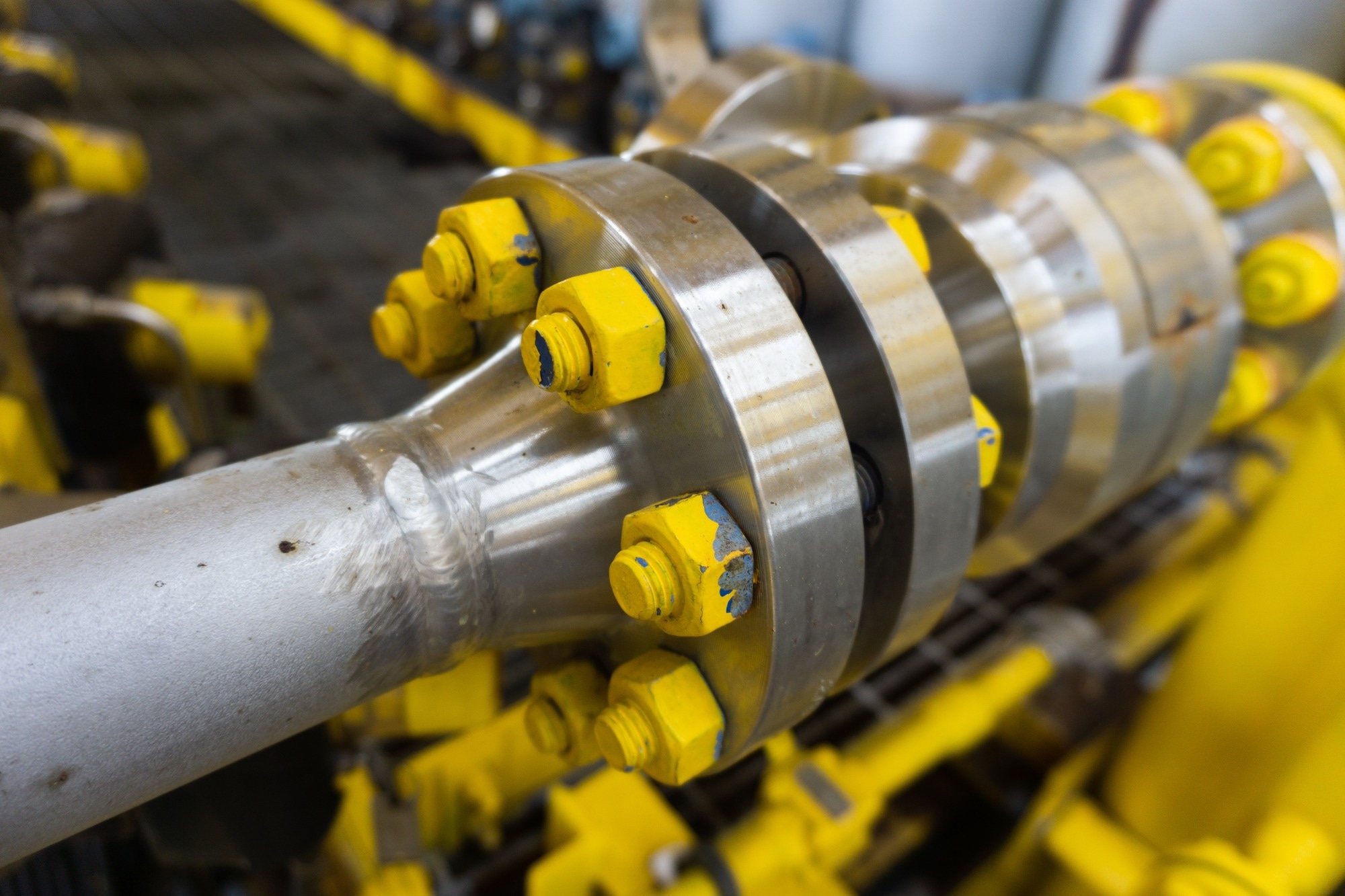 Image Credit: MR.Zanis/Shutterstock.com
The importance of corrosion protection is not theoretical: failures linked to long-term deterioration in aggressive service environments, including the 2018 Morandi Bridge collapse in Genoa, have shown the human and economic cost of underestimating corrosion risk. So it's critical to understand exactly what steel works best for the environment it's used in.
Saving this article for later? Grab a PDF here.
Austenitic stainless steels such as 316L (18Cr–8–12Ni) are single-phase, face-centred cubic (FCC) alloys valued for their excellent general corrosion resistance, toughness, and ease of welding. As a result, they're widely used in food, pharmaceutical, and petrochemical plants.2
Duplex grades like 2205 have a dual-phase microstructure with roughly equal amounts of ferrite and austenite, combining higher strength with improved resistance to localized corrosion and stress corrosion cracking (SCC).3
Super austenitic (e.g., 904L, 254 SMO) and super duplex (e.g., 2507) grades further increase chromium, molybdenum, and nitrogen to extend performance in highly aggressive media, including seawater and strong acids.4
The practical question for designers in oil and gas, chemical processing, desalination, and pulp and paper is which type provides a safer and more economical solution in a given environment.
Using PREN and Pitting Index: Power and Limits
One common screening tool for answering this question is the pitting resistance equivalent number (PREN) or pitting index (PI), expressed as PREN = Cr + 3.3Mo + 16N or PI = Cr + 3.3Mo + 13N.
These empirical formulae reflect the beneficial effects of chromium and especially molybdenum on chloride pitting; nickel, although helpful for SCC resistance, contributes little to pitting resistance and is usually omitted.5
Typical values illustrate why conventional austenitic grades struggle in seawater compared with duplex grades.
- 316L (17Cr–2.5Mo–12Ni): PI/PREN ≈ 25.
- 2205 (22Cr–3Mo–N): PREN ≈ 34-35.
- 904L (20Cr–4Mo–25Ni): PREN ≈ 34-35.
- 254 SMO / 6Mo (20Cr–6Mo–N): PREN ≈ 42-43.
- 2507 super duplex (25Cr–4Mo–N): PREN ≈ 40-41.
Higher PREN correlates with higher critical pitting and crevice temperatures in chloride solutions, which is why standards such as NORSOK require PREN ≥40 for seawater-exposed stainless steels. However, a 2021 review in Metals stressed that such indices do not capture temperature, metallurgical condition (e.g., sigma phase), weld quality, crevice geometry, or deposits, and should therefore be treated as ranking tools, not performance guarantees.5
Corrosion Performance: 316L vs 2205 and Up-Alloyed Grades
Chloride Pitting, Crevice Corrosion, and SCC
A well-cited study by R. A. Walker in 1988 showed that conventional 18Cr-8Ni austenitics suffer reduced resistance to pitting and crevice attack in stagnant chloride environments, with 316 welds failing by pitting after months in poorly flushed seawater.6
Walker noted that chloride SCC is the dominant failure mode for such a plant, accounting for roughly one-third of stainless failures, typically above about 65 °C under tensile stress.
Duplex grades largely suppress chloride SCC under comparable conditions, making them well-suited for hot seawater, sour gas, and caustic environments.6
Electrochemical work in tartaric acid plus chlorides and sulfates (25-60 °C) illustrates the effect of alloying: 316L and 2205 were active and suffered significant corrosion, whereas 2507 and hyper-duplex 2707 exhibited almost purely passive behavior at room temperature due to higher CrMoN contents.1
In the study, super austenitics 904L and Sanicro 28 showed more noble corrosion potentials and lower critical passivation currents at 60 °C than 2205, confirming that high-Ni, high-Mo austenitics can outperform standard duplex in strongly acidic mixed-salt media.7
Oil, Gas, and Seawater Service
In oil and gas, 2205 stands firm as the workhorse CRA, providing similar or better localized corrosion resistance than 904L at lower cost, with much greater resistance to chloride SCC in sour service.4
For seawater systems, super duplex 2507 and related 25Cr grades (PREN≥40) match or slightly exceed the crevice corrosion resistance of 6Mo austenitics (e.g., 254 SMO) in natural and chlorinated seawater while offering higher strength and lower nickel/molybdenum content.4
This has driven their use in seawater injection lines, desalination plants, and marine pumps, where 6Mo and super duplex both survive in chlorinated seawater up to about 30-40 °C if crevices are controlled.4
Other Industrial Environments
Duplex and super duplex grades have replaced 316L in many pulp and paper, chemical, and heat-exchanger applications due to better resistance to caustic, chloride, and erosion-corrosion, especially where high velocities or solids (e.g., sand) are present.3
However, in strongly acidic solutions with significant chloride and sulfate (e.g., tartaric acid mother liquor), Bellezze et al. found in a 2016 Materials and Corrosion study that super austenitics like Sanicro 28 and 904L could outperform duplex alloys, particularly when surface finish or selective ferrite corrosion undermined duplex performance.1
Strength, Fabrication, and Weldability Trade-offs
 Image Credit: Geoffrey Prior/Shutterstock.com
Duplex stainless steels have roughly double the 0.2 % proof stress of common austenitics: 316L typically around 170 MPa.MPa, 904L ~220 MPa, 2205 ~450 MPa, and 2507 ~550 MPa. This allows significant wall-thickness reduction in pressure equipment and piping, cutting weight and in some cases, overall cost, despite more demanding fabrication requirements.6
In the 1988 study, however, Walker stresses that duplex and high-alloy austenitics are less readily weldable than 18Cr-8Ni grades. Weld design must avoid excessive ferrite, sigma, or chi phases, and appropriate filler composition and heat input control are essential to maintain corrosion resistance and toughness in the heat-affected zone.6
Conventional 18Cr-8Ni austenitics weld easily with modest ferrite in the weld metal (5-10 vol%) to avoid solidification cracking, and as long as this ferrite range is met, major welding problems are rare.6
In contrast, duplex welds require tighter control of heat input, interpass temperature, and nitrogen content in shielding or backing gases to maintain an approximately 50/50 phase balance and avoid intermetallic precipitation, which can drastically reduce localized corrosion resistance, according to the 2021 Metals paper.5
Low-temperature toughness is another differentiator: austenitics retain high impact energy well below zero, making them attractive for cryogenic or very low-temperature duties, while duplex steels exhibit a ductile–brittle transition around -40 to -50 °C and are generally restricted by design codes to higher minimum service temperatures.5
At the other end of the spectrum, prolonged service of duplex grades above about 250-300 °C risks embrittlement due to sigma or alpha-prime precipitation, whereas austenitics like 316L or 6Mo remain structurally stable at this service temperature.5
Click here to learn more about superaustenitic steel and its uses!
Cost and Availability
Economically, duplex steels benefit from lower nickel content for a given PREN, often making 2205 cheaper than 316L on a strength-adjusted basis, and substantially cheaper than 904L or 254 SMO in terms of alloying cost per unit corrosion resistance.8
For similar localized corrosion performance, there is usually a duplex alternative to an austenitic grade with better SCC resistance and higher strength, which is why duplex alloys have become standard CRAs in many offshore and process applications.8
However, high-alloy austenitics remain widely available in tube and plate products, and familiarity with fabrication can sometimes outweigh the material premium, particularly for smaller fabricators or use in highly complex geometries.8
Decision-Oriented Takeaway
Duplex grades such as 2205 are typically preferred where chloride-driven pitting, crevice corrosion, and SCC are key risks, temperatures are moderate (<200 °C), wall-thickness reduction is valuable, and qualified duplex welding capability is available. This is particularly true in seawater systems, sour oil and gas, desalination, and many chemical and pulp-and-paper services.3
Super duplex 2507 becomes attractive when PREN ≥ 40 is required (e.g., seawater, high-chloride process streams), offering 6Mo-level localized corrosion resistance at lower alloying cost and higher strength, provided fabrication controls are in place.5
High-alloy austenitics such as 904L and 254 SMO are often a better fit for applications involving strongly acidic environments with chlorides/sulfates, where low-temperature toughness is critical, where extreme formability or simpler welding is desired, or where the penalty of higher nickel content is acceptable relative to process risk.7
In all cases, PREN or PI should be used only as a first-pass screening criterion, followed by environment-specific corrosion testing and weld-procedure qualification to secure reliable performance over plant life.
References and Further Readings
- Bellezze, T.; Giuliani, G.; Roventi, G.; Fratesi, R.; Andreatta, F.; Fedrizzi, L., Corrosion behaviour of austenitic and duplex stainless steels in an industrial strongly acidic solution. Materials and Corrosion 2016, 67 (8), 831-838.
- Hrabovská, K.; Životský, O.; Vánová, P.; Jirásková, Y.; Gembalová, L.; Hilšer, O., Microstructure and magnetism of austenitic steels in relation to chemical composition, severe plastic deformation, and solution annealing. Scientific Reports 2025, 15 (1), 2010.
- Kahar, S. D., Duplex stainless steels-an overview. International Journal of Engineering Research and Applications 2022, 7 (04), 27-36.
- Kangas, P.; Chai, G. C., Use of advanced austenitic and duplex stainless steels for applications in oil & gas and process industry. Advanced Materials Research 2013, 794, 645-669.
- Francis, R.; Byrne, G., Duplex stainless steels - alloys for the 21st century. Metals 2021, 11 (5), 836.
- Walker, R., Duplex and high alloy stainless steels–corrosion resistance and weldability. Materials science and technology 1988, 4 (1), 78-84.
- Fang, K.; Liu, Y.; Luo, K.; Shen, J.; Lu, J.; Liu, E., Corrosion Behavior of AISI 904L Austenitic Stainless Steel in High-Temperature and High-Pressure Water Environment. Metals 2026, 16 (2), 222.
- Cheng, H.; Luo, H.; Li, Y.; Rao, Z.; Zhao, Q.; Pan, Z.; Kong, Q.; Li, X.; Raabe, D., Segregation passivation makes cost-effective stainless steel resistant to corrosion and hydrogen embrittlement. Science Advances 2026, 12 (5), eadz1833.
Disclaimer: The views expressed here are those of the author expressed in their private capacity and do not necessarily represent the views of AZoM.com Limited T/A AZoNetwork the owner and operator of this website. This disclaimer forms part of the Terms and conditions of use of this website.