Hall measurements are possibly the most important measurement for electronic materials and devices.
Using Semilab tabletop PDL-1000 system with Carrier-Resolved Photo Hall (CRPH) option you can evaluate the properties of interest for both the minority and majority charge carrier. This is done by conducting the Hall measurement in the dark and at multiple optical excitation levels and analyzing the change of the measured properties.
What parameters can be measured by PDL-1000 (with AC and DC magnetic field)?
Using a dark Hall measurement, the following majority-carrier parameters of the contacted sample can be determined:
- carrier type (hole or electrons)
- carrier concentration (density)
- sheet resistance
- mobility
With CRPH measurement - based on the Photo-Hall equation and performed after a Hall measurement in the dark - it is also possible to determine minority carrier properties, recombination lifetime, the diffusion length of both charge carriers (electrons and holes), and the ambipolar diffusion length.
What is the difference between Hall measurement in the dark and the CRPH measurement?
Using the traditional Hall measurement on the contacted sample in the PDL-1000 system you can examine both conductivity and the Hall coefficient (for mobility) of the majority charge carrier and determine the density of the majority carrier.
After taking the Hall measurement, the advanced CRPH method can be used to uncover the minority and majority charge carrier properties by applying optical excitation with a laser source (two lasers with different wavelengths can be installed in the system from the available options) with varying intensity.
Once the measurements are complete at distinct excitation levels, the measurement software can determine charge carrier lifetime, carrier mobility, density, and diffusion length.
Get in touch now
What is the advantage of using PDL-1000 with the CRPH option?
- Versatile R&D and semiconductor industrial applications on PV, TCO, thermoelectric materials, organic electronics, compound and other semiconductors
- Can be used to conduct optical excitation dependent sheet resistance and Ohmic check measurements
- System can be used also for generating AC magnetic field for various experiment or test systems
- Provides access to a wide range of mobility with high sensitivity
- Two wavelength-pair laser options for the optical excitation
- Tabletop, compact design without bulky electromagnet
- Can also measure minority charge carrier properties
- Large magnetic field (∼ 2 T pk-pk) and uniformity
- Easy-to-use software with adjustable parameters
- Measures low mobility & very insulating samples
- Can handle mobility less than 0.1 cm2/Vs
What other options are available with PDL-1000?
- White light background illumination to help measuring high resistance materials
- LN2 cryostat allowing temparature dependent measurement
- Gate bias voltage.
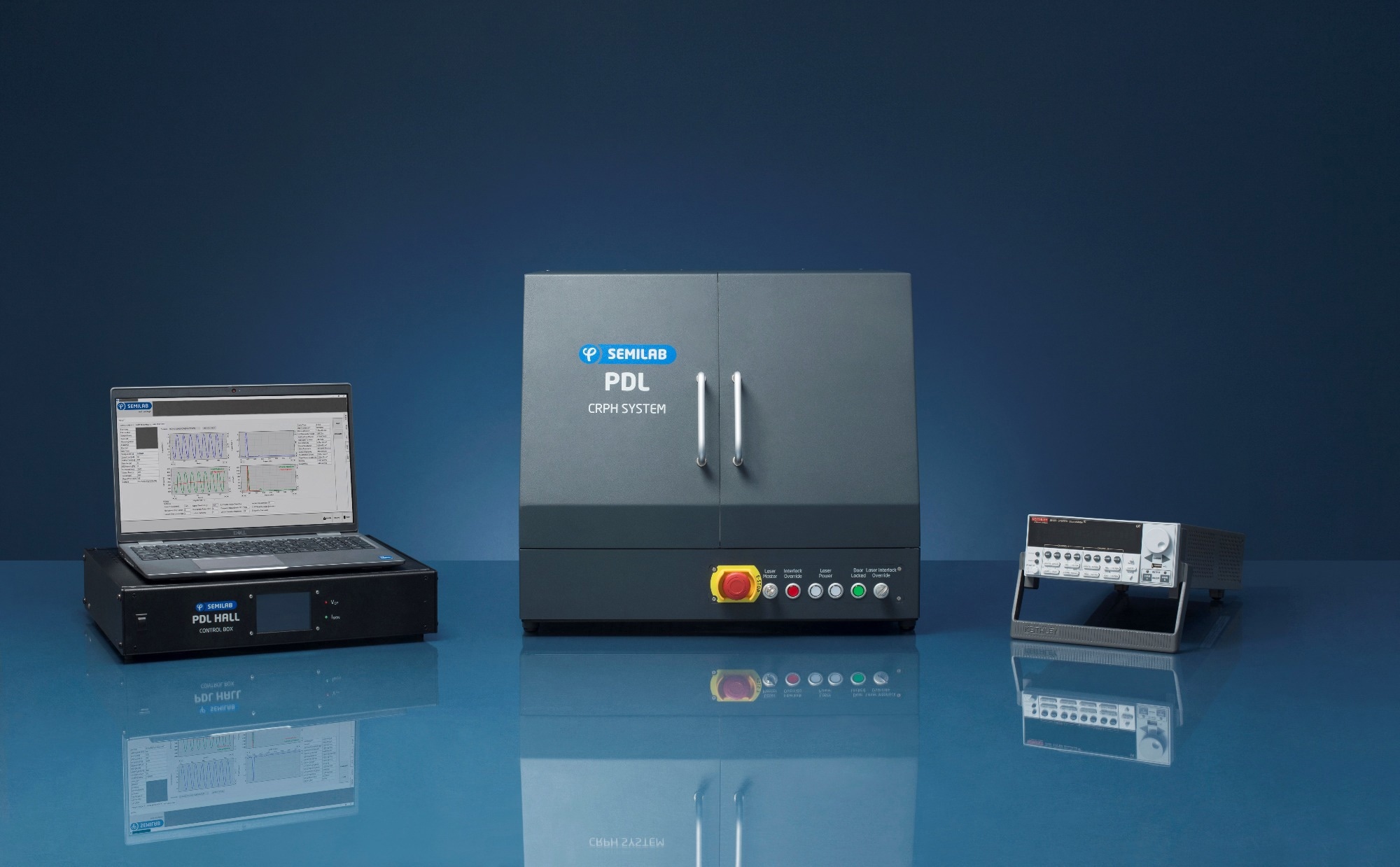
PDL-1000 with CRPH option - Image Credit: Semilab Semiconductor Physics Laboratory.
For more information, you can visit supplier webpage or request a quote, and read the following literature about CRPH in details: Carrier-resolved photo-Hall effect | Nature.
High Sensitivity Parallel Dipole Line Hall (PDL-1000) Measurement with CRPH Option

Image Credit: Semilab Semiconductor Physics Laboratory

Image Credit: Semilab Semiconductor Physics Laboratory

Image Credit: Semilab Semiconductor Physics Laboratory