Researchers are exploring whether electrically controlled plasma layers could add a tunable dimension to stealth, but taking the concept beyond simulations and laboratory systems poses formidable engineering demands.
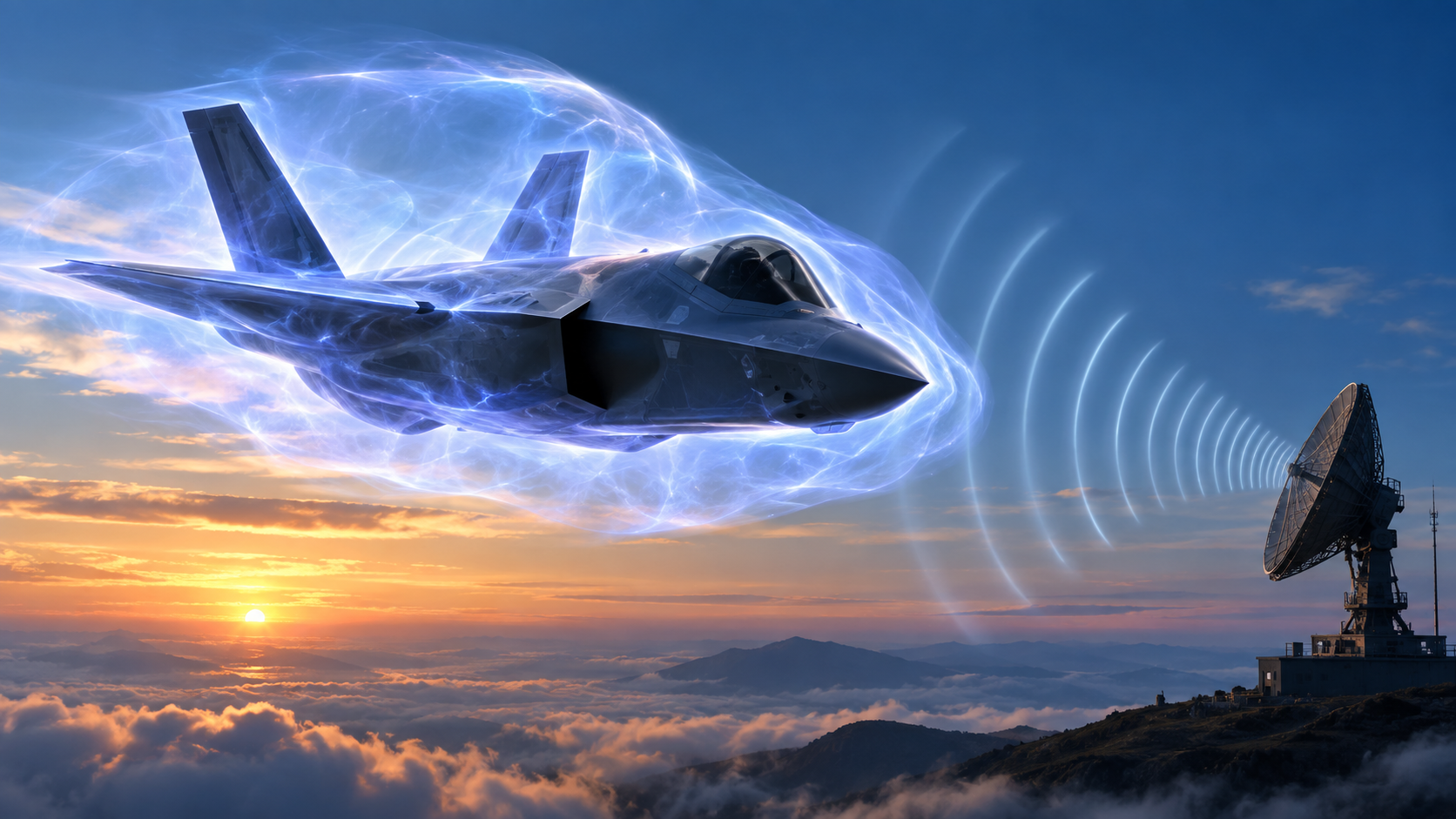
Paper: Plasma stealth: Toward next-generation low observability. AI-generated conceptual image created using ChatGPT/OpenAI
Stealth technology employs several techniques to significantly reduce the likelihood of an asset being detected by hostile radar. While passive stealth methods based on radar-absorbing materials (RAM) and geometric shaping make platforms difficult to detect, track, and engage, continuous advances in multi-frequency radar systems expose the inherent limitations of these static defenses.
Plasma stealth (PS), which involves using a sheath of ionized gas (plasma) to surround an aircraft, has been proposed as an active countermeasure. Incoming electromagnetic (EM) waves can be absorbed, reflected, refracted, or scattered by plasma as its properties are adjusted in real time.
A paper recently published in the journal Defense Technology reviewed the parameters impacting EM wave propagation in plasma, plasma generation and configuration techniques, applications, and challenges.
Parameters Influencing EM Wave Propagation
In plasma, EM wave propagation is influenced by two key parameters: plasma frequency (ωp) and collision frequency (ν). The wave can enter the plasma medium and be refracted or absorbed when the wave frequency (ω) > ωp.
The wave is primarily reflected when ω < ωp. A resonance condition occurs when ω ≈ ωp, resulting in the wave energy being effectively transferred to the plasma, leading to maximum absorption.
Collision frequency describes how often electrons collide with neutral molecules or atoms. These collisions dissipate energy and contribute to wave absorption, which is strongest when ν is close to ω.
Using the Drude model, both parameters collectively define the plasma’s complex permittivity.
Plasma Generation and Configuration Methods
A plasma sheath can be created using particle beams, lasers, electrical discharges, and radioactive sources, with each method producing plasmas with varying temperatures, shapes, and densities depending on the requirements.
Laser- and Radio-frequency (RF)- Supported Plasmas: Laser-initiated, RF-sustained plasma can be created in a laboratory by performing a two-step process in a vacuum chamber/a controlled environment that is backfilled with a target gas to a specific pressure.
While laser-RF systems efficiently generate high-density plasma in laboratories, no in-flight or operational demonstrations have been reported to date, limiting their relevance to practical aerospace applications.
Dielectric-barrier-discharge (DBD) Plasmas: These plasmas are formed when a high-voltage alternating current is applied across electrodes separated by a dielectric barrier. DBD systems can produce self-pulsing microdischarges and stable, non-thermal plasmas; the review also describes a stealth-oriented source operated in a sealed, low-pressure argon chamber.
Common excitation yields electron densities of ~10¹6–10¹7 m-³ with high collision rates. DBD systems show promise, but scaling them for large-area applications is difficult owing to demanding operational and design requirements.
RF-generated Plasmas: RF excitation is a well-known technique for producing plasmas. In laboratory chambers operating at pressures from 1 mTorr to 1 Torr, MHz-to-GHz oscillatory fields can support capacitively coupled or inductively driven plasmas.
Electron densities of 10¹7–10¹8 m-³ can be obtained using these methods. While RF-based systems are effective, they require impedance-matching networks and pressurized cavities, which increase complexity and weight.
PS Technology Applications
The authors identify integrating plasma with current non-stealth aircraft and existing stealth aircraft that mostly rely on RAMs or aerodynamic shaping as a viable application.
A targeted plasma shield could reduce radar returns from critical aircraft areas that are easily detected by radar, such as the cockpit, radar dome, and engine inlets, rather than covering the entire aircraft with a plasma sheath.
This approach could allow PS to act as an instantly activated, compact system that can be integrated into specific aircraft sections to reduce radar cross-section (RCS) during critical stages of operation.
PS could also have future applications in space-based military satellites and high-speed intercontinental missiles. Other uses may emerge as the field matures.
Key Challenges
PS has significant potential in military applications, but moving it from laboratory research to operational military systems presents multiple challenges.
Much of the evidence still comes from simulations, laboratory experiments, and idealized plasma configurations, and no practical plasma-stealth capability has been verified at hypersonic velocities.
For instance, a high plasma density is required to effectively reduce RCS using sustainable plasmas. Generating and sustaining such a high-density plasma sheath can require megawatt-scale electrical power for full-aircraft coverage.
The extreme aerothermodynamic environment associated with hypersonic flight significantly degrades the stability of the plasma sheath. Unstable, steep gradients in ionization, temperature, and pressure generated by the bow shock make the surrounding flow extremely inhomogeneous.
A plasma layer can also interfere with radio communication and GPS signals, while visual, infrared, electromagnetic, thermal, and ionized-trail emissions could create other detectable signatures.
Finally, the high cost of PS is a major hurdle to its implementation in military operations.
PS could redefine stealth as an actively commanded capability. The review treats plasma as a supplement to conventional stealth, with future systems likely to combine plasma with RAM, metasurfaces, and AI-based control. Addressing power, stability, communication, secondary-signature, and integration problems will be necessary before operational deployment becomes realistic.
Disclaimer: The views expressed here are those of the author expressed in their private capacity and do not necessarily represent the views of AZoM.com Limited T/A AZoNetwork the owner and operator of this website. This disclaimer forms part of the Terms and conditions of use of this website.