Introduction
What Properties Make a Good Engineering Plastic for Gears
POM as the Benchmark Material for Precision Plastic Gears
Polyamide Gears and Their Environmental Trade-Off
PBT Gear Wear and Deformation Under Load
PEEK for High-Temperature and High-Load Gearing
How Carbon-Fiber Reinforcement Changes PEEK Gear Performance
Why Polymer Gears Wear
Frictional Heating as the Hidden Limit on Performance
Why Polymer Gears Can Be Quieter Than Metal Gears
How Wear Changes Gear Noise Over Time
Polymer-Polymer or Polymer-Steel Pairings
Dry Running Versus Lubricated Polymer Gears
How Manufacturing Changes Gear Performance
What Ultimately Limits Polymer Gear Service Life
Predicting Polymer Gear Service Life
Choosing an Engineering Plastic for Gear Applications
Conclusion
References
From microscopic flank wear to temperature-driven deformation and changing gear noise, the behavior of engineering plastics reveals why seemingly small differences in material, manufacturing, and operating conditions can transform the performance of an entire gear system.
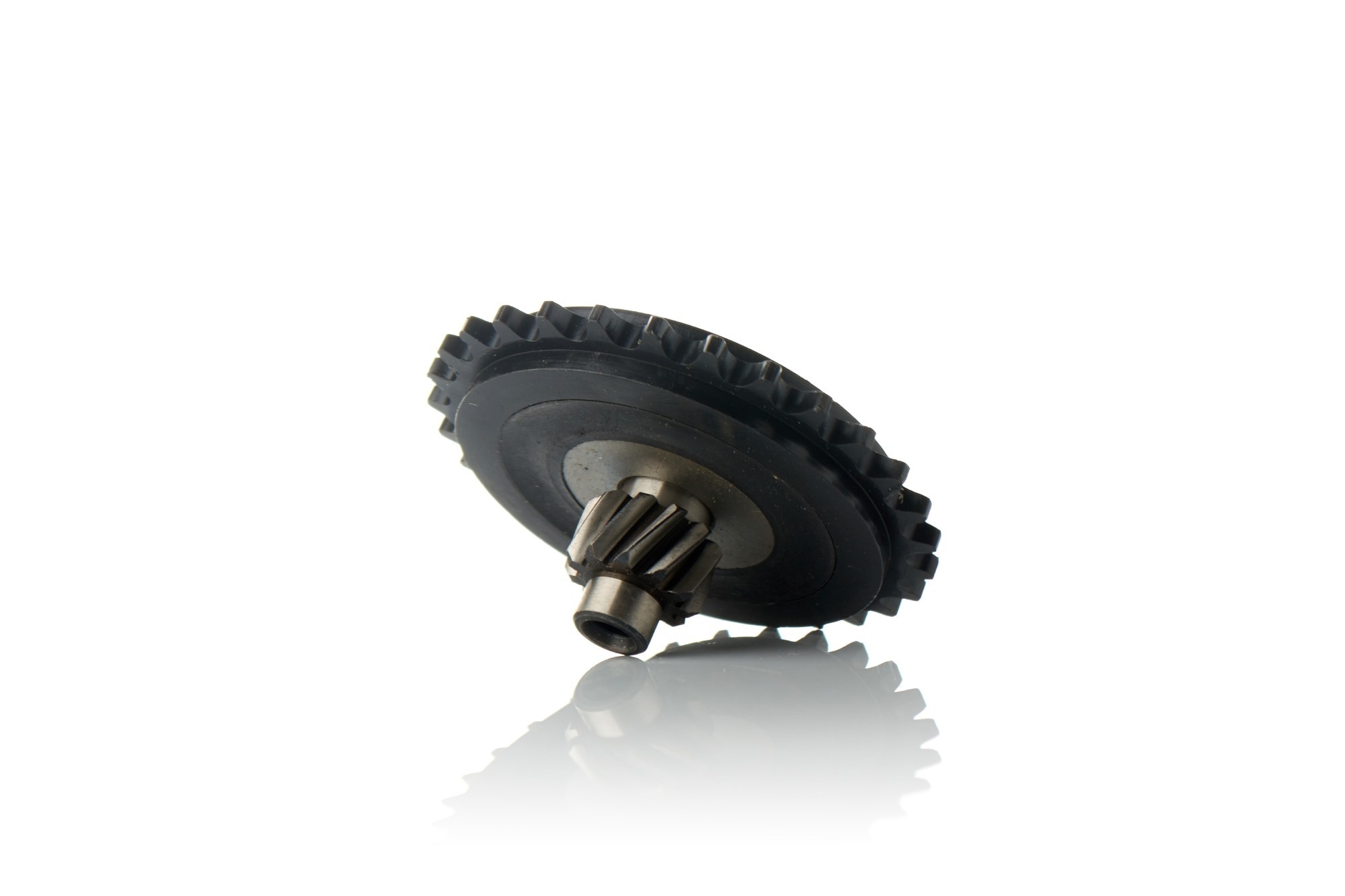
Engine oil pump drive gear featuring a durable black plastic outer cogwheel. Image Credit: AoedeRelaxin / Shutterstock
Introduction
Engineering plastic gears carry loads in printers, actuators, appliances, and automotive assemblies. These applications demand low weight, quiet operation, corrosion resistance, and economical, high-volume molding. Metal gears still dominate heavy power transmission, and polymers occupy the territory where moderate torque meets tight cost and acoustic targets. What a molded tooth achieves depends on how the polymer responds to contact pressure, sliding, and the heat they produce.1
Selecting a polymer gear goes far beyond comparing tensile strength values. A single strength figure describes none of the behavior that decides gear performance, such as tooth deflection under load, heat generated in the mesh, the rate at which the flank loses material, and the sound the drive radiates after long service. Material choice determines those quantities and the service life that follows from their interaction.2
Among the engineering thermoplastics widely used or investigated for gears are POM, PA, PBT, and PEEK:2,4,6,7,8
- Polyoxymethylene (POM) anchors precision gearing.
- Polyamide (PA), mainly PA6 and PA66, supplies toughness and damping.
- Polybutylene terephthalate (PBT) offers stiffness with modest moisture uptake.
- Polyether ether ketone (PEEK) improves the temperature and load envelope.
Mating-material selection is equally important because polymer-polymer and polymer-steel gear pairs behave differently.3
What Properties Make a Good Engineering Plastic for Gears
Mechanical Properties
Elastic modulus governs tooth stiffness, which controls how load spreads across the contact and between neighboring teeth. Bending strength establishes the margin against root failure, and fatigue resistance determines how many bending cycles the root can withstand. Similarly, creep involves accumulated deformation under sustained torque, and impact resistance addresses sudden loads from motor start-up or jamming. Lower modulus increases tooth compliance and alters load sharing, while the comparatively high internal damping of many polymers can reduce transmitted vibration.4
Tribological Properties
The coefficient of friction between flanks controls sliding resistance and the heat delivered into each tooth surface. Adhesive wear removes material through local bonding and transfer, while abrasive wear cuts the softer flank with asperities from the harder counterface. Polymer transferred onto that counterface can lower friction once running-in ends. The initial surface roughness and the choice of mating material determine whether such a film forms.5
Thermal Properties
Thermoplastics conduct heat poorly compared with steel, so frictional energy remains near the flank where it is generated. Thermoplastic modulus and strength are strongly temperature-dependent, with softening behavior governed by molecular mobility, crystallinity, glass-transition behavior, and, at higher temperatures, proximity to melting; thermal expansion shifts the center distance and backlash; and melting behavior sets the absolute ceiling. Heat generation and heat dissipation, therefore, belong to one selection decision rather than to separate stages of the design calculation.6
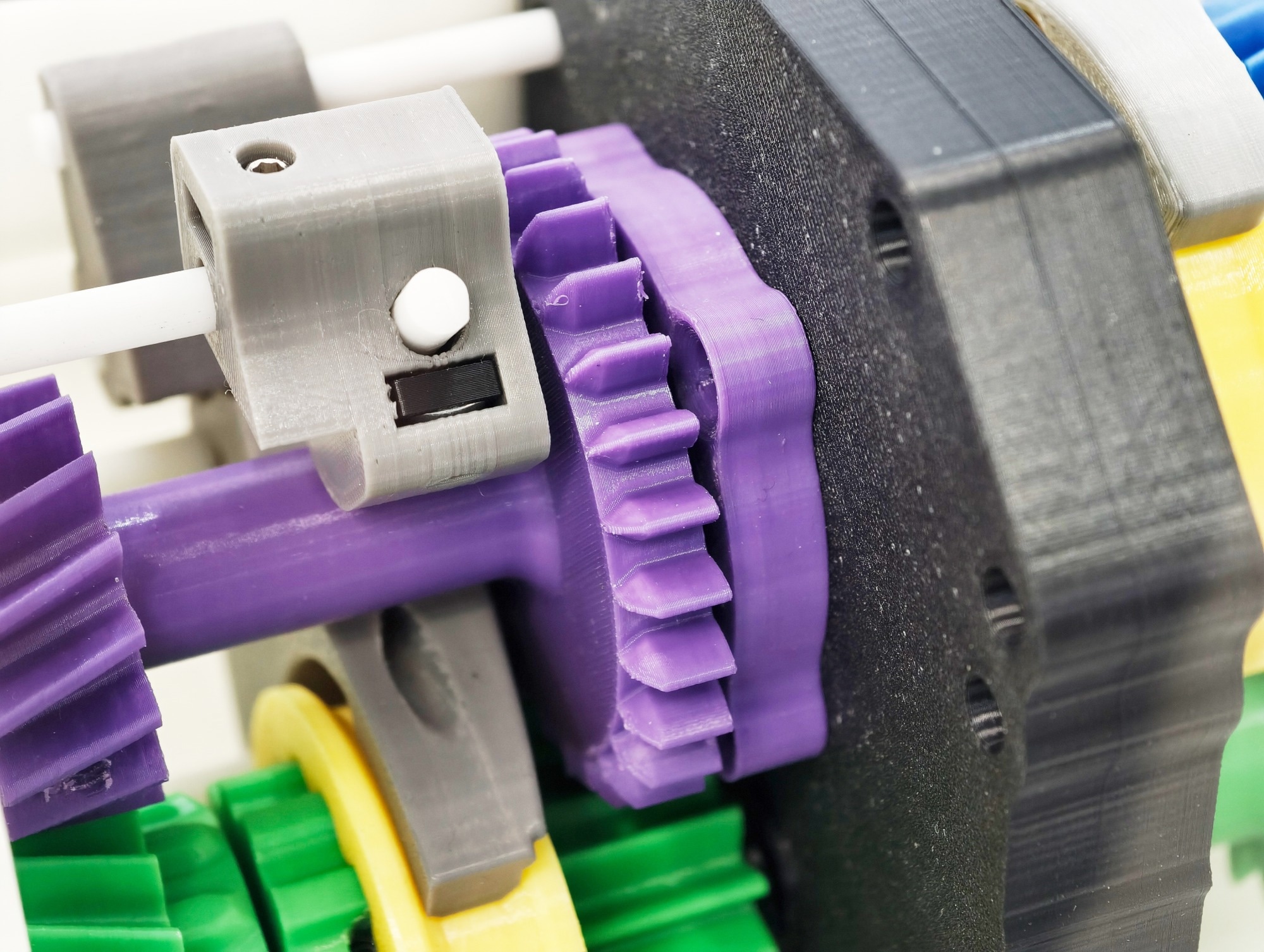
Plastic products created using advanced 3D printing technology. Image Credit: Nordroden / Shutterstock
POM as the Benchmark Material for Precision Plastic Gears
POM has become the benchmark polymer for precision gearing and is widely selected for gears because of its high mechanical strength, low coefficient of friction, and cost-effectiveness.4
However, these advantages are accompanied by certain limitations inherent to its chemistry. The load capacity drops as flank temperature rises, which caps continuous torque and speed. Repeated root bending nucleates fatigue cracks that propagate toward tooth fracture, and sustained loading induces creep that alters the mesh geometry before any fracture occurs. Recent POM tooth-root damage modeling shows a nonlinear dependence of lifetime on rotational speed; the location of the lifetime maximum shifts with torque, consistent with competing mechanically driven and thermally driven damage effects.4
Continuous measurement of POM gears running against steel resolves the wear history into stages. An early running-in phase reshapes the flank rapidly as high asperities flatten and the real contact area grows. Material loss then varies with position along the tooth height. A slower steady-state regime follows once the surface condition and contact geometry stop changing rapidly, meaning an early wear rate severely overstates full-life damage.5 In the investigated POM-steel tests, the first roughly 30,000 load cycles formed the running-in regime, after which wear became position-dependent and then approximately linear at the characteristic flank positions.5 At 70 °C, the POM gear in these tests conformed more uniformly to the steel flank and reached the wear criterion after more cycles than at 30 °C.5 This result is condition-specific: elevated temperature generally lowers polymer stiffness and fatigue strength, so a different failure mechanism can reverse the lifetime trend.5,7
Polyamide Gears and Their Environmental Trade-Off
PA6 and PA66 have established their significance in gearing applications due to their toughness. Polyamides can absorb and dampen vibration and are therefore attractive where low operating noise is important.3,6 POM/PA combinations are also specifically identified in the literature as capable of improving wear performance when the drive and driven materials are appropriately assigned.7
Environmental sensitivity is the cost. Polyamides absorb ambient moisture, which swells the part, shifts tooth dimensions, and plasticizes the matrix, while stiffness also varies with temperature across normal operating conditions.6 The resulting dimensional sensitivity means that moisture as well as temperature must be included when specifying backlash and tolerances for PA gearing.6
PBT gear behavior reflects the combined effects of elastic tooth deflection, permanent deformation, thermal expansion, and flank wear.2 In situ testing separates three effects that occur together: elastic deflection recovers each cycle, permanent deformation accumulates locally, and wear removes profile. Tests of PBT gears meshing with steel showed that both wear and deformation increased with increasing rotational speed and transmitted torque.2 Loading torque had a particularly strong influence on tooth-flank wear, while severe operating conditions could superimpose wear and plastic deformation.2
PEEK for High-Temperature and High-Load Gearing
PEEK should be classified as a high-performance material rather than a general-purpose one. In the additive-manufactured material comparison, PEEK had the highest listed continuous-use temperature of the three tested materials and showed substantially less tooth-surface change during operation than ABS M-30 or ULTEM 9085.8
Moreover, PEEK is resistant to aggressive chemicals and performs well under demanding sliding contact conditions. The printed-gear study identifies PEEK as resistant to abrasive wear, high temperatures, most chemical reagents, and dimensional changes at elevated temperatures.8
Comparative tests of gears made from PEEK, Polyetherimide (PEI), and Acrylonitrile Butadiene Styrene (ABS) using extrusion-based printing methods indicate that wear is influenced by the polymer used, the manufacturing process, and the specific contact conditions. In those tests, PEEK underwent only slight changes in initial surface topography, whereas ULTEM 9085 showed the greatest wear. Because different printers, layer thicknesses, and fill levels were used, the results should not be treated as a universal material ranking independent of manufacturing conditions.8
Flank durability varies substantially between high-temperature polymers, which argues for testing candidates under the intended duty. Oil lubrication improves thermal stability and suppresses wear, but it can also shift the governing failure mechanism toward fatigue damage: in oil-lubricated unreinforced PEEK tests, little profile loss from wear was observed before pitting became the termination criterion.1
Carbon-fiber reinforcement cannot be assumed to improve every aspect of PEEK gear performance. The added fibers improve mechanical properties and can benefit tooth-root load-carrying capacity, but the oil-lubricated tests found a rougher flank, a thinner specific lubricant film, pronounced abrasive wear combined with pitting, and lower tooth-flank load-carrying capacity than for the unreinforced PEEK variant.1 For the test conditions reported, the specific lubricant-film parameter fell from about 1.6 for unreinforced PEEK to 0.6 for the carbon-fiber-reinforced grade.1 Material reinforcement must therefore be evaluated against the particular failure mode: greater stiffness or root strength can be obtained at the cost of poorer flank tribology.1
Why Polymer Gears Wear
Running-In and Tooth-Flank Wear
The position along the tooth influences the development of wear. Near the pitch line, the flanks engage with minimal relative sliding, while the sliding velocity increases toward the tip and into the dedendum, then reverses direction across the pitch point. This sliding action generates frictional work and accelerates abrasive removal, leading to greater material loss in those areas over time. Consequently, the involute experiences distortion rather than a uniform reduction in thickness.5 As that profile evolves, contact pressure redistributes along the flank, so wear progressively changes the conditions that generate subsequent wear.5
Why Torque and Speed Matter
Experiments consistently show that increasing transmitted torque and rotational speed can accelerate polymer-gear wear and deformation.2,5 In the POM-steel wear tests, higher torque and speed reduced the number of cycles required to reach the wear-failure criterion, while the POM tooth-root study demonstrated that lifetime does not vary monotonically with speed: a local lifetime maximum occurred within the tested speed range.4,5
Frictional heating operates as a feedback loop. When there is sliding contact, heat is generated at the gear flank. This increase in temperature reduces the polymer's modulus, causing the softened tooth to deflect further. As a result, the contact area and contact path change, which can create additional heat and further material loss. Low thermal conductivity keeps heat near the surface, where it most significantly affects strength and wear.1
Three temperatures are important for a running plastic gear: the flank temperature, the bulk temperature, and the ambient temperature. The flank temperature peaks briefly during engagement and is crucial for surface softening. The bulk temperature governs stiffness loss and fatigue strength, while the ambient temperature establishes the baseline for heat rejection into the housing. Hybrid gears with a polymer rim on a conductive core can redirect heat away from the mesh, affecting both measured temperature and wear.6 In FDM-produced PA hybrid gears, aluminum inserts lowered bulk temperature by as much as 9 °C, or 17%, relative to the all-polymer gear at 2.9 Nm and also produced the smallest measured material loss of the tested configurations.6
The acoustic advantage of polymer gears is rooted in physics. Greater tooth compliance can reduce some high-frequency mesh excitation, while the comparatively high internal damping of many polymers dissipates vibrational energy within the gear and limits its transmission through the shafts and housing. Excessive compliance, however, can increase transmission error, so low modulus alone does not guarantee quiet operation. Also, a lower mass reduces the inertia that drives impulsive contact. These characteristics are among the reasons polymer gears are used where low vibration and reduced operating noise are important.3
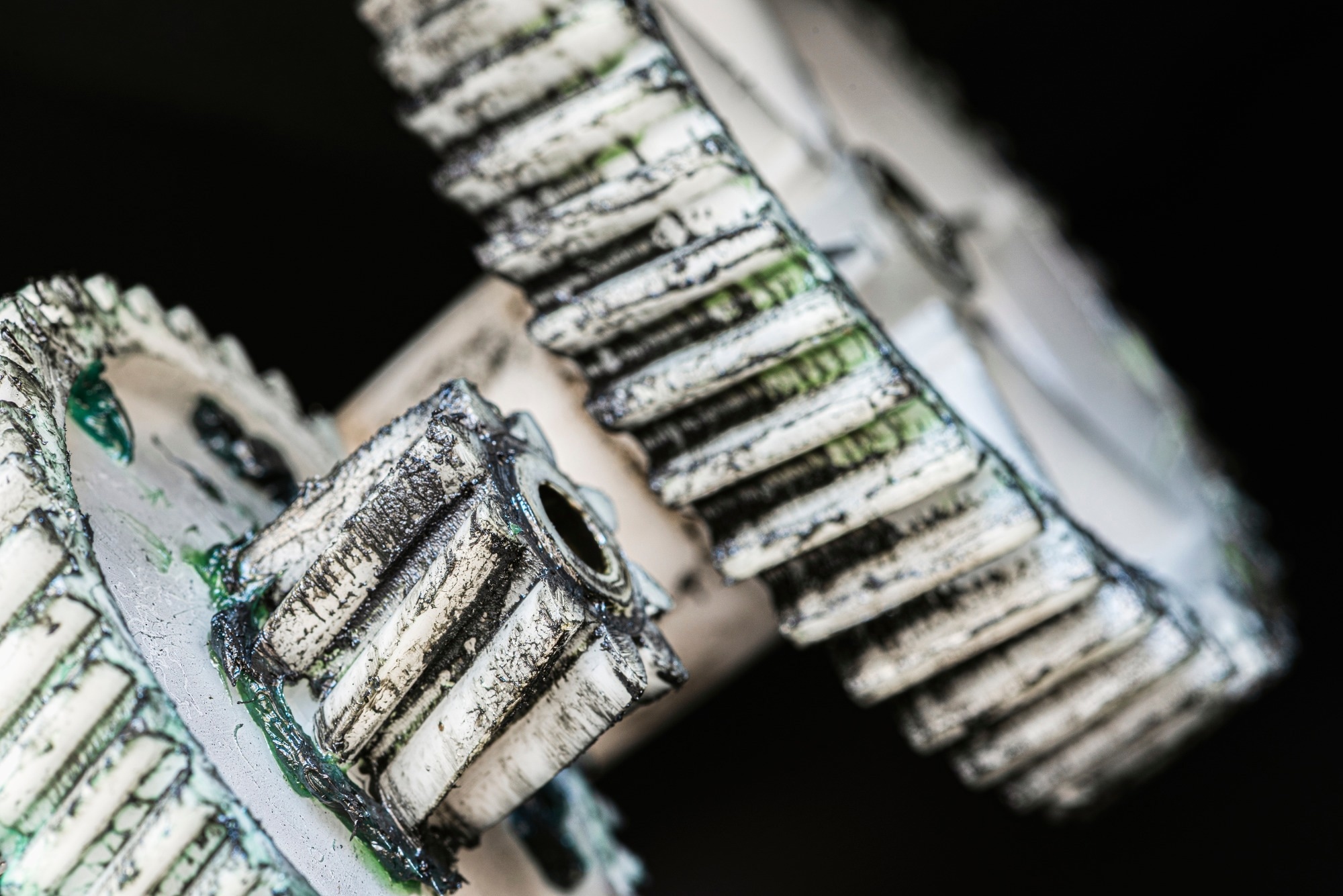
Worn plastic gears with grease, mechanical components of household appliances. Image Credit: Flegere / Shutterstock
Under the right conditions, a polymer gear can operate quietly. Measured sound pressure depends on tooth stiffness, transmission error, friction, sliding velocity, applied torque, surface condition, tooth geometry, and accumulated wear. Noise evaluation of POM and PA66 pairs found that sound pressure varied with both the applied load and the tooth profile design, placing geometry and duty cycle alongside polymer selection in any realistic acoustic prediction.3 For both conventional involute E-gears and S-gears in that study, sound-pressure level was proportional to torque, and S-gears showed an acoustic advantage under normal loading and typical drive speed.3
Gear Noise and Transmission Error - Gear Training from the British Gear Association
How Wear Changes Gear Noise Over Time
Wear changes acoustic behavior because material loss alters flank geometry, friction, transmission error, and mesh stiffness.3,6
Polymer-gear noise does not necessarily rise continuously from the start of operation.3 In POM/PA66 tests, sound pressure was slightly higher during running-in, declined somewhat during the wear-in phase as operating temperature increased, and then rose sharply during severe surface degradation, by more than 10 dB shortly before final failure.3 FDM PA gears showed a compatible early-life pattern: initially elevated noise and vibration decreased after wear-in, while later flank degradation worsened meshing, increased temperature, and reduced transmission efficiency.6
Polymer-Polymer or Polymer-Steel Pairings
Polymer-polymer pairs minimize mass, produce less noise, resist corrosion, and operate without lubricants, making them suitable for consumer products and clean mechanisms. A POM/PA66 pair has been experimentally demonstrated as a practical low-noise combination, although its acoustic behavior still depends strongly on torque and tooth geometry.3
On the other hand, polymer-steel pairs offer increased stiffness, and the steel member can act as a heat sink, partially compensating for the polymer's poor thermal conductivity.5 Steel flank topography can strongly influence polymer wear because asperities on the harder counterface can promote abrasive removal. The counterface and its surface condition therefore form part of the material-pairing specification rather than acting as a neutral mating component.5,6
Dry Running Versus Lubricated Polymer Gears
Many plastic gears are intentionally designed to operate without lubrication. Suitable polymer pairings can operate without external lubrication at modest duty, provided tribological compatibility keeps wear and temperature within acceptable limits; removing oil eliminates the need for seals, reservoirs, contamination risk, and maintenance in the product. This simplicity benefits appliances, office machines, and small actuators alike, forming a significant part of the economic rationale for using molded gearing in high-volume consumer and industrial equipment.8
However, lubrication becomes attractive as duty intensifies through higher load, higher speed, longer required life, or temperatures approaching the polymer limit. Oil reduces friction, suppresses flank wear, and transports heat from the contact. It also changes which mechanism ends gear life, since teeth that stop losing material continue accumulating stress cycles, and fatigue mechanisms such as root fracture and flank pitting become comparatively more important.1 For oil-lubricated unreinforced PEEK, wear was sufficiently limited for pitting to emerge as the principal flank damage at the termination criterion.1
Injection Molding, Crystallinity, and Gear Accuracy
Material designation alone does not describe a molded gear. In the injection-molding experiments, mold temperature and cooling time had the strongest measured effects on POM crystallinity, whereas melting temperature, packing pressure, and packing time did not significantly influence crystallinity within the tested parameter range.7 Higher mold temperature and longer cooling also tended to improve the resulting gear geometry.7 Shrinkage variation distorts tooth thickness, pitch, and lead. Those deviations concentrate load on individual teeth and shift contact across the face width, raising flank pressure and root stress above nominal design values for the same polymer grade.7 Improving lead-deviation quality from approximately Q12 to Q10 reduced stresses by about 30% to 80%, depending on load, while improving from Q10 to Q8 produced a smaller reduction of about 5% to 20%.7
Additive Manufacturing and Polymer Gears
Additively manufactured gears cannot be characterized by nominal polymer identity alone because the printing process and print quality directly affect tooth-flank geometry and surface roughness.6,8 The ABS M-30, ULTEM 9085, and PEEK study found process-related topographic defects and different levels of post-test surface change, while the PA study showed that higher print quality reduced roughness, heating, and wear. Results obtained for one printer, process, layer thickness, or fill level should therefore not be transferred directly to molded gears or to a different additive process.6,8
3D printer working close-up. Image Credit: MarinaGrigorivna / Shutterstock
What Ultimately Limits Polymer Gear Service Life
Tooth wear reduces gear life by changing the shape of the teeth. As the teeth wear down, they become thinner, create gaps, and no longer mesh correctly. This leads to increased impact and transmission errors. Tooth-root fatigue causes failure through cracks. Each time the teeth engage, they bend. Over time, repeated bending creates cracks in the most stressed areas, eventually causing the tooth to break off the gear.5
Excessive deformation leads to failure through malfunction. High temperatures and material softening bend the teeth outside the acceptable range while keeping them intact. Thermal failure occurs quickly once the flank temperature reaches the softening range, resulting in plastic flow or local smearing at the contact. The principal failure classes identified in the literature are tooth-root or flank fatigue, wear, and thermal overload with severe plastic deformation; in lubricated operation, pitting can become particularly prominent because wear is suppressed and fatigue cycles accumulate.1,7
Predicting Polymer Gear Service Life
Strength values alone cannot predict gear lifetime. A credible calculation needs torque, speed, ambient and flank temperature, tooth geometry, strain rate, material nonlinearity, wear rate, lubrication, and the mating gear. VDI 2736 provides the established framework, and current research extends it, with recent POM damage modeling questioning rigid-body and linear-elastic assumptions because a thermoplastic tooth deforms viscoelastically and changes its properties as the contact heats up.4 The bi-parametric model combines nonlinear viscoplastic finite-element behavior with two competing damage contributions associated with mechanical molecular-bond destruction and thermal degradation. It reproduced the observed nonlinear speed dependence at two torque levels within the experimental scatter band, although predictive accuracy declined at the lower torque as root-geometry influence increased.4
Choosing an Engineering Plastic for Gear Applications
POM is a widely used choice where mechanical strength, low friction, and cost are important, but its suitability still depends on temperature, rotational speed, torque, wear mode, and whether tooth-root fatigue or flank wear governs the required life.4,5 PA can be attractive where vibration damping and low noise are valuable, but moisture absorption and temperature-dependent properties must be accounted for in dimensional and load-capacity calculations; no single polyamide can be considered universally optimal for quiet gearing because geometry, load, and operating temperature also govern acoustic behavior.3,6
PBT can provide effective gear performance, but its time-dependent wear and deformation rise with increasing torque and rotational speed and must be checked against the intended duty.2 PEEK extends the usable temperature and performance range, but reinforcement must be selected carefully: carbon fibers can improve mechanical and root-load properties while worsening flank roughness, lubricant-film conditions, wear, and pitting under some operating conditions.1,8 PEI/ULTEM 9085 also requires application-specific validation: in the cited additive-manufactured comparison, it showed greater wear than either PEEK or ABS M-30.8
Conclusion
Wear follows from the combined effects of chemistry, stiffness, friction, temperature, and the mating material, progressing through distinct regimes rather than at a single fixed rate. Noise arises from damping, tooth deformation, friction, and changes in geometry and profile introduced by wear. Service life emerges from the interaction between material properties and operating conditions, so a sound selection evaluates the entire gear pair over its intended duty cycle.4 Simple material rankings can therefore be misleading: warmer POM produced milder wear under one POM-steel condition, carbon-fiber PEEK suffered poorer flank behavior than unreinforced PEEK under the tested oil lubrication, and manufacturing quality measurably altered stress, temperature, and wear.1,5,6,7
References
- Illenberger, C. M., Tobie, T., & Stahl, K. (2022). Operating behavior and performance of oil-lubricated plastic gears. Forsch Ingenieurwes 86, 557–565. DOI:10.1007/s10010-021-00513-7. https://link.springer.com/article/10.1007/s10010-021-00513-7
- Herzog, C. et al. (2022). In situ investigation of the influence of varying load conditions on tooth deformation and wear of polymer gears. Forsch Ingenieurwes 86, 545–555. DOI:10.1007/s10010-022-00591-1. https://link.springer.com/article/10.1007/s10010-022-00591-1
- Trobentar, B. et al. (2022). Noise evaluation of S-polymer gears. Polymers, 14(3), 438. DOI:10.3390/polym14030438. https://www.mdpi.com/2073-4360/14/3/438
- Düzel, S. et al. (2025). Bi-parametric damage model for the lifetime prediction of POM gears. Forsch Ingenieurwes 89, 92. DOI:10.1007/s10010-025-00870-7. https://link.springer.com/article/10.1007/s10010-025-00870-7
- Osolnik, N., & Kalin, M. (2026). In situ wear-progression measurement in POM-steel gear contacts. Wear, 594, 206674. DOI:10.1016/j.wear.2026.206674. https://www.sciencedirect.com/science/article/pii/S004316482600164X
- Šuljic, I. et al. (2024). Experimental Analysis on Hybrid Polymer Gears Produced with Fused Deposition Modeling Method: Thermal Behavior and Wear. Applied Sciences, 14(24). DOI:10.3390/app142411509. https://www.mdpi.com/2076-3417/14/24/11509
- Zorko, D. (2023). Effect of Process Parameters on the Crystallinity and Geometric Quality of Injection Molded Polymer Gears and the Resulting Stress State during Gear Operation. Polymers, 15(20). DOI:10.3390/polym15204118. https://www.mdpi.com/2073-4360/15/20/4118
- Pisula, J. et al. (2021). An Analysis of Polymer Gear Wear in a Spur Gear Train Made Using FDM and FFF Methods Based on Tooth Surface Topography Assessment. Polymers, 13(10). DOI:10.3390/polym13101649. https://www.mdpi.com/2073-4360/13/10/1649
Disclaimer: The views expressed here are those of the author expressed in their private capacity and do not necessarily represent the views of AZoM.com Limited T/A AZoNetwork the owner and operator of this website. This disclaimer forms part of the Terms and conditions of use of this website.