The new CAMSIZER X2+ is ideal for substantially improving the quality control of fine powders and suspensions. More precise and rapid analysis of particle shape and particle size helps to enhance the product quality, save labor costs, energy and raw materials, and reduce rejects.
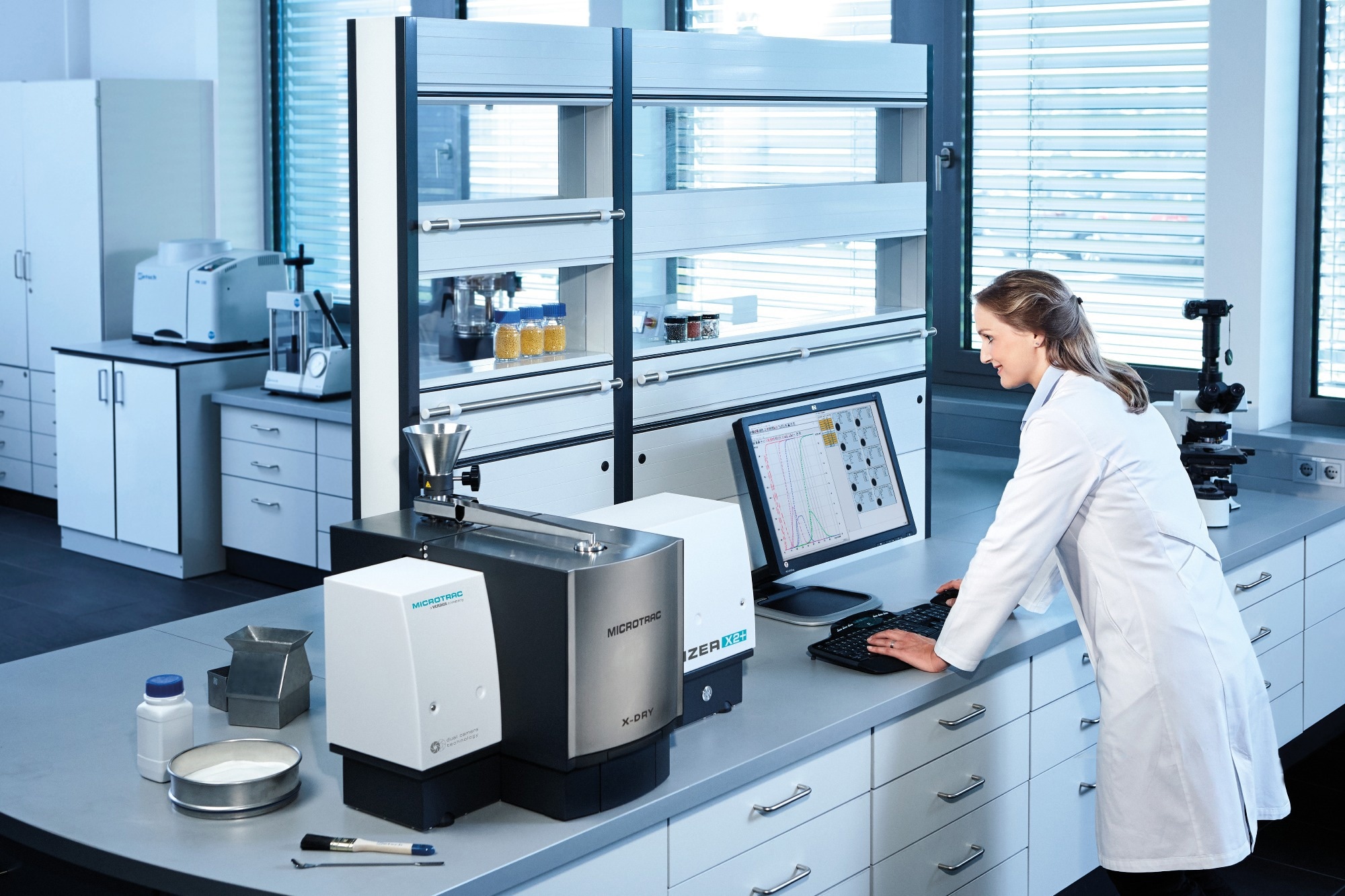
Image Credit: Microtrac
The CAMSIZER X2+ is a highly powerful and versatile particle size and shape analyzer, offering an exceptionally broad measuring range. Combining advanced camera technology with adaptable dry and wet dispersion options, it delivers state-of-the-art performance. Operating according to Dynamic Image Analysis (ISO 13322-2), the system provides precise particle size and shape characterization of powders, granules, and suspensions across a measuring range of 0.9 μm to 8 mm.
The CAMSIZER X2+ generates a controlled particle flow that is captured by a high-resolution optical system. Equipped with ultra-bright LED stroboscopic light sources and two high-resolution digital cameras, it achieves frame rates exceeding 420 images per second. These images are processed and analyzed in real time by powerful software. As a result, hundreds of thousands to several million particles can be measured with exceptional accuracy in just 1 to 3 minutes.
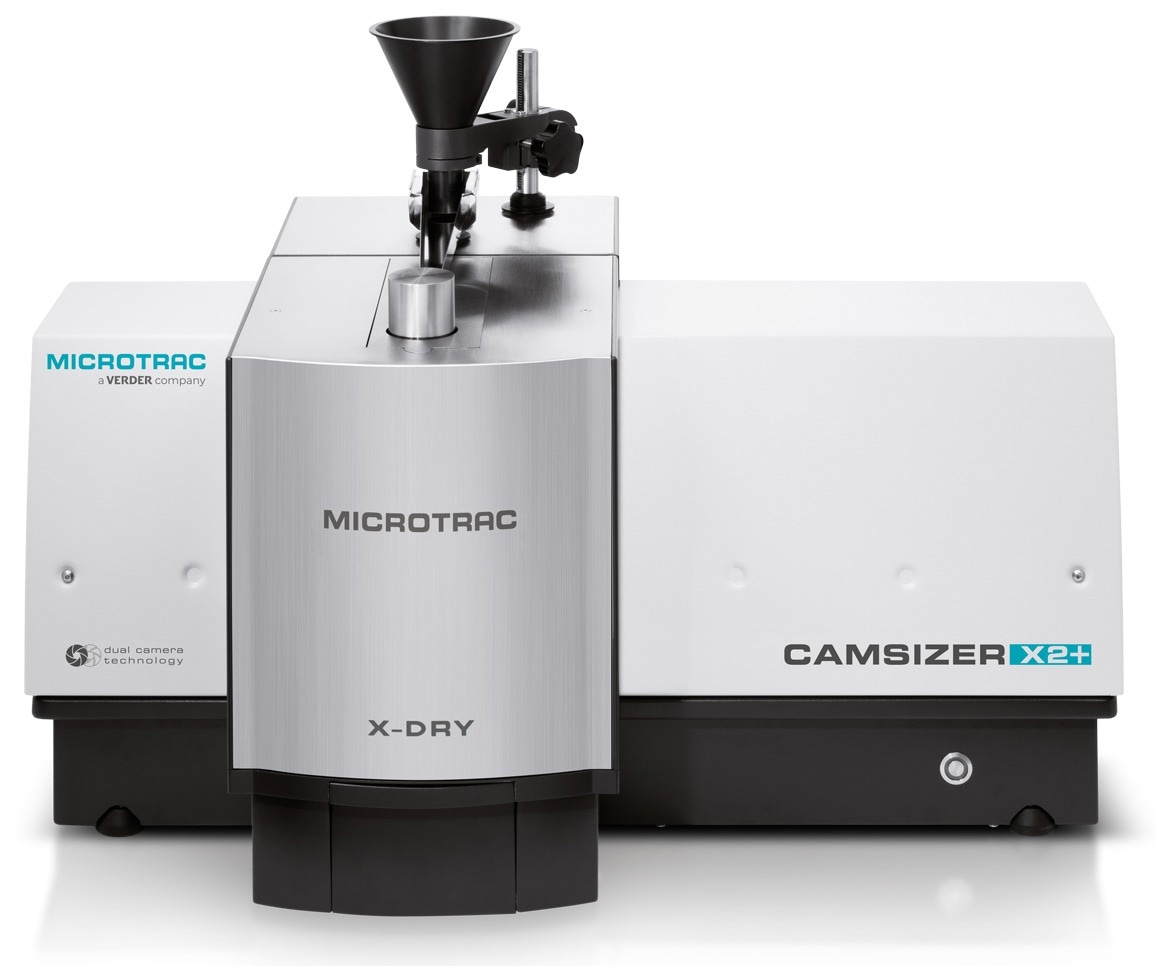
Image Credit: Microtrac
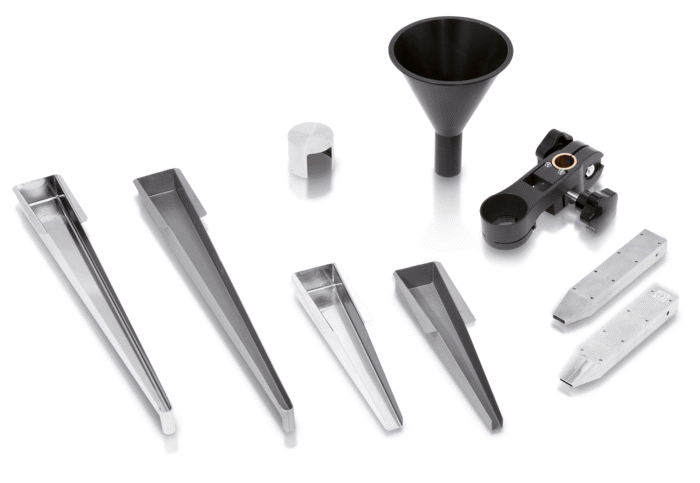
Image Credit: Microtrac
Application Examples
abrasives (medium-size and small grit), cement, chemicals, construction materials, activated carbon, detergents and enzymes, foodstuffs,, glass / glass beads, metal and ore powders, pharmaceutical powders / granules / fine pellets, plastic powders, plastic fibers, salts, sugar, wood fibers, sand, refractory materials
Product Advantages
- Dynamic Image Analysis (ISO 13322-2) for particle size and shape measurement from 0.9 µm to 8 mm
- High-resolution detection of both wide distributions and narrow or multimodal particle populations
- Reliable identification of trace amounts of oversized and undersized particles
- Results fully comparable to traditional sieve analysis and laser diffraction methods
- Comprehensive evaluation capabilities, including multiple size models, extensive shape parameters, particle library access, and single-frame analysis
- Exceptional reproducibility for consistent, dependable results
- Fast measurement times of 1–3 minutes enabling high sample throughput
- Modular X-Change system for seamless switching between dry and wet dispersion
- Ultra-bright LED illumination combined with high-resolution cameras for maximum image clarity
- User-friendly operation with minimal maintenance requirements
Features
| . |
. |
| Measuring principle |
Dynamic Image Analysis (ISO 13322-2) |
| Measuring range |
Standard
0.9 µm to 8 mm
10 µm to 8 mm (gravity dispersion)
0.9 µm to 5 mm (air pressure dispersion)
0.9 µm to 1 mm (wet dispersion |
| Type of analysis |
dry and wet analysis |
| Measuring time |
~ 1 to 3 min (depends on desired measuring statistics) |
| Number of cameras |
2 (Dual Camera Technology) |
| Sample volume |
< 20 mg - 500 g (depends on sample type and measurement mode) |
| Camera performance |
> 420 images/s, each with approx. 5.0 MPixel |
| Width of analysis area |
~ 350 mm2 |
| Resolution |
0.9 µm per pixel |
| Measurement parameters |
particle size (smallest diameter, length, mean diameter, etc.) particle shape (aspect ratio width to length, symmetry, sphericity, convexity etc., acc. to ISO 9276-6) |
| Dimensions (W x H x D) |
~ 850 x 580 x 570 mm |
| Weight (Measuring unit) |
~ 50 kg |
| Operating unit |
Quad Core PC incl. Windows 11, monitor, keyboard and mouse, network card, PC interface cards for hardware communication, evaluation software |
Function Principle
The CAMSIZER X2+ makes use of the principle of Digital Image Analysis (DIA). The patented principle is reasonably simple: Dispersed particles travel in front of two bright, pulsed LED light sources. Two digital cameras are used for capturing the shadows of the particles.
One camera is optimized to examine the small particles with high resolution, the other camera for identifying the big particles with a good statistic, that means large field of view. Each camera is illuminated by one LED with optimized brightness, field of view and pulse length. A user-friendly software is used for analyzing the shape and size of each particle, and it finally calculates the respective distribution curves in real-time.