From salt spray and icing to abrasion and UV exposure, the review maps the weak points that could determine whether water-repellent coatings survive demanding defense service.
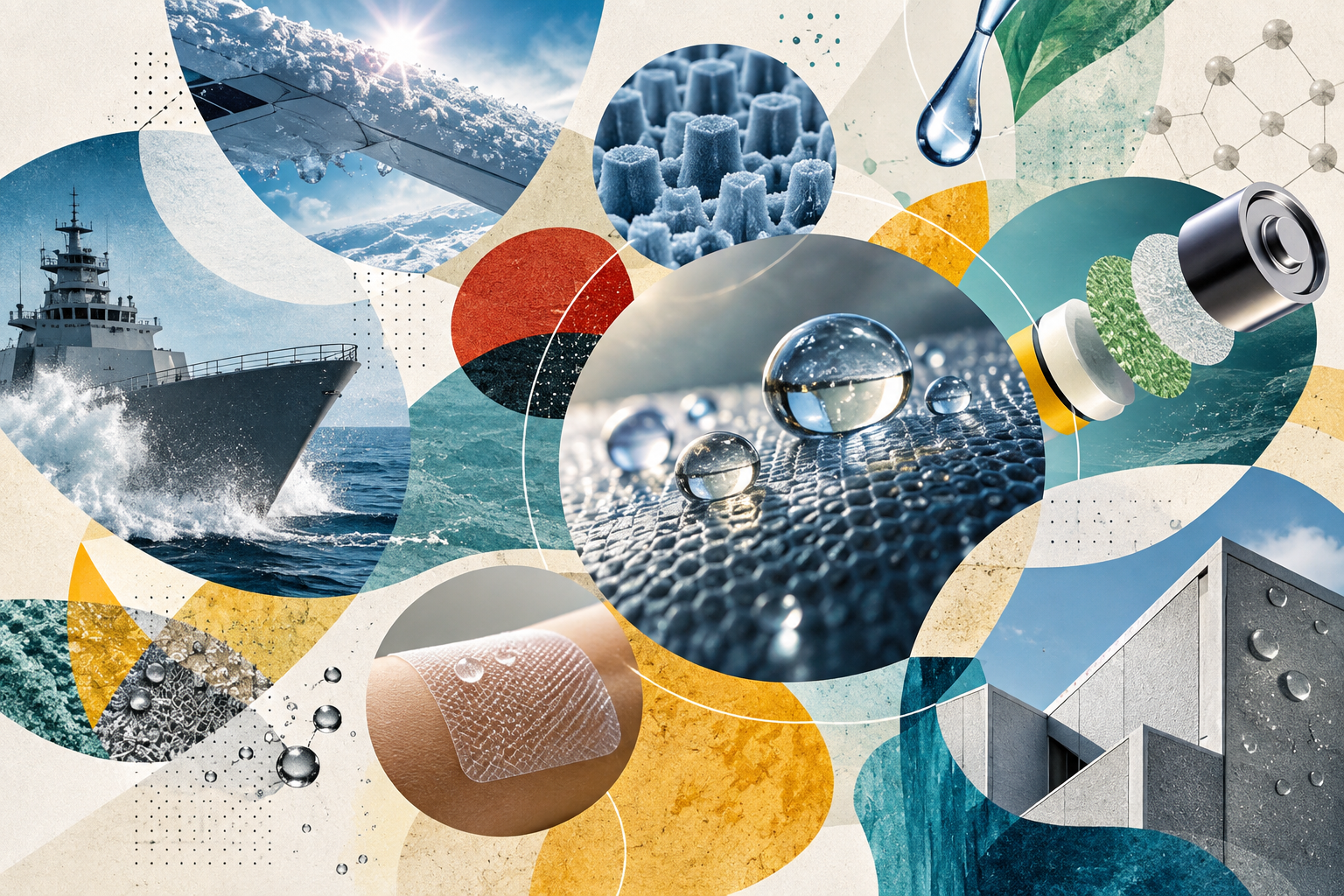
Paper: Durable superhydrophobic materials: Advanced fabrication, applications, and industrial challenges. AI-generated abstract conceptual image created using ChatGPT/OpenAI
A recent review published in the journal Colloid and Interface Science Communications explores the development of durable superhydrophobic materials, focusing on advanced fabrication strategies, failure mechanisms, functional applications, and the challenges associated with industrial implementation. The review focuses on durability and classifies material failure according to structural degradation, loss of low-surface-energy chemistry, and coating–substrate interfacial failure.
Addressing the Durability Challenge in Superhydrophobic Materials
Superhydrophobic materials combine hierarchical surface roughness with low-surface-energy chemistry to produce exceptionally high water contact angles and low water adhesion. These features stabilize the Cassie–Baxter wetting state, where water rests partly on trapped air rather than fully wetting the surface, allowing water droplets to roll across surfaces and remove contaminants. Such properties make durable superhydrophobic materials attractive for defense applications, where equipment and protective surfaces may be exposed to moisture, saltwater, icing, abrasion, and other harsh environmental conditions.
Yet, maintaining superhydrophobicity during prolonged operation remains a major challenge. Mechanical abrasion can damage micro- and nanostructures, while chemicals, ultraviolet radiation, temperature fluctuations, and environmental exposure can degrade low-surface-energy components. Because of this, surfaces that initially show excellent water repellency may lose their protective functionality during service.
Previous research has largely focused on achieving high water contact angles using various fabrication techniques. Yet, initial water repellency does not necessarily indicate long-term durability under demanding operating conditions. This review addresses this gap by organizing fabrication approaches and durability strategies according to the dominant failure mechanisms of superhydrophobic surfaces. This failure-based structure could help guide material selection and design for defense applications, where sustained performance and resistance to harsh environmental exposure are critical.
Evaluating Advanced Fabrication Strategies
The review examines a broad range of fabrication approaches, including template fabrication, chemical etching, electrospinning, self-assembly, solution impregnation, vapor and chemical deposition, electrodeposition, spray coating, and sol–gel processing. These techniques offer varying degrees of control over surface morphology, chemical composition, coating thickness, and substrate integration, which can influence their suitability for demanding defense environments.
Template-based methods generate well-defined hierarchical structures, while chemical etching can directly texture metallic substrates, reducing the risk of coating delamination. Hybrid laser–chemical approaches combine controlled microscale structuring with additional nanoscale roughness, offering a route to more wear-resistant protective surfaces. Electrospinning produces hierarchical fibrous architectures with high surface area. Fiber fracture and compaction can reduce mechanical durability, while pressure-driven Cassie-state collapse can limit the performance of electrospun membranes under transmembrane stress.
The review also highlights the importance of strong chemical anchoring. Covalent attachment improves chemical stability, while layer-by-layer assembly can add redundancy to hydrophobic layers. Conventional solution impregnation remains vulnerable to laundering, solvents, and hydrolysis if low-surface-energy components are not strongly anchored. PFAS restrictions now narrow the available formulation space and increase pressure to develop durable fluorine-free alternatives, but these alternatives can sacrifice repellency or durability.
Spray coating and sol–gel processing offer practical advantages for large-area treatment, modest processing requirements, and adaptable substrates, which are important for extending protective coatings across defense equipment. For spray coatings, thickness uniformity on complex contours remains a limitation. Yet, coating cohesion and substrate adhesion remain significant challenges. Stronger binders, hybrid matrices, and engineered intermediate interfaces can improve coating integrity and reduce delamination during prolonged service.
Materials and Failure Mechanisms Shape Surface Durability
The review demonstrates that the durability of superhydrophobicity depends on how surface structures respond to specific failure mechanisms. Structural damage can weaken micro- and nanostructures, but protective architectures and self-similar designs can shield delicate features and help restore water-repellent functionality after wear. Chemical durability depends on retaining low-surface-energy components during exposure to aggressive environments. Strong chemical bonding, self-healing systems, and replenishable chemistries can reduce functional loss after chemical or mechanical degradation.
The coating–substrate interface also plays a critical role. Weak adhesion can cause cracking, peeling, or complete removal of the coating, even when the surface structure and chemistry remain intact. Strong binders, hybrid matrices, and engineered interfaces can strengthen coating integrity under repeated mechanical stress.
The authors stress that water contact angle alone is insufficient for evaluating durability. Sliding angle, contact-angle hysteresis, and liquid impalement pressure provide additional information about droplet mobility and Cassie-state stability. Durability tests should match service conditions, including abrasion, particle impact, chemical exposure, ultraviolet irradiation, salt spray, scratching, and adhesion failure.
These durability strategies expand the potential of superhydrophobic materials for demanding applications. In defense systems, photothermal surfaces could support anti-icing, while some hierarchical and substrate-integrated surfaces can limit water and chloride penetration and improve corrosion protection. Low-adhesion surfaces may also reduce contamination and fouling. Emerging applications in drag reduction and protective coatings further suggest that superhydrophobic materials could support multifunctional defense materials designed for harsh operating environments.
Durable Superhydrophobic Materials for Defense Applications
Durable superhydrophobic materials offer promising opportunities for defense applications, but their performance must withstand prolonged mechanical, chemical, thermal, and environmental exposure. Defense equipment can encounter moisture, saltwater, abrasion, icing, and corrosive conditions, making long-term water repellency more important than a high initial water contact angle. Material design needs to address the specific stresses associated with each defense application.
Overall, the review highlights a shift from maximizing initial water contact angle to failure-aware, application-specific materials engineering. For defense systems, this approach matters because protective surfaces must retain their function throughout demanding service.
Future research needs to prioritize fluorine-free materials suited to large-area production, reliable substrate integration, and failure-matched durability testing under realistic service conditions. The authors also identify sprayable protected architectures, regenerative grid insulation, photothermal de-icing, and predictive wear design using machine learning as key research directions. Establishing clear structure–property–durability relationships will help researchers design superhydrophobic materials that deliver consistent long-term performance and support the development of more resilient protective technologies for defense systems.
Disclaimer: The views expressed here are those of the author expressed in their private capacity and do not necessarily represent the views of AZoM.com Limited T/A AZoNetwork the owner and operator of this website. This disclaimer forms part of the Terms and conditions of use of this website.