In this interview, AZoMaterials speaks with Dr. Aleksandra Mitrovic, Global Product Manager for Laser Diffraction at Anton Paar, and Andreas Wagner, Product Specialist in Particle Characterization at Anton Paar, about the latest advances in laser diffraction, integrated imaging, automation, and real-world industrial applications.
This interview summarizes the recent webinar presented by Dr. Aleksandra Mitrovic and Andreas Wagner - you can watch the webinar here.
Can you please introduce yourselves and your roles at Anton Paar?
Dr. Aleksandra Mitrovic: I serve as the Global Product Manager for Laser Diffraction at Anton Paar, a role I have held for the past eight years. Throughout this time, I have focused on particle characterization technologies, steadily expanding my expertise in laser diffraction and its practical applications. My responsibilities include guiding product development, shaping our global positioning strategy, and ensuring our instruments address the evolving needs of both research institutions and industrial customers.
Andreas Wagner: I work as a Product Specialist within Anton Paar’s particle characterization portfolio. In this capacity, I apply a range of techniques - particularly laser diffraction - with a strong emphasis on real-world applications. I support customers across various industries in implementing particle size analysis effectively, helping them translate measurement data into meaningful improvements in process and product.
Why is laser diffraction such a critical technique for particle size analysis?
Aleksandra: Particles play a critical role in both production processes and final product performance. In paints, particle size directly affects gloss and color intensity. In foods and cosmetics, it shapes texture and sensory feel. In the pharmaceutical industry, it can determine product performance and regulatory compliance. In cement, particle size has a direct impact on hydration behavior and strength development.
Laser diffraction provides fast, high-resolution particle size distributions, making it ideal for product optimization during development and for quality assurance in production.
Could you briefly explain the principle behind laser diffraction?
Aleksandra: Laser diffraction is based on the fact that particles of different sizes scatter light at different angles. Smaller particles scatter light at larger angles, and larger particles scatter at smaller angles.
Inside the instrument, particles pass through a laser beam. The scattered light is detected across a wide angular range and compared to theoretical models. From this comparison, we calculate how much of each size class is present. The result is a highly resolved particle size distribution.
There is increasing interest in combining laser diffraction with image analysis. Why is this important?
Aleksandra: Laser diffraction provides spherical equivalent volume-based data, which is statistically very robust. However, it does not directly deliver detailed particle shape information.
By integrating dynamic image analysis, we add real-time shape information. This is particularly valuable in R&D when establishing correlations between particle size, shape, and performance. In quality control, imaging helps detect outliers or contamination that might otherwise go unnoticed.
Andreas: From an application perspective, shape analysis helps explain deviations in performance. For example, irregular or elongated particles may behave very differently in flow or packing compared to spherical ones. Combining size and shape in a single workflow provides a deeper understanding of materials.
What distinguishes the Litesizer DIF series from other laser diffraction instruments?
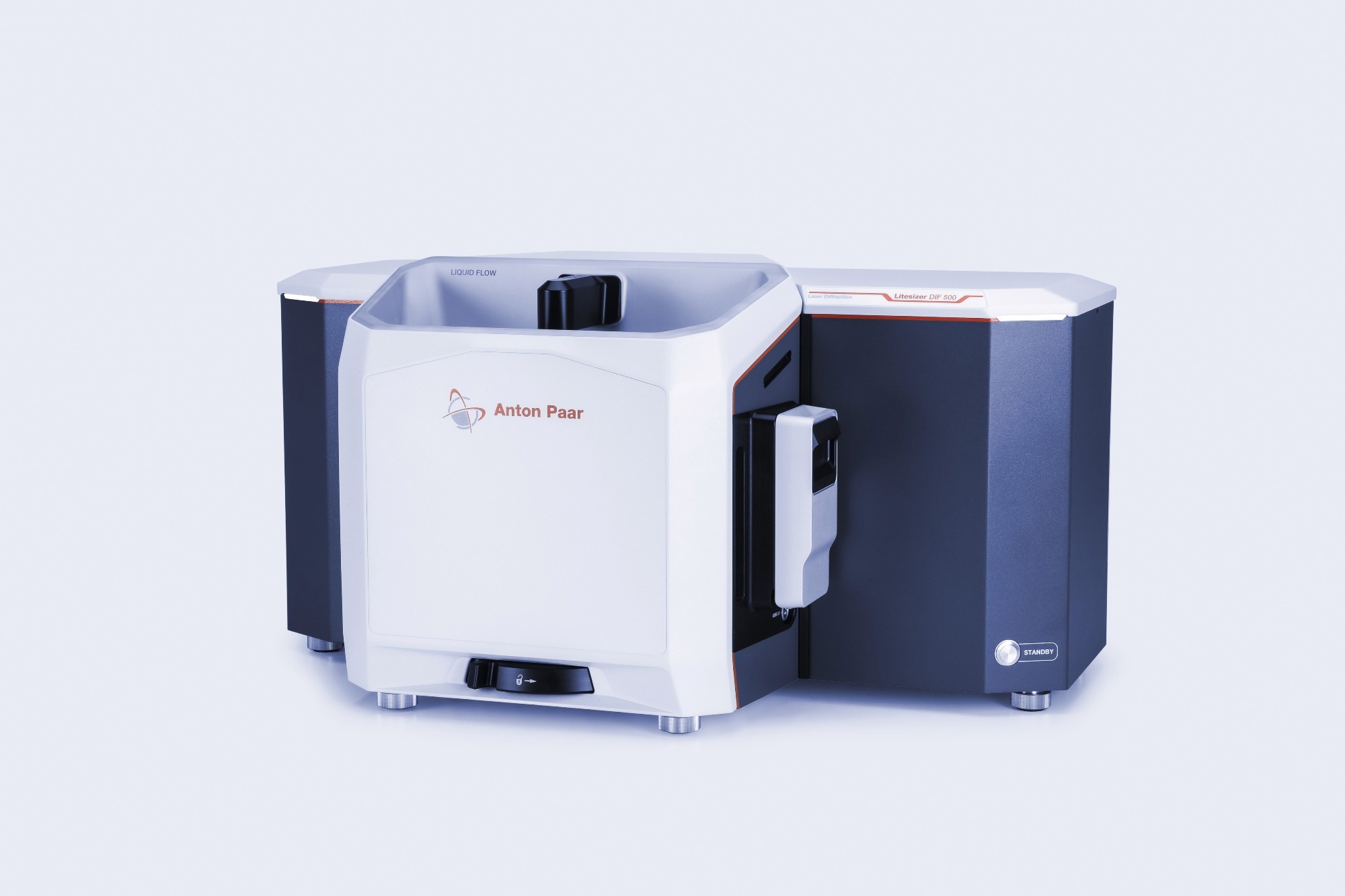
Aleksandra: Robustness is one major differentiator. The instrument features solid metal housing, shock-absorbing elements, and an internal fine dust filter protecting the optical bench. This ensures stable performance even in demanding industrial environments.
We also use high-quality solid-state lasers with a 10-year warranty. Their highest power on the market ensures an excellent signal-to-noise ratio, enabling reliable analysis even for very small sample amounts. Additionally, we cover the widest angle range on the market and offer fastest data acquisition.
How flexible is the system in terms of dispersion options?
Aleksandra: Dispersion is essential because particles must be properly separated before measurement.
We offer both liquid and dry dispersion units that can be exchanged within seconds. The system automatically detects the module, and no cables or tubing need to be connected manually.
The liquid units support volumes from 150 to 600 milliliters and include ultrasonic dispersion, automatic filling and draining, tank illumination, and concentration indicators. The dry jet unit measures powders from 100 nanometers up to 3.5 millimeters and includes built-in safety features for dust control.
What role does automation play in modern laser diffraction workflows?
Aleksandra: Many laboratories measure dozens or hundreds of samples daily. Our autosampler is a collaborative robot that can handle up to 60 samples in a single run. It pours the sample and performs vial rinsing automatically for liquid measurements.
This improves reproducibility, reduces manual workload, and allows users to focus on other tasks while measurements run unattended.
Andreas, could you share some real-world application examples?
Andreas: Laser diffraction is widely used across industries.
In cement, particle size determines hydration behavior, strength development, and workability. In alumina powders, it influences packing density and sintering behavior. In powder coatings, particle size affects flowability and coating performance.
Battery materials are particularly sensitive. Even small changes in particle size distribution can significantly impact electrode packing density, porosity, and electrochemical performance. Fast measurement with laser diffraction allows immediate process feedback.
Watch the Webinars Now
We also see strong demand in environmental laboratories for soil classification, where sand, silt, and clay fractions must be determined quickly and reliably.
How does laser diffraction handle complex distributions such as bimodal samples?
Andreas: Many industrial powders are produced through milling processes. These processes can result in bimodal particle size distributions - either intentionally, by blending different fractions, or unintentionally, when particles partially fracture and generate finer material.
Laser diffraction is well-suited to resolving such distributions with clarity and precision. However, meaningful interpretation always requires a solid understanding of the production process and the specific material characteristics. Measurement data alone is not enough; it must be evaluated in the context of how the powder was produced and how it is expected to perform.
What is your outlook on the future of laser diffraction technology?
Aleksandra: Laser diffraction is a well-established technique, but innovation continues. By integrating imaging, improving automation, enhancing robustness, and delivering fast, high-quality data, we are modernizing this traditional method.
At Anton Paar, we invest heavily in research and development to ensure our instruments continue to meet the evolving needs of industry and research laboratories.
About Dr. Aleksandra Mitrovic
Dr. Aleksandra Mitrovic is the Global Product Manager for Laser Diffraction at Anton Paar, headquartered in Graz, Austria. She holds a PhD in molecular biotechnology with a focus on enzyme engineering. 
With extensive experience in laser diffraction and complementary particle analysis methods, Dr. Mitrovic works closely with research and development teams, application specialists, and industrial partners worldwide. Her expertise lies in translating fundamental particle science into practical industrial solutions that improve product quality and process efficiency. She plays a key role in shaping the development and global positioning of Anton Paar’s particle characterization portfolio.
About Andreas Wagner
Andreas Wagner is a Product Specialist in Particle Characterization at Anton Paar. He works extensively with laser diffraction and other par ticle analysis techniques, supporting customers across diverse industries including construction materials, mining, coatings, batteries, and environmental laboratories.
His expertise centers on practical implementation, method optimization, and troubleshooting of particle size analysis workflows. By bridging technical instrument knowledge with real-world industrial challenges, he helps ensure that customers achieve reliable, reproducible, and application-relevant results in their particle characterization processes.
This information has been sourced, reviewed and adapted from materials provided by Anton Paar GmbH.
For more information on this source, please visit Anton Paar GmbH.
Disclaimer: The views expressed here are those of the interviewee and do not necessarily represent the views of AZoM.com Limited (T/A) AZoNetwork, the owner and operator of this website. This disclaimer forms part of the Terms and Conditions of use of this website.