As clean energy demand accelerates, a new global modeling study reveals how future nickel supply could force difficult trade-offs between decarbonization, tropical forest protection, marine biodiversity, and the uncertain role of deep-sea mining.
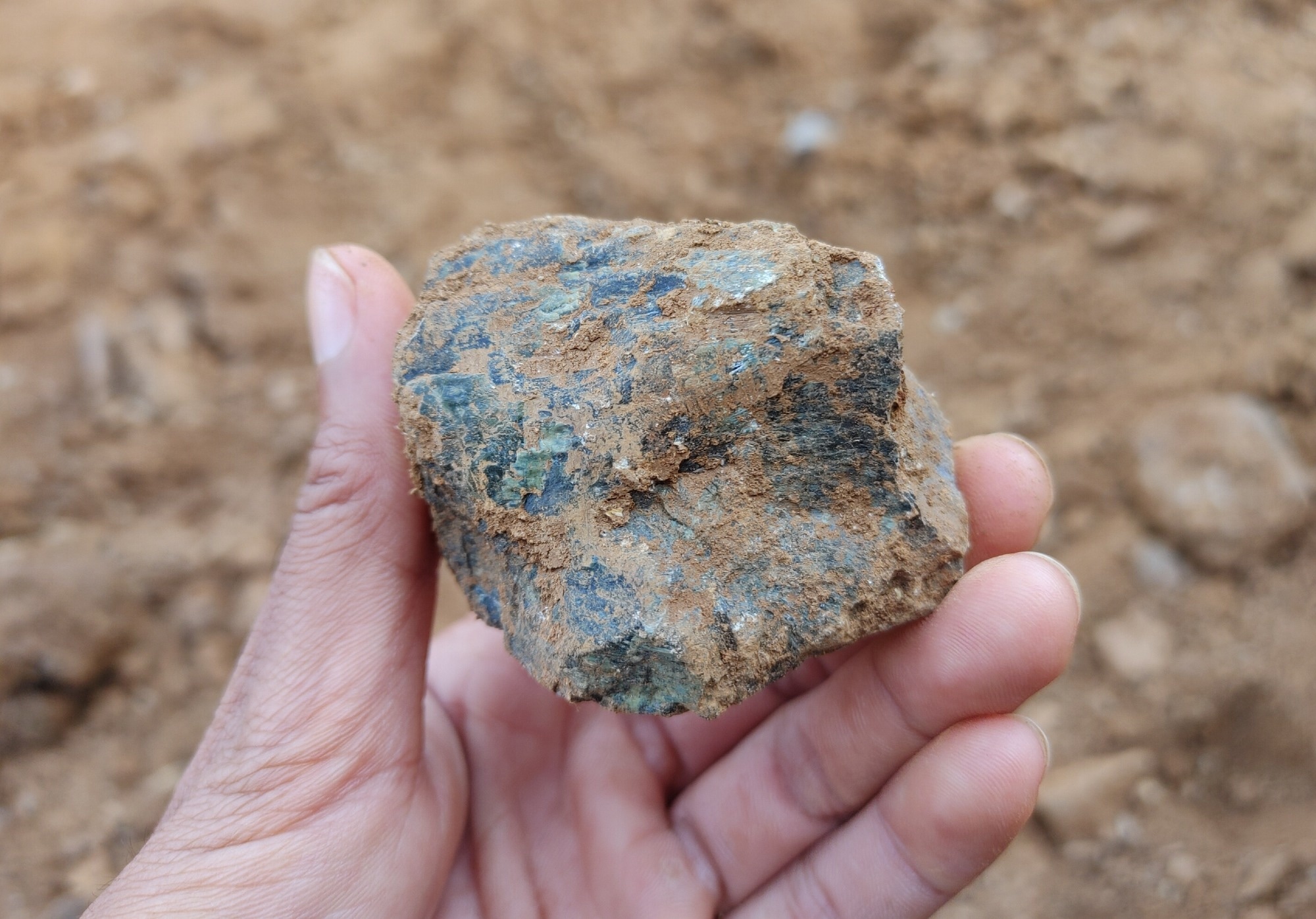
Study: Growing nickel supply from the tropics threatens priority conservation areas. Image Credit: Jidil / Shutterstock
In a recent article published in the journal Nature Ecology & Evolution, researchers present a comprehensive assessment of global nickel supply dynamics and the conservation and supply-chain implications of expanding nickel mining under future demand scenarios, highlighting the challenges of sourcing this essential metal sustainably for clean energy technologies.
The authors are an international, interdisciplinary team of environmental scientists, biodiversity and conservation researchers, sustainable minerals experts, ecologists, geographers, and systems modelers from Australia, the UK, Sweden, and Austria, with strong representation from The University of Queensland.
Nickel Resource Dynamics
Nickel resources are divided primarily into two types: laterite and magmatic sulfide deposits. Laterite deposits, formed by intense weathering of ultramafic rocks near the surface, are typically found in tropical regions such as Indonesia, New Caledonia, and the Philippines.
These are mostly extracted through open-pit strip mining, which involves significant land clearing and environmental disturbance. Conversely, magmatic sulfide deposits originate from deeper geological magmatic processes and tend to be located in higher latitudes, including Australia, Canada, and Russia. These are mined via underground or open-pit methods with comparatively smaller surface footprints.
Current global nickel production is dominated by tropical laterites, particularly in Indonesia, due to lower production costs and broader regional economic conditions. However, these deposits generally have lower ore grades, requiring more extensive mining and processing to yield equivalent amounts of nickel compared to sulfide deposits. Furthermore, terrestrial nickel mining often occurs in regions of high conservation value for biodiversity and carbon storage, creating material and environmental trade-offs that complicate sustainable supply planning. The authors estimate that 44–49% of nickel demand under the Announced Pledges Scenario could be supplied by projects in the top 10% of terrestrial priority areas for biodiversity and carbon conservation.
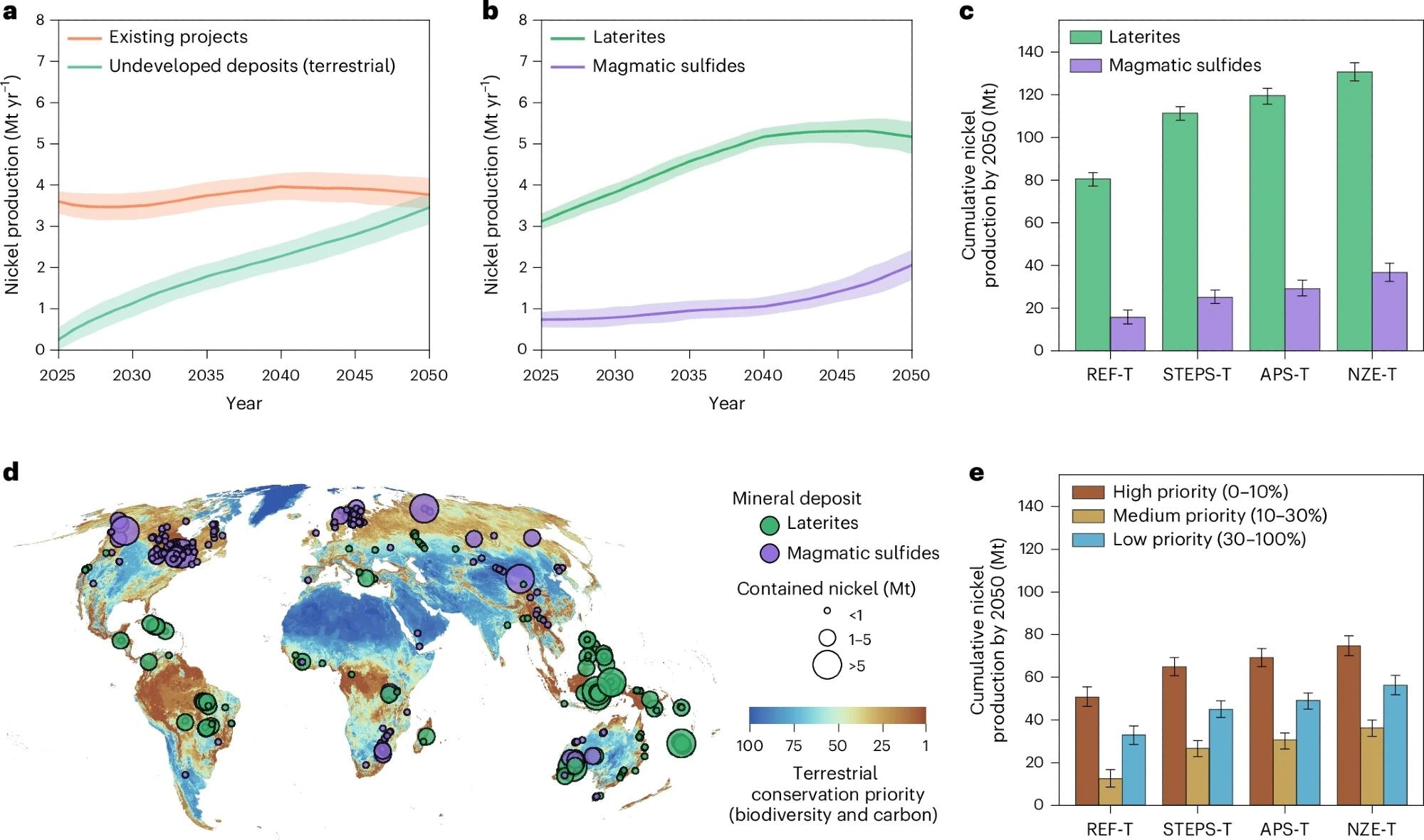
a–c,e, Nickel production is categorized by initial project status (a), deposit type (b,c) and priority areas for biodiversity and carbon (e). d, The global map shows the location and estimated nickel contained within known deposits overlaid onto terrestrial conservation priorities for conserving biodiversity and storing carbon. The line charts in a and b show the median annual terrestrial nickel production under the Announced Pledges Scenario (APS-T, where T denotes terrestrial resources only) across model simulations (n = 500) at each timestep, and the shaded bands show the 5th to 95th percentile range. The column charts in c and e show the median cumulative nickel production across model simulations (n = 500) between 2025 and 2050, and the error bars show the 5th and 95th percentiles. Cumulative terrestrial production estimates vary across demand scenarios in c and e, including the baseline reference scenario of no demand growth (REF-T), the Stated Policies Scenario (STEPS-T), the Announced Pledges Scenario (APS-T) and the Net Zero Emissions by 2050 Scenario (NZE-T).
Supply Scenario Modeling
The study employs the Primary Exploration, Mining and Metal Supply Scenario (PEMMSS) model to simulate nickel mine development, production, and depletion globally between 2025 and 2050. This stochastic, mine-by-mine simulation evaluates how supply from known deposits can meet projected demand under different scenarios, including conservation restrictions.
The model incorporates detailed geological and economic properties for each deposit type, laterite and magmatic sulfide, and factors in mine development timelines, production capacities, and ore grades.
Nickel deposits and operating mines were mapped against global priority conservation areas identified for biodiversity and carbon storage importance. Different scenarios explored include excluding mining from top-ranked conservation zones, ranging from 0% to 30% protection, and implementing moratoria on deep-sea mining development for polymetallic nodules.
The model outputs allowed assessment of how these environmental policies might reshape future nickel supply, examine potential supply shortfalls, and highlight shifts in production geography and ore quality over time.
Ecological Impact Assessment
The modeling suggests that existing nickel mines can maintain a supply of approximately 3.2 to 4.3 million tonnes per year through to 2050, though this alone will not satisfy projected demand increases. Under scenarios that reflect international decarbonization pledges, annual nickel production must increase by about 43% over the next decade.
To meet these targets, the global nickel mining industry may have to triple ore production volumes, primarily by developing numerous new and expanded terrestrial deposits. However, this increase will coincide with a decline in average ore grade to below 1% nickel, elevating mining and processing requirements.
Laterite deposits, which account for 78–83% of the modeled nickel supply between 2025 and 2050 under the Announced Pledges Scenario, dominate supply growth, especially in the tropics. These deposits pose particular environmental concerns due to their location beneath tropical forests with high biomass carbon stocks.
Mining laterites necessitates progressive land clearing and open-pit strip mining, resulting in substantial habitat loss, carbon loss from biomass, undercounted deforestation emissions, and increased carbon emissions from energy-intensive processing. By contrast, magmatic sulfide deposits, although fewer and geographically more dispersed at higher latitudes, usually offer higher-quality ore with potentially lower surface impacts.
Additionally, a substantial portion of terrestrial nickel deposits lies within 50 kilometers of coastlines in marine biodiversity hotspots, especially around the Coral Triangle in Southeast Asia. Processing these deposits will generate immense volumes of waste, including tailings, raising the risk of sediment contamination, ecosystem disruption, and tailings dam failures, which may affect both terrestrial and marine environments. The study estimates that 7.4 to 8.4 billion tonnes of ore may need to be mined and processed upstream of global strongholds of marine biodiversity.
The potential for deep-sea mining of polymetallic nodules offers an unconventional source of nickel, but it faces delays and opposition driven by ecological concerns. However, the authors do not advocate deep-sea mining; instead, they use it to illustrate how delays or moratoria could reshape terrestrial mining pressure while emphasizing uncertainty about commercial viability and ecological risk. Delaying deep-sea mining could increase pressure on terrestrial nickel sources, thereby increasing environmental costs in tropical ecosystems.
The modeling indicates that avoiding mining in the top 10% of terrestrial conservation priority areas could substantially reduce laterite supply and create an estimated 18 to 27 million tonne supply shortfall by 2050 under the Announced Pledges Scenario, while delays on deep-sea mining development may incentivize the rapid expansion of smaller, lower-grade terrestrial deposits, which could become economically unviable or environmentally problematic in the long term.
Sustainable Mining Strategies
The study highlights that while low-cost Indonesian laterite operations dominate future supply, higher-cost but potentially more ecologically responsible producers face competitive challenges. Market pressures may jeopardize investments in best-practice mining and rehabilitation unless stronger environmental and economic incentives encourage sustainable materials sourcing.
Sustainable materials management for nickel requires careful balancing of supply security with ecological conservation. Designating ‘no-go’ zones for mining in critical conservation areas, improving transparency in production reporting, strengthening responsible sourcing standards, and supporting demand-side measures, including longer-term recycling improvements and reduced long-term demand, are crucial steps.
Achieving responsible nickel sourcing for industrial applications demands integrating geological knowledge with strong governance and environmental stewardship to sustain both resource availability and planetary health.
Download your PDF copy by clicking here.