Tiny additions of rare-earth oxides can reshape how laser-cladded metals solidify, opening new possibilities for controlling cracks, wear, and corrosion across demanding industrial applications.
Paper: Rare Earth-Enhanced Laser Cladding Metal-Based Coatings: A Review. Image Credit: Rodolfo Possato / Shutterstock
Adding rare-earth oxides could significantly reduce crack susceptibility and strengthen protective metal coatings, with optimal concentrations typically ranging from 0.5 to 2.0 wt%. A recent review published in the journal Materials examined the effects of rare-earth additives on laser cladding, focusing on cerium oxide, lanthanum oxide, and yttrium oxide. The authors synthesized evidence on how these additives influence internal microstructural behavior and affect hardness, wear resistance, and corrosion resistance, with applications in heavy industry and beyond.
The Role of Laser Cladding in Surface Restoration
Industrial mechanical components are often exposed to fatigue, frictional wear, and corrosion during service. Surface modification techniques, such as laser cladding, are employed to restore and reinforce degraded metallic structures. This method is favored for its ability to deliver energy locally and use material efficiently.
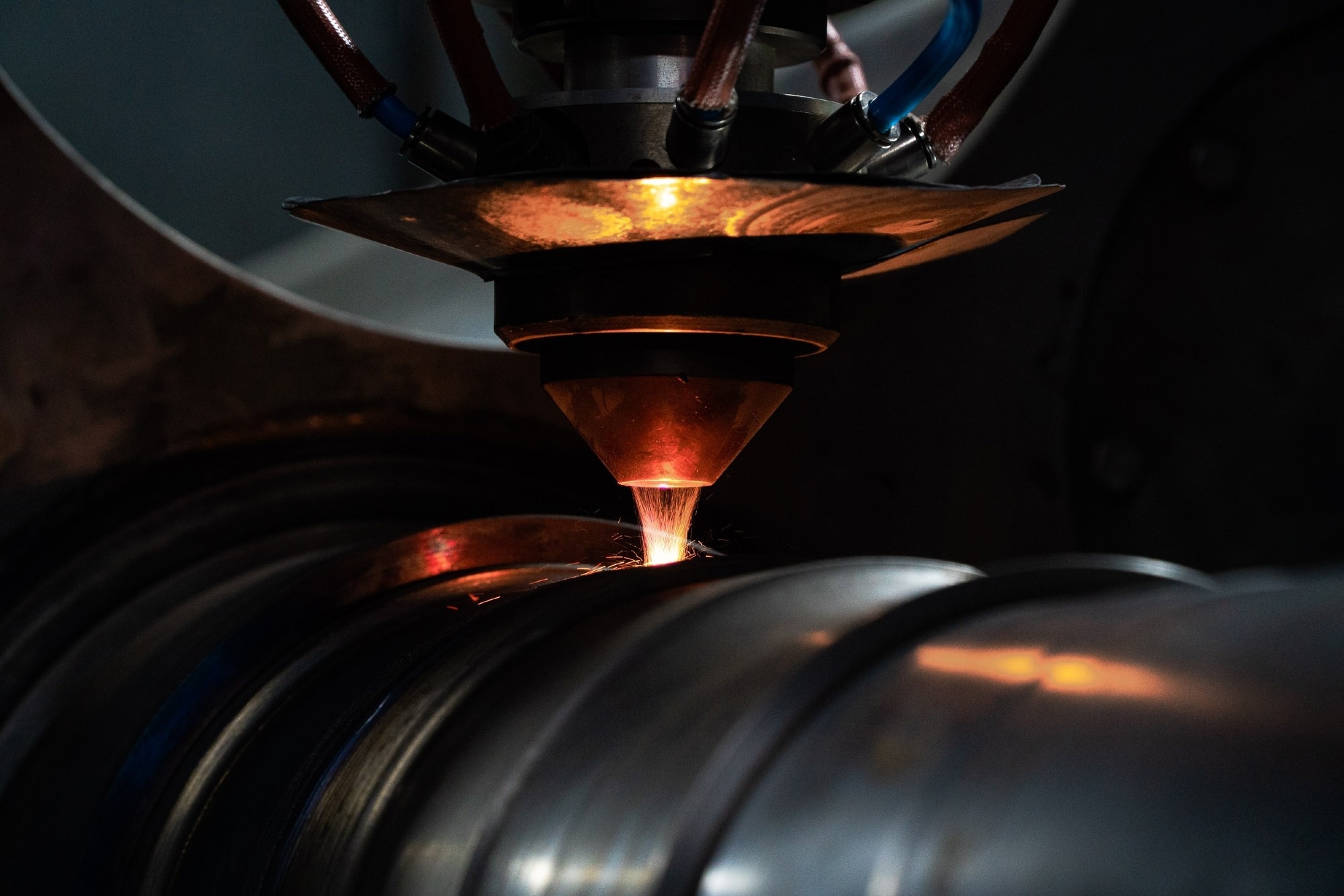
In laser cladding, alloy powders are fed onto a substrate and rapidly melted by a high-energy laser, forming a localized molten pool. This allows the material to solidify into a protective cladding layer with very low dilution and a strong metallurgical bond to the substrate. However, rapid temperature fluctuations during processing generate thermal stresses that can drive crack initiation and propagation, and pores and other defects may also develop.
Investigating the Impact of Rare Earth Elements
To address cracking associated with rapid cooling, the review examined evidence on the addition of rare-earth oxides to laser-cladding powder matrices. The evaluation covered the behavior of compounds, including cerium oxide, lanthanum oxide, and yttrium oxide, in iron-, nickel-, cobalt-, and high-entropy alloy coatings. The analysis focused on how changes occurring in the molten state influence the properties and microstructure of the solidified coating.
The authors synthesized previous research into the physical and chemical interactions within the molten pool during rapid heating and cooling. Particular attention was given to the distribution of the surface-active rare-earth elements, their interactions with impurities, and changes in properties such as surface tension, thermal fluid flow, and solidification behavior.
Previous atomic-scale and lattice-mismatch analyses between rare-earth compounds and host alloys were also considered to characterize interatomic bonding and microstructural effects. The analysis further identified concentration ranges and particle sizes associated with the modifying effects while limiting adverse chemical interactions. These parameters provide guidance for controlling the structure and performance of modified protective coatings.
Microstructural Improvements and Performance Benefits
Adding rare-earth oxides altered the microstructure of the coatings by refining grains and purifying the molten metal. Cerium and lanthanum can react with impurities such as sulfur and oxygen, forming stable reaction products, some of which float to the surface as removable slag. This purification reduces defect-related stress concentration. The rare-earth particles also act as nucleation sites and promote the formation of fine, equiaxed grains instead of coarse columnar structures.
These microstructural changes/reorganizations improved mechanical properties. In one Stellite 6 cobalt-based coating, adding 2.0 wt% cerium oxide increased hardness by around 35% compared with the unmodified coating. Lattice distortion associated with the larger atomic radii of rare-earth elements generates local stress fields that hinder dislocation movement and increase resistance to plastic deformation under heavy loading.
The refined microstructure also positively affected wear and corrosion behavior. Tribological tests indicated changes in dominant wear mechanisms, including shifts from severe delamination or adhesive wear toward milder oxidation-related and abrasive wear in some systems, thereby reducing material loss. In corrosive environments, the finer grain structure limited pathways for aggressive ions. In one Y2O3-modified high-entropy alloy coating, passivation current density fell by about 60%, while corrosion current density decreased by approximately 50%, consistent with the formation of a more protective passive film.
Practical Applications of Enhanced Coatings
The property changes produced by rare-earth oxide additives have significant implications across industrial sectors. In components exposed to high temperatures, such as aerospace engine blades and gas-turbine hot sections, cerium oxide modifications can increase resistance to high-temperature oxidation. Similarly, lanthanum oxide may be beneficial in heavy machinery and mining equipment systems subjected to high external impact and abrasion due to its solid-lubrication properties. The implementation of yttrium oxide can also enhance resistance to rapid thermal cycling by suppressing crack propagation.
Future Directions in Rare Earth Integration
In summary, rare-earth oxide additives can enhance the mechanical and environmental performance of laser-cladded protective coatings, but their effectiveness depends on composition, particle size, powder system, service conditions, and processing conditions. Excessive concentrations can lead to particle agglomeration, diminishing coating performance, while material costs and the environmental impacts of rare-earth extraction remain significant challenges for large-scale use. Future work should focus on developing standardized, cost-effective composite powder systems and optimizing powder processing and laser cladding parameters to achieve consistent coating performance.
Disclaimer: The views expressed here are those of the author expressed in their private capacity and do not necessarily represent the views of AZoM.com Limited T/A AZoNetwork the owner and operator of this website. This disclaimer forms part of the Terms and conditions of use of this website.