Lithium is geologically less abundant and more geographically concentrated than sodium, which has raised concerns around long-term cost volatility and availability as battery storage demand scales.2
Sodium, by contrast, is one to two orders of magnitude more abundant in Earth’s crust and seawater, and can be sourced from broad, low-cost brine and mineral deposits, giving sodium-ion chemistry an intrinsic materials advantage for large-scale stationary deployment.2
Battery-grade lithium salts (such as Li2CO3) remain far more expensive per tonne than sodium salts (such as Na2CO3), which feeds directly into catholyte and electrolyte costs.
Recent techno-economic analyses suggest that sodium-ion cells can be manufactured at a lower materials cost per kWh than Li-ion, especially when lithium prices are elevated, even if sodium-ion energy density is lower.3-4
Structure-Property: Ionic Size, Voltage, and Energy Density
Set out in ACS Energy Letters, K. H. Abraham describes how the larger ionic radius and higher atomic mass of Na+ relative to Li+ underpin many performance trade-offs.
The Na+ ion (≈1.02 Å in octahedral coordination) is less compact and diffuses more sluggishly in typical layered oxide or graphite-like structures than Li+ (≈0.76 Å). This reduces achievable specific capacity and rate capability in otherwise analogous frameworks.2
Thermodynamically, the Na/Na+ redox couple has a higher potential than Li/Li+, so practical Na-ion cells operate at a 10-25 % lower average cell voltage than comparable Li-ion systems, further depressing energy density.2
As a result, contemporary commercial Li-ion (NMC, NCA, high-Ni) reach 240-350 Wh kg-1 at the cell level, while LFP sits around 150-210 Wh kg-1; sodium-ion cells typically achieve only 60-70 % of that, roughly 90-175 Wh kg-1 depending on cathode chemistry.2
Cathode Chemistries and Structural Implications
Lithium-ion cathodes are dominated by layered transition-metal oxides (NMC, NCA, LCO) and polyanionic phosphates (LFP), which have been optimized over decades for high reversible capacity, structural stability, and high voltage.
These materials benefit from well-ordered frameworks that accommodate the small Li+ ion with relatively modest lattice strain, enabling long cycle life at high degrees of delithiation.5
Sodium-ion cathodes draw from similar structural families but face distinct constraints due to Na+ size and coordination preferences. Key classes include:
- Layered oxides NaxMO2, which can achieve competitive capacities but often suffer from phase transitions and Na+/vacancy ordering that degrade cyclability2
- Prussian blue and Prussian white analogues, whose open 3D frameworks tolerate Na+ insertion at relatively high voltage but are sensitive to water and vacancy defects1
- Polyanionic frameworks such as NASICON-type and sodium vanadium/iron phosphates, which trade some voltage and capacity for enhanced structural robustness
These structural differences shape application fit. Layered Na-oxides push sodium-ion toward higher energy density within its chemistry space, but may compromise long-term stability under deep cycling.
Polyanionic and Prussian blue systems prioritize cycling and thermal stability at somewhat lower specific energy. These attributes align well with stationary storage.1
Anodes, Intercalation Hosts, and Safety
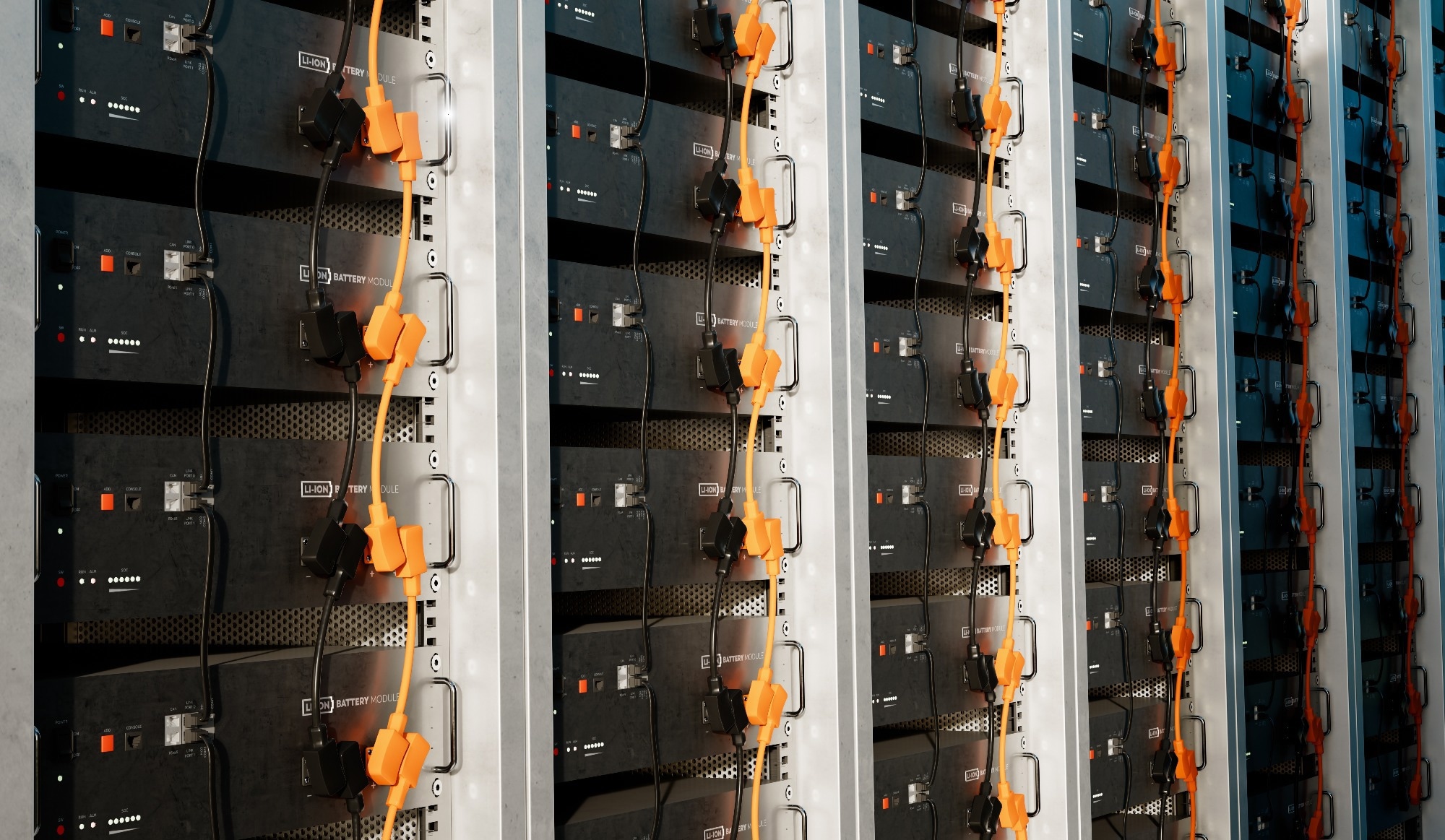 Image Credit: petrmalinak/Shutterstock.com
Graphite, the workhorse anode for Li-ion batteries, does not efficiently host Na+ due to unfavorable staging and co-intercalation thermodynamics, so sodium-ion relies on alternative anodes such as hard carbons, Ti-based oxides, and alloying-type materials.6
Hard carbon currently dominates commercial Na-ion because its disordered microstructure can accommodate Na+ via a combination of adsorption, intercalation into turbostratic layers, and filling of nanopores, achieving practical capacities around 250–350 mAh g-1.7
For lithium, graphite and LFP-based chemistries have well-proven SEI formation and stable intercalation, while silicon- or tin-containing composites push energy density higher at the cost of mechanical degradation from large volume changes.7
Sodium-alloy anodes (e.g., Na-Sn, Na-Sb) promise high capacity but face even more severe volume expansion and pulverization challenges than Si in Li-ion, limiting their near-term manufacturability for long-life cells.8
A key materials-level advantage of sodium-ion is that Al can serve as both the cathode and anode current collectors because Na does not alloy with Al at typical potentials, whereas Li-ion requires copper on the anode side to avoid Li-Al alloying.
This substitution reduces mass, cost, and fire risk while simplifying recycling and pack engineering.8
Electrochemical Performance: Energy, Power, and Cycle Life
Benchmark studies show that lithium-ion consistently offers higher gravimetric and volumetric specific energy than sodium-ion for comparable electrode architectures, primarily because of Li’s lower mass, higher cell voltage, and more compact intercalation.
This advantage translates directly into higher driving range for EVs or longer runtime for portable devices at a given pack mass and volume, explaining Li-ion’s continued dominance in mobility and consumer electronics.7, 9
Cycle life comparisons are more nuanced and strongly chemistry-dependent. High-nickel Li-ion (NMC/NCA) typically delivers 1,000-2,000 full cycles under standard operating conditions, while LiFePO4 can exceed 3,000-6,000 cycles, and some advanced designs approach 8,000+ cycles.6, 10
Recent sodium-ion cells using optimized hard-carbon anodes and robust cathodes report 2,000-6,000 cycles, with some laboratory and early commercial systems surpassing 10,000 cycles, particularly under partial depth-of-discharge profiles suited to stationary storage.10
Because sodium-ion gravimetric energy density is lower, the material-level trade is often between more kWh of lower-density storage versus fewer kWh of high-density Li-ion.
In stationary contexts where volume and weight are less constrained, stacking more Na-ion cells is usually acceptable, but in vehicles, every extra kilogram and liter directly penalizes range and vehicle design freedom.9
Table 1: Key differences between Sodium and Lithium-ion Batteries.
| Feature |
Sodium-Ion Batteries |
Lithium-Ion Batteries |
| Cost and raw materials |
Lower-cost, widely available materials; stronger supply security |
Higher material costs; more constrained supply chain |
| Energy density |
Lower energy density; larger and heavier packs |
Higher energy density; better for compact, lightweight designs |
| Performance |
Lower cell voltage and reduced range/runtime in space-limited applications |
Higher voltage and better performance in EVs and electronics |
| Materials and design |
Uses hard carbon anodes and can use aluminum current collectors on both sides |
Uses graphite anodes and typically requires copper on the anode side |
| Best applications |
Best suited to stationary storage and cost-sensitive systems |
Best suited to EVs, portable electronics, and high-performance uses |
| Main advantage |
Cost, abundance, and scalability |
Energy density, maturity, and commercial performance |
Manufacturability, Cost, and Scalability
Structurally, sodium-ion cells can reuse much of the existing Li-ion manufacturing infrastructure. This includes slurry casting, calendaring, stacking and winding, and formation processes. They require relatively modest adjustments to electrode formulations and electrolytes.
The majority of materials innovations are in cathode and hard-carbon synthesis rather than in plant design. This shortens commercialization timelines and capex for scaling sodium production lines.1-2
In regard to materials, sodium-ion offers several levers for cost reduction: abundant Na salts, Al current collectors on both electrodes, and the avoidance of cobalt and high-nickel content when Prussian blue or Fe-based cathodes are used.2
Analyses of projected production at scale suggest that sodium-ion packs could be produced at roughly 50 USD kWh-¹ versus 70 USD kWh-¹ for comparable Li-ion, assuming current raw-material price trends.
This gap may narrow as Li supply expands and Na-ion demand grows, but the underlying elemental abundance and simpler supply chains give sodium-ion a stronger long-term materials advantage for terawatt-hour-scale stationary storage.11
Learn more about the challenges in scaling battery tech here!
Where Each Chemistry Has the Edge
From a structure-property standpoint, Li-ion’s combination of small Li+, high-voltage layered cathodes, and graphite/silicon-based anodes makes it uniquely suited to applications where specific energy and compactness are paramount, such as battery-electric vehicles, aviation concepts, and premium portable electronics.5
In these domains, sodium-ion’s fundamentally lower energy density and voltage window are difficult to overcome without radical new host structures or architectures, and even aggressive Na-ion R&D is unlikely to fully erase Li’s intrinsic thermodynamic and mass advantages.5
Sodium-ion, however, aligns well with stationary storage, behind-the-meter systems, and some low-speed or short-range mobility where pack size and mass can be relaxed to prioritize cost, safety, and ease of sourcing.8
The ability to use non-critical raw materials, tolerate 0 V storage, and potentially deliver very long cycle life with hard carbon and robust polyanionic or Prussian blue cathodes makes Na-ion particularly attractive for grid balancing, renewable integration, and second-use scenarios.8
References and Further Readings
- Wathoni, A. Z.; Madurani, K. A.; Lai, C. W.; Kurniawan, F., Comprehensive review of sodium-ion battery materials: Advances and performance challenges. ChemPhysMater 2025. DOI: 10.1016/j.chphma.2025.06.003 https://scholar.its.ac.id/en/publications/comprehensive-review-of-sodium-ion-battery-materials-advances-and/
- Abraham, K., How comparable are sodium-ion batteries to lithium-ion counterparts? ACS Energy Letters 2020, 5 (11), 3544-3547. DOI: 10.1021/acsenergylett.0c02181 https://pubs.acs.org/doi/full/10.1021/acsenergylett.0c02181
- Maisch, M., Acculon launches production of sodium-ion battery modules, packs. pv-magazine January, 2024. https://www.pv-magazine.com/2024/01/11/acculon-launches-production-of-sodium-ion-battery-modules-packs/
- González, A.; Choque, G.; Grágeda, M.; Ushak, S., The development and analysis of a preliminary electrodialysis process for the purification of complex lithium solutions for the production of Li2CO3 and LiOH. Membranes 2025, 15 (2), 50. DOI:10.3390/membranes15020050, https://www.mdpi.com/2077-0375/15/2/50
- Paul, S.; Acharyya, D.; Punetha, D., Benchmarking the Performance of Lithium and Sodium-Ion Batteries With Different Electrode and Electrolyte Materials. Energy Storage 2024, 6 (7), e70068. DOI:10.1002/est2.70068, https://onlinelibrary.wiley.com/doi/10.1002/est2.70068
- Abdolrasol, M. G.; Ansari, S.; Sarker, I. A.; Tiong, S.; Hannan, M., Lithium-ion to sodium-ion batteries transitioning: trends, analysis and innovative technologies prospects in EV application. Progress in Energy 2025, 7 (2), 022007.
- Schirber, M., Sodium as a green substitute for lithium in batteries. Physics 2024, 17, 73. DOI:10.1103/Physics.17.73, https://physics.aps.org/articles/v17/73
- Why Sodium-Ion Batteries Are a Promising Candidate for Stationary Energy Storage. https://acculonenergy.com/why-sodium-ion-batteries-are-a-promising-candidate-for-stationary-energy-storage/. [Accessed March 2026]
- Viswanathan, V.; Mongird, K.; Franks, R.; Li, X.; Sprenkle, V.; Baxter, R., 2022 grid energy storage technology cost and performance assessment. Energy 2022, 2022, 1-151.
- PAN, D. L. Sodium-Ion vs Lithium-Ion Batteries Differences and Applications in 2025. https://www.large-battery.com/blog/na-ion-vs-li-ion-batteries-2025/. [Accessed March 2026]
- Scott, A., Sodium-ion batteries: Should we believe the hype? November 17, 2025. https://cen.acs.org/energy/energy-storage-/Sodium-ion-batteries-Should-believe/103/web/2025/11 [Accessed March 2026]
Disclaimer: The views expressed here are those of the author expressed in their private capacity and do not necessarily represent the views of AZoM.com Limited T/A AZoNetwork the owner and operator of this website. This disclaimer forms part of the Terms and conditions of use of this website.