Solid State Batteries: Definition, Advantages, and Limitations
Lithium-Ion Batteries and Their Operating Principles
What is Holding Solid-State Batteries Back from Success?
Outlook for Solid-State Battery Development
References
For years, solid-state batteries have been touted as a safer, more energy-dense successor to lithium-ion, but commercial reality has proven much harder than the promise.
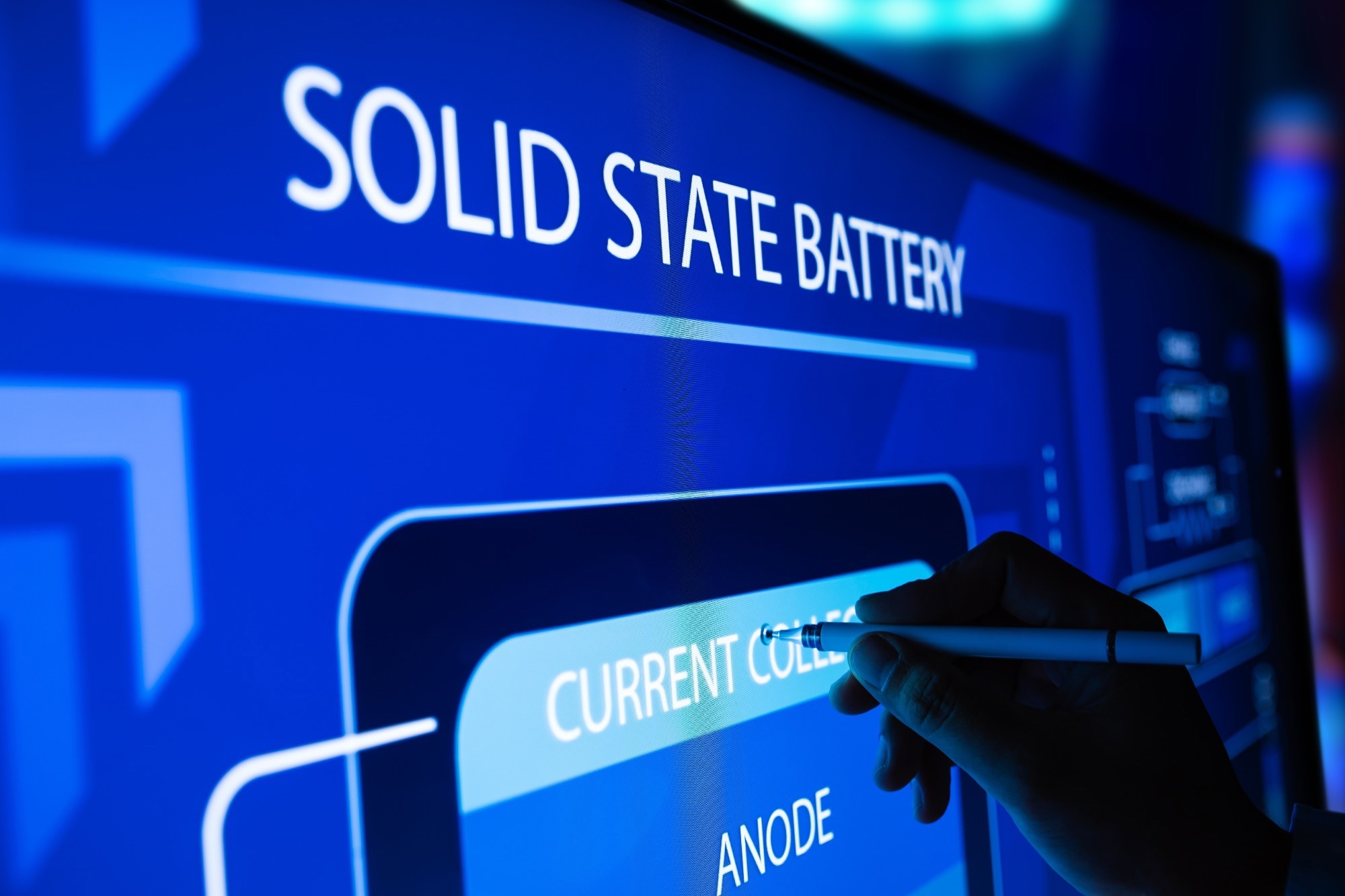 Image Credit: Thx4Stock team/Shutterstock.com
Saving this article for later? Grab a PDF here.
Solid State Batteries: Definition, Advantages, and Limitations
In conventional battery systems, the electrolyte is usually a liquid solution containing lithium salts. Solid-state batteries, in contrast, are electrochemical energy storage devices in which the electrolyte is a solid material.
The structure of a solid-state battery has three main components: a cathode, an anode, and a solid electrolyte placed between them. During operation, lithium ions move through the solid electrolyte between the electrodes, and electrons travel through the external circuit to power a device. 1, 2
Initially, solid-state batteries got attention due to several potential advantages. For instance, liquid electrolytes used in many traditional batteries are flammable and can contribute to thermal runaway under certain conditions. Replacing this liquid component with a solid material may reduce the likelihood of leakage and combustion. Another source of attention was their potential for higher energy density.
Some solid-state designs allow lithium metal anodes, which have a higher theoretical capacity than the graphite anodes used in conventional batteries. This demonstrated an idea of batteries that could store more energy in the same physical space. 1, 2
So, solid-state batteries have been studied for many applications, including electric vehicles, consumer electronics, and grid storage. However, despite years of research and development, they have not yet been able to establish battery technologies with great commercial success.
Lithium-Ion Batteries and Their Operating Principles
A lithium-ion battery consists of a graphite anode, a lithium-containing cathode material such as lithium cobalt oxide or lithium nickel manganese cobalt oxide, a separator, and a liquid electrolyte containing dissolved lithium salts.
The separator is a porous membrane that prevents electrical contact between the electrodes but allows ion transport through the liquid electrolyte.
During discharge, lithium ions move from the anode to the cathode through the electrolyte, while electrons flow through the external circuit, providing electrical energy to a connected device. When the battery is charged, the direction of ion movement reverses, with lithium ions returning to the anode and being stored within the graphite structure. 3, 4
The key difference between lithium-ion batteries and solid-state batteries is in the electrolyte and sometimes the anode material. Lithium-ion batteries use liquid electrolytes and typically rely on graphite anodes, whereas solid-state batteries replace the liquid electrolyte with a solid material and may use lithium metal anodes.
This structural difference leads to changes in safety characteristics, energy density potential, and manufacturing approaches. 3, 4
What is Holding Solid-State Batteries Back from Success?
There are several challenges that solid-state batteries face that hold them back from being used widely. Joe Adiletta, CEO at Volexion, notes that battery manufacturers in general face numerous challenges when scaling production. Paraphrasing MIT Professor Yet-Min Chieng, he said:
It's not the nineteen requirements that you do make that make you successful. It's the one you don't meet that means you're unsuccessful.
Joe Adiletta, CEO at Volexion
But there's more to it than that. Joe emphasizes that, for start-ups, many of these targets or metrics stem from a lack of expertise and/or capital. When testing for unknowns and in small-scale tests, not all of these requirements are evident.
A good example of that is safety testing. You can safety test tiny batteries and nothing happens, nothing goes wrong. But as soon as you start putting large amounts of energy into increasingly more and more confined spaces, then bad things can happen. And you might not know that until you've invested the time, energy, and dollars into that scale-up process.
Joe Adiletta, CEO at Volexion
Material and Manufacturing Challenges in Solid-State Electrolytes
A recent review in the Journal of Energy Storage systematically examined the materials, ion-transport mechanisms, and engineering challenges associated with all-solid-state lithium batteries.2
The study compared different types of solid electrolytes, including oxides, sulfides, and polymers, and analyzed how their structural and electrochemical properties influence battery performance. Researchers also evaluated strategies such as electrolyte modification, interfacial engineering, and composite electrolyte designs to improve ion transport and stability.
However, their analysis identified several barriers that still limit commercialization.
For instance, many solid electrolytes exhibit insufficient ionic conductivity at room temperature, while poor solid-solid contact between the electrolyte and electrodes leads to high interfacial resistance and performance degradation. The study also noted that large-scale manufacturing is difficult due to the high cost of materials, complex synthesis processes, stringent environmental controls, and relatively low production yields.
Moisture Sensitivity in Sulfide-Based Solid Electrolytes
Another study, published in Nature Communications, investigated the extreme moisture sensitivity of sulfide solid electrolytes, a major manufacturing challenge for solid-state batteries. The researchers focused on the commonly used electrolyte Li6PS5Cl, which normally degrades rapidly when exposed to humid air, making large-scale manufacturing difficult.
They applied a surface molecular engineering approach, coating the electrolyte particles with a long-chain alkyl thiol to address this issue. This molecule chemically bonds to the electrolyte surface, and its hydrophobic tail repels water.
Experiments showed that the modified electrolyte could be exposed to air at 33 % relative humidity for up to two days while maintaining ionic conductivity above 1 mS cm-1, representing an over 100-fold improvement in stability compared with previous approaches.
Lithium Dendrite Formation in Solid-State Batteries
In a 2025 preprint, researchers developed a phase-field simulation model to investigate lithium dendrite growth in solid-state lithium batteries. The model coupled mechanical stress, thermal conditions, and electrochemical reactions to simulate how dendrites form and evolve at the interface between the lithium metal anode and the solid electrolyte.7
The researchers then tested how different operating conditions, such as temperature and external pressure, influence dendrite morphology and growth patterns. Their simulations showed that dendrites can still form in solid electrolytes and may eventually penetrate the electrolyte layer, which can cause internal short circuits and reduce battery efficiency.
The results also indicated that increasing temperature and applying external pressure can partially suppress dendrite growth, but these conditions may introduce mechanical instability in the battery structure.
This paper, although preliminary, clearly demonstrates the engineering challenges that still limit the practical deployment of solid-state batteries.
Want to know more about lithium-ion battery's rivals? This article takes a closer look at sodium.
Outlook for Solid-State Battery Development
Lithium-ion batteries remain the dominant technology with their well-established supply chains, proven reliability, and ongoing incremental improvements. But, solid-state batteries will continue to attract researchers’ interest because of their potential to improve energy density and safety in electrochemical energy storage systems.
Advances in materials science, interface engineering, and manufacturing processes are gradually addressing some of the limitations identified in early research.
However, the transition from laboratory results to reliable commercial products is complex, as challenges related to interfacial stability, large-scale manufacturing, and cost competitiveness influence the pace of development.
The reality is that lithium-ion manufacturing today involves a very high-precision, very high-throughput, highly engineered set of processes that produce billions of batteries. Looking around your desk, you probably have a whole bunch of them lying around - from your phone to your smart watch to your laptop. You're sitting next to half a dozen lithium-ion batteries, right? So any change to that process, even if minor, represents substantial effort and input on the manufacturing side. And you've just got to be really sure that you're not going to disrupt that flow.
Joe Adiletta, CEO at Volexion
References
- Antony Jose, S., et al. (2025). Solid-state lithium batteries: advances, challenges, and future perspectives. Batteries. DOI:10.3390/batteries11030090, https://www.mdpi.com/2313-0105/11/3/90
- Moradi, Z., Lanjan, A., Tyagi, R., & Srinivasan, S. (2023). Review on current state, challenges, and potential solutions in solid-state batteries research. Journal of Energy Storage. DOI:10.1016/j.est.2023.109048, https://doi.org/10.1016/j.est.2023.109048
- Xie, J., & Lu, Y. C. (2020). A retrospective on lithium-ion batteries. Nature Communications. DOI:10.1038/s41467-020-16259-9, https://www.nature.com/articles/s41467-020-16259-9
- Nasajpour-Esfahani, N., Garmestani, H., Bagheritabar, M., Jasim, D. J., Toghraie, D., Dadkhah, S., & Firoozeh, H. (2024). Comprehensive review of lithium-ion battery materials and development challenges. Renewable and Sustainable Energy Reviews. DOI:10.1016/j.rser.2024.114783, https://doi.org/10.1016/j.rser.2024.114783
- Qiao, Q., et al. (2025). Recent advances and remaining challenges of solid-state electrolytes for lithium batteries. Progress in Materials Science. DOI:10.1016/j.pmatsci.2025.101559, https://doi.org/10.1016/j.pmatsci.2025.101559
- Liu, M., et al. (2025). Surface molecular engineering to enable processing of sulfide solid electrolytes in humid ambient air. Nature Communications. DOI:10.1038/s41467-024-55634-8, https://www.nature.com/articles/s41467-024-55634-8
- Hou, P., et al. (2025). Phase field simulation of dendrite growth in solid-state lithium batteries based on mechanical-thermo-electrochemical coupling. arXiv preprint arXiv. DOI:10.48550/arXiv.2509.02013, https://arxiv.org/abs/2509.02013
Disclaimer: The views expressed here are those of the author expressed in their private capacity and do not necessarily represent the views of AZoM.com Limited T/A AZoNetwork the owner and operator of this website. This disclaimer forms part of the Terms and conditions of use of this website.