From DandeLiionReviewed by Olivia FrostJul 28 2026
This article is based on a poster originally authored by Ivan Korotkin, Smita Sahu, Giles Richardson, and Jamie M. Foster.
DandeLiion (available at dandeliion.com) is a robust and extremely fast solver for the Doyle Fuller Newman model, the standard electrochemical model for (dis)charge of a planar Li-ion cell.
DandeLiion conserves lithium, using a second-order spatial discretization method that enables accurate computations using relatively coarse discretization. The code runs ‘in the cloud,’ and it is roughly 100 times faster than its commercial counterparts for the moderately-sized test case of the discharge of a single cell.
Its linear scaling property means that the disparity in performance is even more pronounced for bigger systems, making it particularly suitable for large battery packs used in electric vehicles, which helps in designing and optimizing the battery pack for better performance and safety.
The Newman Model and Thermal Coupling
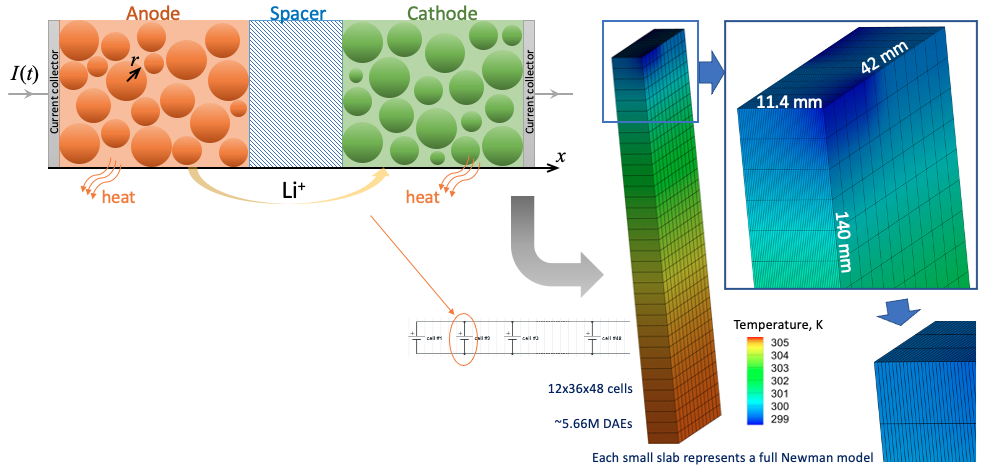
Image Credit: DandeLiion
- Two-scale (pseudo 2-D) model:
- Macroscale (size of electrode)
- Microscale (size of electrode particle)
- Models four key phenomena:
- Li transport in electrode material
- Li and charge transport in electrolyte
- Li/charge transfer reaction at electrode/electrolyte interface
- Charge transport in electrode matrix (Ohm’s Law)
Drive Cycle Simulation
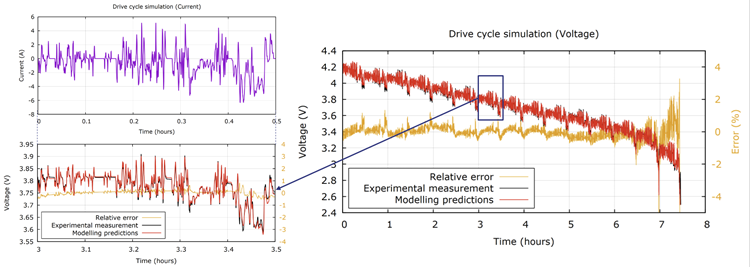
Simulation (red lines), experiment* (black lines), the relative deviation of simulation results from the experiment (orange lines), and a single pattern of the total current (purple line). Full discharge profile. In 99% of instances, the error is within 1–2%. Image Credit: DandeLiion
Performance and Scalability
- High-order finite element and control volume method
- Shared-memory parallelism, separated thread management for the linear solver and for the RHS/Jacobian computation
- Ability to solve huge systems even on a standard desktop within reasonable time
Example: A test simulation of one single full discharge on a complex 3D geometry with 20×40×48 = 38400 fully coupled full DFN models* (10M states) takes 35 minutes on a desktop with an Intel i7-8700 CPU.
The system size can be even bigger if simulated on an HPC facility.
* Each DFN model includes independent calculation of all heat dissipation terms + non-linear diffusivity in solid particles and the electrolyte.
- Linear scaling
- Step change in simulation speed
- Thermally coupled models
- Digital twin
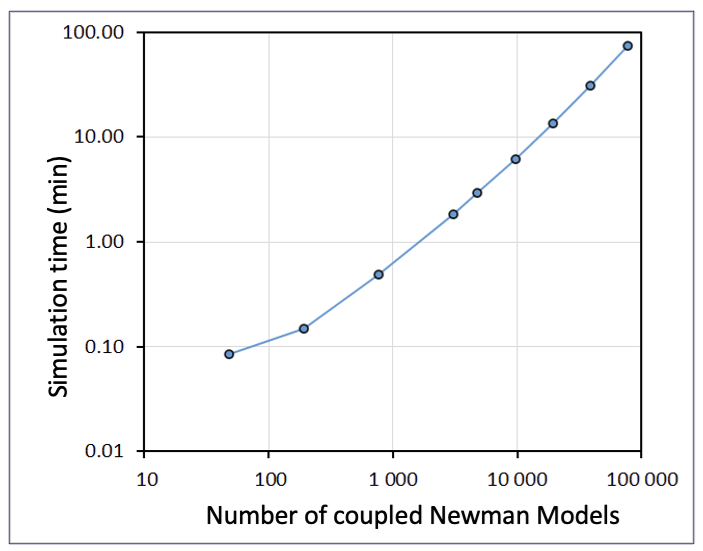
Image Credit: DandeLiion
Degradation Model: Li Plating and Dendrite Formation
- A novel physics-based model predicted the growth of lithium plating, dendrite formation, and dead Li in lithium-ion batteries, which can reduce battery capacity, short circuits, and safety hazards.
- The model can help identify and differentiate between recoverable Li metal and dangerous or "dead" Li metal, which can contribute to capacity fade.
- The model can be used to optimize battery design and operating conditions to prevent the formation of Li deposits and dendrites, and improve the safety and performance of lithium-ion batteries.
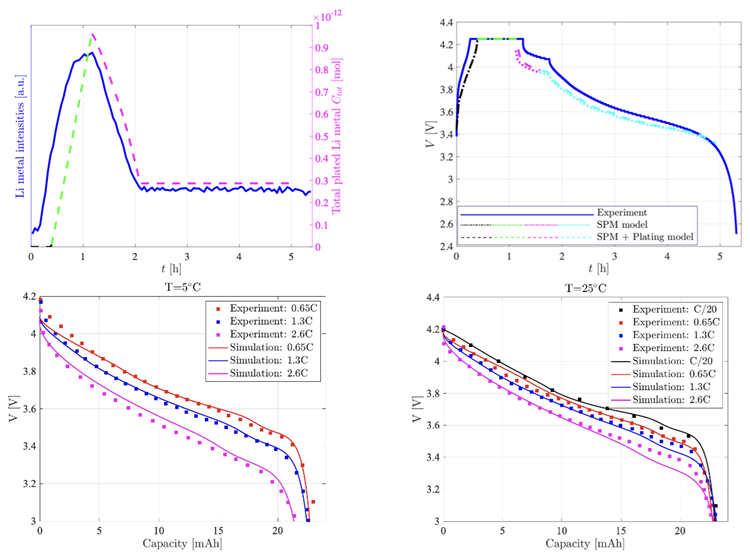
(Top left) Total plated lithium prediction after one cycle; (Top right) Voltage plots model and validation against experiment; (Bottom row) Voltage plots model vs experiments. Image Credit: DandeLiion
Pouch Cell Simulation
Pouch Cell Simulation
- Pseudo-5D simulation
- Second-order accuracy space discretization (FE+CV), 2–6 variable-order time discretization
- Full thermo-electrochemical coupling
- User-defined boundary conditions:
- Tab cooling
- Full thermal isolation
- Side cooling
- Two (opposite) sides cooling
- Any other combinations are technically possible
- Position and size of the tabs can be defined by the user
- Output in ParaView 3D format
- Consistent treatment of energy transport and heat losses
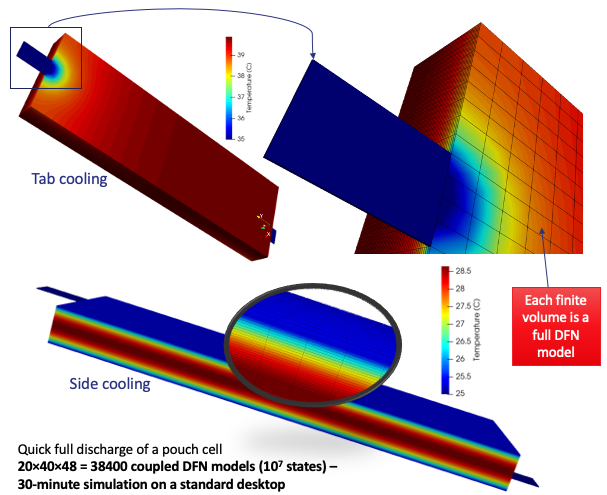
Image Credit: DandeLiion
Thermally Coupled Tesla Model S Battery Module Simulation Example
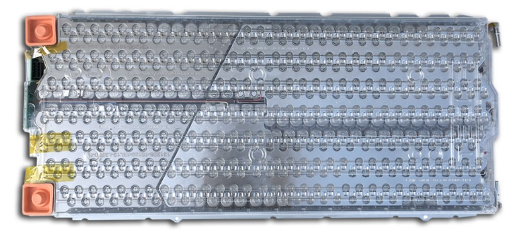
74p6s Battery module cell stacking arrangement. Image Credit: DandeLiion
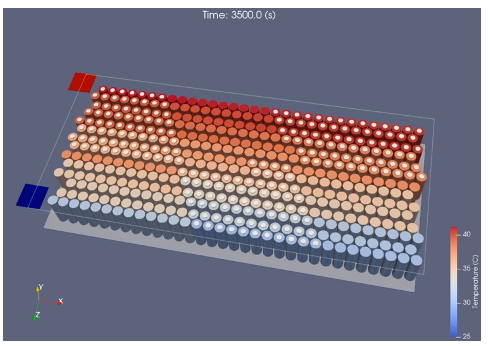
Image Credit: DandeLiion
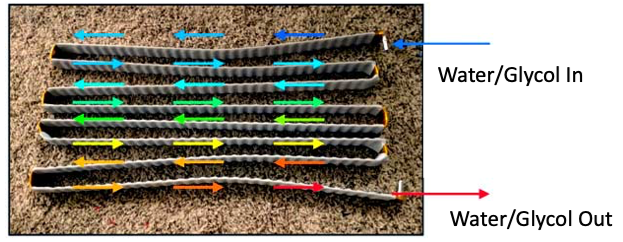
Image Credit: DandeLiion
Temperature Distribution (Constant Current 1C Discharge)
- 440 cells between two plates
- Six cell blocks
- 70–74 cells in each block
Note: it heats up to approximately 42 °C.
Without coolant, the temperature reaches 57 °C.
The hottest block is not the one with 70 cells (the block of cells with the highest current).
Thermally Coupled Cylindrical Cell
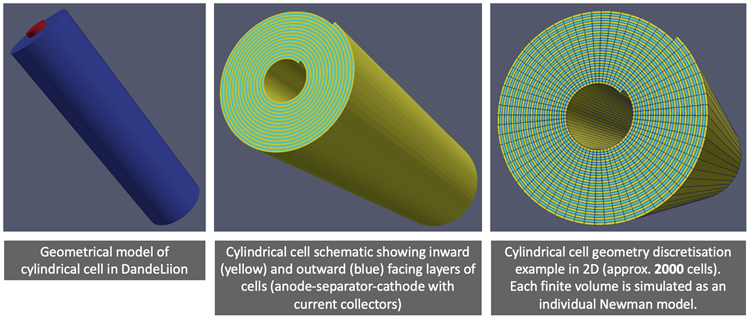
Both 2D and 3D models are mathematically derived (a paper in preparation) and being implemented into DandeLiion. Image Credit: DandeLiion
Upcoming Features
- Novel model for non-linear aging
- Various chemical and mechanical degradation models
- Prismatic cell model
- Generic system of reactions in DandeLiion Degradation Module
References
- Korotkin, I., et al. (2021). DandeLiion v1: An Extremely Fast Solver for the Newman Model of Lithium-Ion Battery (Dis)charge. Journal of The Electrochemical Society, 168(6), p.060544. DOI: 10.1149/1945-7111/ac085f. https://iopscience.iop.org/article/10.1149/1945-7111/ac085f/meta.
- Richardson, G. and Korotkin, I. (2021). Heat generation and a conservation law for chemical energy in Li-ion batteries. Electrochimica Acta, 392, p.138909. DOI: 10.1016/j.electacta.2021.138909. https://www.sciencedirect.com/science/article/abs/pii/S0013468621011993.
- Alana Aragon Zulke, et al. (2021). Parametrisation and Use of a Predictive DFN Model for a High-Energy NCA/Gr-SiOx Battery. Journal of the Electrochemical Society, 168(12), pp.120522–120522. DOI: 10.1149/1945-7111/ac3e4a. https://iopscience.iop.org/article/10.1149/1945-7111/ac3e4a/meta.
- Sahu, S. and Foster, J.M. (2023). A continuum model for lithium plating and dendrite formation in lithium-ion batteries: Formulation and validation against experiment. Journal of Energy Storage, 60, p.106516. DOI: 10.1016/j.est.2022.106516. https://www.sciencedirect.com/science/article/pii/S2352152X22025051.
Acknowledgments
Produced using materials originally written by Ivan Korotkin, Smita Sahu, Giles Richardson, and Jamie M. Foster from DandeLiion.

This information has been sourced, reviewed, and adapted from materials provided by DandeLiion.
For more information on this source, please visit DandeLiion.