From radiation-resistant solar cells to heat-storing regolith and locally produced electrical conductors, material choices could determine how future lunar bases generate, store and distribute power.
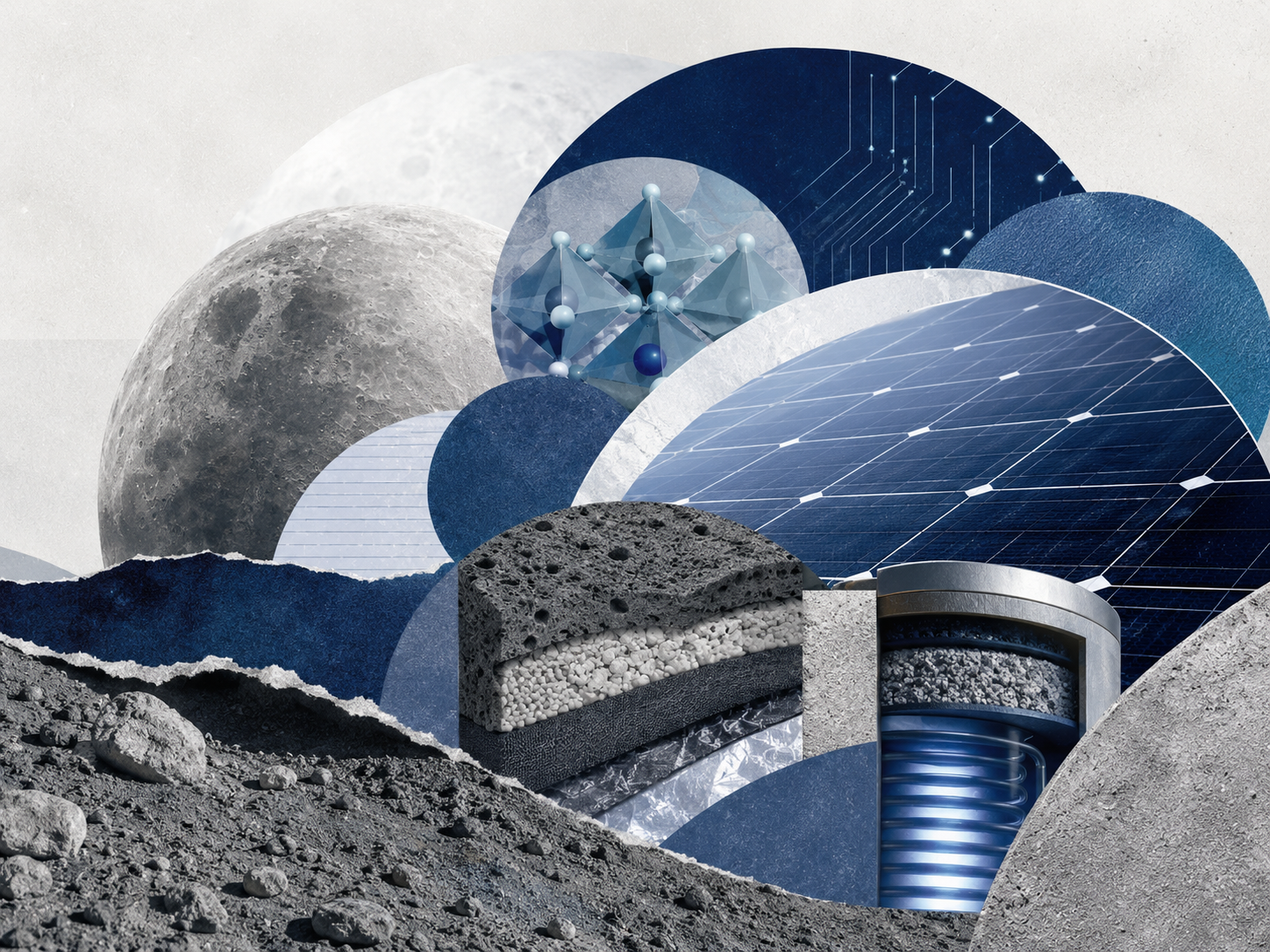
Paper: Lunar surface energy infrastructure: from in-situ resource utilization to deep space exploration. AI-generated abstract conceptual image created using ChatGPT/OpenAI
A recent review published in the journal npj Space Exploration examines how future lunar bases could develop reliable energy infrastructure using technologies from Earth and resources available on the Moon. The researchers compare power-generation, energy-storage, and power-grid technologies according to their performance, environmental resilience, in-situ resource utilization (ISRU) potential, and technology readiness. The review also evaluates the economic implications of different energy architectures and proposes a staged development pathway.
Addressing the Energy Challenge on the Moon
Future lunar bases will require much more advanced energy systems than those used by individual spacecraft. Long-term habitation, scientific research, resource extraction, and industrial activities could require electricity ranging from hundreds of kilowatts to megawatts. Meeting these demands will be challenging because energy infrastructure must operate under extreme temperature variations, vacuum, low gravity, abrasive lunar dust, and intense radiation.
These harsh conditions can degrade solar cells, limit battery performance, and accelerate material degradation through repeated thermal cycling. Power-generation systems must also manage heat efficiently because the Moon lacks an atmosphere for conventional convective cooling.
In situ resource utilization (ISRU) offers a potential solution to the high cost and logistical burden of transporting infrastructure from Earth. Lunar regolith could be used for radiation shielding and thermal energy storage, and may eventually provide materials for electrical conductors, batteries, and photovoltaic systems. This could reduce launch mass and support the gradual expansion of lunar infrastructure, provided the savings from avoiding Earth-launched materials outweigh the cost of producing them in situ.
Although previous studies have investigated individual energy technologies, future lunar settlements will require integrated generation, storage, and power transmission to function as a cohesive system. This review addresses this gap by evaluating these technologies together, considering their materials performance, environmental adaptability, ISRU potential, technology readiness, and economic feasibility.
Evaluating Technologies for Lunar Energy Infrastructure
The researchers developed a systematic framework covering three connected parts of lunar energy infrastructure: power generation, energy storage, and power grids. They compared each technology according to its performance, ability to withstand the lunar environment, compatibility with ISRU, and technology readiness level (TRL).
For power generation, the review examined solar photovoltaic (PV), concentrating solar power (CSP), thermoelectric generators, radioisotope thermoelectric generators, and nuclear fission and fusion systems. Solar power benefits from the Moon’s strong solar irradiance, which ranges from approximately 1316 to 1421 W/m² without atmospheric attenuation. PV systems could therefore provide an important source of daytime electricity.
The authors also considered the material limitations of lunar PV systems. Conventional silicon cells can experience substantial efficiency losses under radiation. Some perovskite-based tandem cells have demonstrated strong radiation tolerance and could become attractive for future lunar applications. Researchers have also explored producing photovoltaic materials from lunar regolith, although this approach remains in its early stages.
Energy-storage technologies were grouped into chemical, thermal, and mechanical systems. These included metal-ion and metal-air batteries, regenerative fuel cells, regolith-based thermal storage, flywheels and gravity-based systems. The researchers assessed how each option could support operations during the long lunar night while reducing dependence on Earth-launched materials.
For power transmission, the review examined wired and wireless systems, distribution networks, and microgrid configurations. It compared radial, ring, and mesh networks according to their simplicity, efficiency, reliability, and scalability. The researchers also conducted a first-order cost-benefit analysis based on launch mass and lifecycle energy costs. This suggested that continuous nuclear systems could require roughly an order of magnitude less Earth-launched mass per unit of continuous power than solar systems paired with sufficient storage for the lunar night. However, the authors stressed that these estimates are illustrative rather than a validated cost model.
Materials and Technologies Shape the Lunar Energy Landscape
Solar photovoltaic (PV) systems are promising for near-term lunar applications because of their technological maturity and access to abundant sunlight. However, high-energy radiation can damage photovoltaic semiconductors and reduce conversion efficiency. Conventional silicon cells may lose approximately 20–25% of their efficiency under strong radiation exposure. Perovskite-based tandem architectures offer a potential alternative, with monolithic tandem panels retaining more than 85% of their initial efficiency after proton irradiation.
As power requirements increase, nuclear fission could provide continuous baseload electricity, including during the lunar night. Compact reactor designs, radiation shielding, and efficient heat rejection remain important challenges. Lunar regolith could reduce shielding mass by providing locally sourced protection. Radioisotope thermoelectric generators are more mature and suitable for low-power applications, but their 5–7% conversion efficiency and shielding requirements limit their use for large bases.
Energy storage requires robust materials and technologies – lithium-ion batteries are established but face performance challenges under extreme lunar temperatures. Regenerative fuel cells offer high specific energy but require complex storage of hydrogen and oxygen. Regolith-based thermal storage provides lower energy density but strong ISRU potential. Sintered regolith has demonstrated thermal conductivity of about 0.6 W/m·K, while loose regolith insulation can limit nighttime heat loss.
Enabling Materials for Long-Term Lunar Exploration
Developing lunar energy infrastructure will require more than selecting efficient power-generation technologies. Materials must withstand intense radiation, vacuum, extreme temperatures, and abrasive lunar dust while also supporting in-situ manufacturing and maintenance under severe logistical constraints.
Radiation-resistant semiconductor materials could improve the durability of photovoltaic systems, while sintered lunar regolith could provide materials for thermal storage and radiation shielding. Advanced battery chemistries could reduce dependence on Earth-supplied components. Lunar-derived aluminum and other materials could eventually support electrical conductors and structural elements, helping reduce the mass and cost of transported infrastructure.
The review suggests that this progression should be guided by technology readiness, economic feasibility, and increasing power demand rather than fixed timelines, with fission taking an increasing baseload role alongside solar, while RTGs become more specialized and infrastructure becomes increasingly ISRU-enabled as continuous power demand rises. Overall, the review concludes that no single technology can meet all lunar base energy requirements, favoring hybrid systems in which energy generation, storage, and transmission evolve together as demand and ISRU capabilities increase. Integrating advanced materials with lunar resources could reduce launch requirements, improve system resilience, and support the development of long-term human settlements beyond Earth.
Disclaimer: The views expressed here are those of the author expressed in their private capacity and do not necessarily represent the views of AZoM.com Limited T/A AZoNetwork the owner and operator of this website. This disclaimer forms part of the Terms and conditions of use of this website.