Researchers tested whether recovered pulp and post-hydrolysis residues from contaminated municipal waste could bypass energy-intensive purification steps while retaining the mechanical properties needed for structural biocomposites.
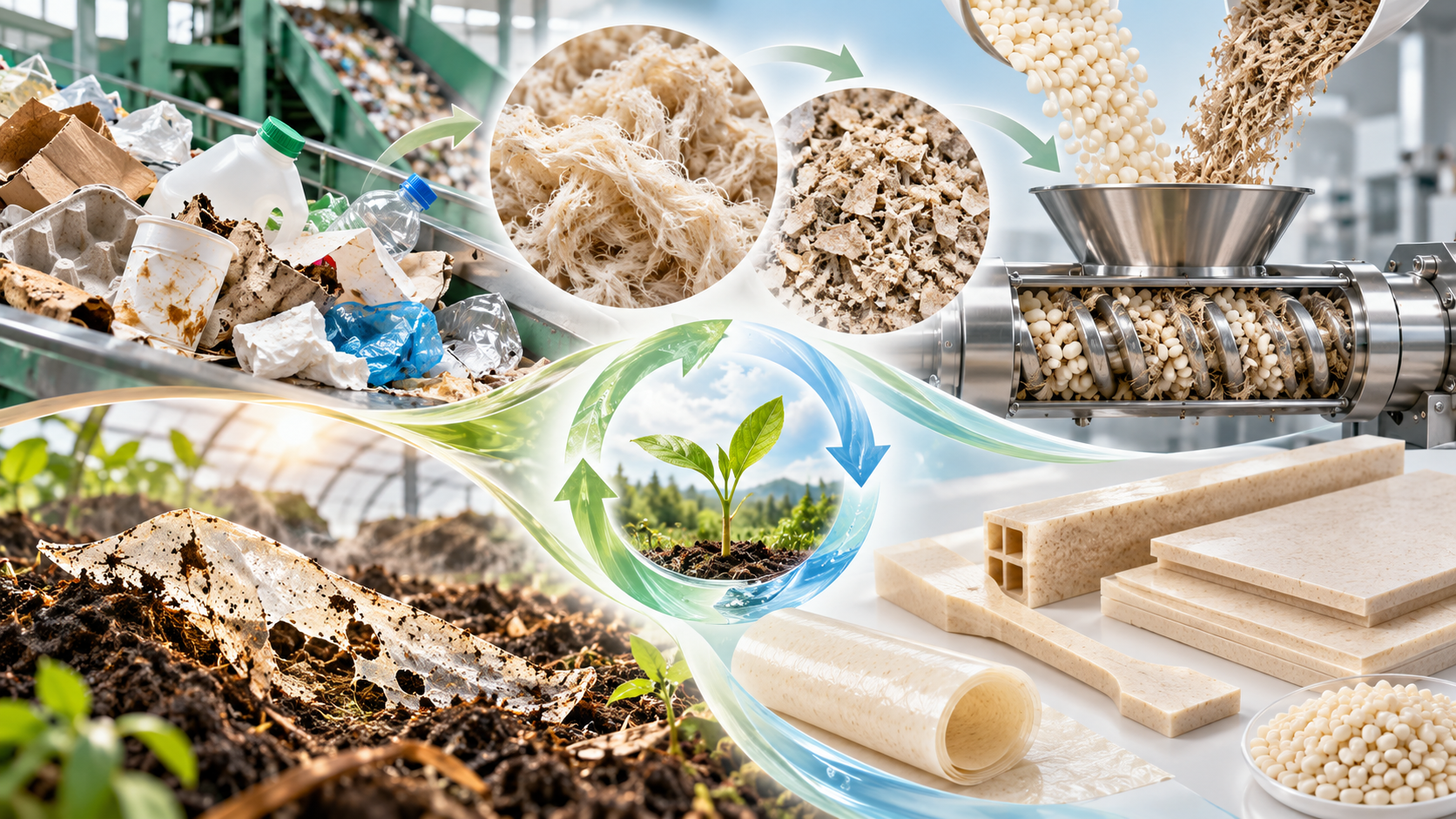
Paper: Direct upcycling of unrecyclable household waste into biodegradable high-performance biocomposites. AI-generated abstract conceptual image created using ChatGPT/OpenAI
In a recent study published in the journal Communications Chemistry, researchers demonstrated a method that incorporates lignocellulosic material recovered from unrecyclable household waste streams into biodegradable poly(L-lactide) (PLLA) biocomposites. The method uses recovered lignocellulosic pulp and secondary post-hydrolysis residues from contaminated municipal waste streams as reinforcement in commercial PLLA.
The resulting materials achieved a tensile modulus of approximately 6 GPa and completely disintegrated under simulated industrial composting conditions within 30 days. The findings point to another route for using household waste fractions that would otherwise be rejected during recycling.
Addressing Recycling Rejects
Conventional recycling systems can leave contaminated material unrecovered, complicating the transition to a circular materials economy. The United Kingdom alone generates approximately 27 million tonnes of household waste each year, yet the national recycling rate has stagnated at around 45%.
When materials recovery facilities (MRFs) process mixed recyclables, they can reject up to 30% because of heavy contamination and sorting limitations. This rejected material is often sent to landfills or incineration, adding disposal costs for local authorities, including landfill gate fees of about £150 per tonne.
The degraded lignocellulosic pulp recovered from these waste streams has traditionally held little value, creating a need for alternative uses.
New Processing Methodology for Waste Valorization
Researchers tested a processing route for two waste streams: recovered solids (RS) from the paper and cardboard fraction of MRF rejects, and post-hydrolysis solids (PHS) produced during enzymatic saccharification of the recovered pulp.
The process begins with hot-water washing at 80 °C for 30 minutes to reduce microbial load and loosen adhered contaminants, followed by rinsing and removal of coarser impurities. The solids are dried and dry-blended to create a uniform fibrous material for polymer processing.
The washed residues are mixed with commercial PLLA pellets, with RS or PHS constituting 30 wt% in each composite. This mixture is processed using a co-rotating twin-screw extruder, with barrel temperatures set at 170 °C in the feeding zone, 180 °C in zones 1-3, and 190 °C in zones 4-6, followed by a die temperature of 200 °C.
The extruded strands are pelletized and processed by high-pressure injection molding. Differential scanning calorimetry and tensile testing characterize the composites, and scanning electron microscopy examines the washed RS and PHS. Industrial composting is simulated at 58 ± 2 °C for 37 days using 0.06-mm compression-molded film specimens, with residual dry mass used to measure disintegration.
Mechanical Properties and Composting Behavior
Chemical compositional analysis found that the RS contained approximately 68% total sugars, primarily cellulose, and about 21% lignin. The PHS had a more fragmented structure. As-received PHS contained 47% extractives and 24% ash; after washing, the authors estimated that inorganics made up about 50% of the material.
Thermal analysis showed that both waste-derived materials helped PLLA form crystalline regions more readily by acting as nucleating agents in the PLLA matrix. Their incorporation increased the degree of crystallinity in the injection-molded composites from 20% for the neat PLLA control to approximately 40%.
The waste fractions also acted as mechanical reinforcements, so the stiffness increase cannot be attributed to crystallinity alone. The biocomposites reached a tensile modulus of approximately 6 GPa, compared with 2.5 GPa for unreinforced PLLA at a comparable degree of crystallinity. Tensile strength remained approximately 60 MPa across the composite formulations. The composites yielded and fractured at lower strains than neat PLLA, showing a trade-off between stiffness and ductility.
The composting tests also showed faster disintegration of the waste-derived composites. Both RS- and PHS-reinforced materials completely disintegrated within 30 days under simulated composting conditions. By comparison, the unmodified PLLA samples lost only 40% of their mass during the same period, though neat PLLA reached about 94% disintegration by day 37.
The authors note that this acceleration occurred with higher PLLA crystallinity and propose that breakdown of RS and PHS creates pores, increasing water and microbial access to the PLLA matrix. The composting specimens were 0.06-mm films rather than the 3-mm injection-molded tensile specimens, so the 30-day result applies to that test format.
Practical Applications and Scale-Up
The direct upcycling method produced structural biocomposites in the study; packaging applications were not tested. Researchers show that washed, unbleached waste fractions can be compounded with thermoplastic polymers without bleaching or papermaking. This allows recovered material from contaminated waste streams to be processed into polymer composites that combine mechanical stiffness with complete disintegration under simulated industrial composting conditions.
At larger scales, this method could reduce the amount of contaminated municipal waste sent to landfills or incineration and create a composite feedstock from material otherwise destined for disposal. The study does not report industrial processing costs or a new full-process lifecycle assessment, so those questions remain open before commercial use.
Toward Fully Waste-Derived Composites
One potential environmental benefit comes from removing the bleaching and papermaking stages used in the authors' earlier process.
Based on the authors' previous cradle-to-gate LCA model, removing those steps could cut global warming potential, a lifecycle measure of climate impact, by up to 5.65 kg of carbon dioxide (CO2) equivalent per kilogram of recovered lignocellulosic pulp. This figure is based on the earlier model rather than on a new life-cycle assessment of the complete process reported in the present study.
The authors propose combining this method with biorefinery processes that convert waste-derived carbohydrates into lactic acid or lactide. The aim is to produce both the PLLA matrix and reinforcement from waste. Industrial-scale studies would still need to measure environmental performance, processing requirements, and economic feasibility.
Disclaimer: The views expressed here are those of the author expressed in their private capacity and do not necessarily represent the views of AZoM.com Limited T/A AZoNetwork the owner and operator of this website. This disclaimer forms part of the Terms and conditions of use of this website.