“No flying machine will ever fly from New York to Paris,” aviation pioneer Orville Wright once said. What even the visionary Wright brothers considered impossible is now a reality – thanks in part to new materials that make modern aircraft and engines possible in the first place. In the more than 100 years since the Wrights’ first flight attempts, aviation has not only become more powerful but, fortunately, also significantly safer. The materials used in aircraft construction must meet the strictest safety requirements, including fire safety standards. At the same time, they must be lightweight and mechanically robust – and, increasingly, recyclable as well.
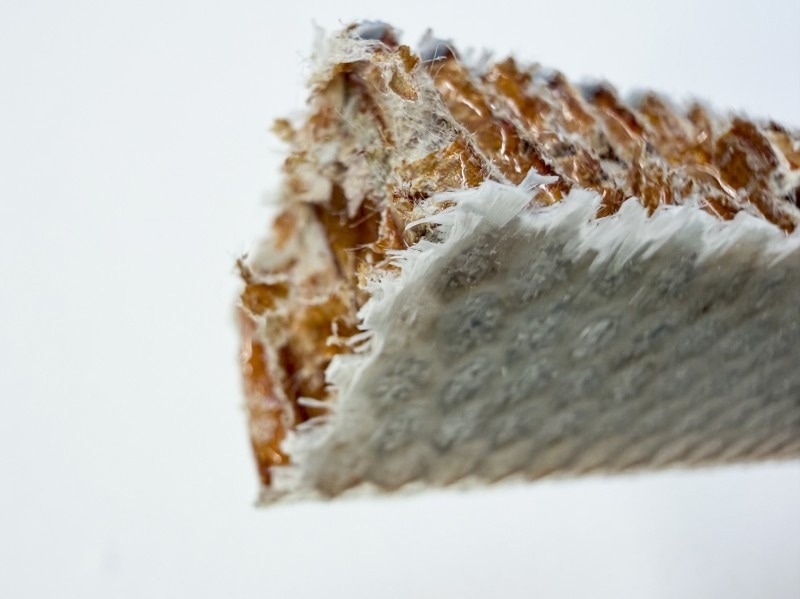 Designed to recycle: With the right solvent and a little heat, the “sandwich” can be broken down again into its individual components. Image Credit: Empa
“Bringing all these properties together under one roof is a challenge,” explains Empa researcher Sabyasachi Gaan from the Advanced Fibers laboratory. “For example, when you make a material flame-retardant, you always end up altering its other properties as well.” Gaan and his team, together with their industry partner Elantas – part of the German specialty chemicals group ALTANA – took on this challenge in a project supported by Innosuisse. Their focus was on a specific composite material used in the interior construction of airplanes and trains, such as for the floor of the passenger cabin.
Making Epoxy More Sustainable
The material is a multilayered “sandwich.” At the center is a honeycomb structure made of aramid, a heat-resistant polymer. This stable, lightweight core is covered on top and bottom with several flat-woven layers of glass or carbon fibers. Epoxy resin serves as the binder, as it does in many composite materials. Normally, this polymer cannot be recycled either chemically or thermally – in other words, it can neither be melted nor dissolved. “Composites containing epoxy currently end up in landfills or are incinerated,” says Gaan.
This is exactly where the Empa researchers have an ace up their sleeves. They have developed an additive for epoxy resin that makes the material flame-retardant – and recyclable at the same time. If epoxy is mixed with this phosphorus-containing molecule during production, it can be softened and reshaped under certain conditions after curing – a process known as thermomechanical recycling, which was previously impossible for epoxy.
All Components Recovered
In the Innosuisse project, the partners pursued a different goal: the complete recycling of the composite material. With the right solvent and a little heat, the “sandwich” can be broken down again into its individual components: the honeycomb structure and the woven fibers. Aramid honeycombs in particular – but also carbon fibers – are relatively expensive. Recycling them is therefore also economically attractive. “In principle, it’s also possible to recover the epoxy resin itself from the solution. We plan to tackle that in future projects,” says Gaan.
The recyclable epoxy resin was developed at Empa. Together with Elantas, the researchers have now explored its potential for industrial application for the first time. “Our material complies with fire safety regulations and achieves nearly the same advantageous mechanical properties as conventional epoxy,” says Gaan. “But for the first time, it allows for complete recycling of the composite material.”
The partners are satisfied with how the project is progressing. The next step is to further scale up production and recycling. “For the aerospace industry, it is crucial to combine fire protection, lightweight construction, and recyclability. This epoxy composite system demonstrates that this is now possible for the first time,” says Fiorenzo Lenzi, Head of the Aerospace/Ballistic Product Line at Elantas.
At the same time, Sabyasachi Gaan and his team are already researching additional applications for the recyclable, flame-retardant plastic, such as in the energy sector and the construction industry. The scientist emphasizes that the fact a material has come this far is also thanks to basic research. “Before we can work on the applications, we need to have a very good understanding of the material’s properties.” The Wright brothers would likely agree with him. For, as Wilbur Wright wrote in a 1900 letter to the engineer Octave Chanute, “It is possible to fly without motors, but not without knowledge and skill.”
Novel flame-retardant and recyclable fiber-reinforced composite
Empa researchers developed a novel composite made of epoxy and glass fibers that is flame-retardant and fully recyclable. Video Credit: Empa