Witness remarkable precision and adaptability with this state-of-the-art thermal analysis system, designed to swiftly and accurately identify the thermal characteristics of various materials.
Broad temperature range: Engineered for temperature assessments up to 1600 °C, it delivers reliable results even in the most challenging conditions.
Automatic sample changer: Enhance efficiency with the LFA 707 StratoFlash® Classic’s automated sample changer. This feature enables accurate analysis of five samples simultaneously under uniform conditions, facilitating accelerated research and development and quality control processes.
Precise laser system: Owing to its monochromatic, coherent, and collimated beam, the technology attains remarkable accuracy in measurements, allowing for the identification of even the tiniest changes in temperature response.
Wide choice of sample holders: Regardless of whether users are dealing with solids, liquids, pastes, powders, or intricate composites–including anisotropic and multilayered designs–this device adjusts effortlessly to various requirements. The system accommodates both round and square sample shapes, with sizes between 6 and 25.4 mm, and offers a non-invasive testing approach that preserves the integrity of samples for subsequent examination or application.
Advanced calculation models and perfect fit: With sophisticated, user-friendly models, users will benefit from seamless data evaluation, accurate curve fitting, and dependable results.
Automatic Sample Changer for Three or Five Samples
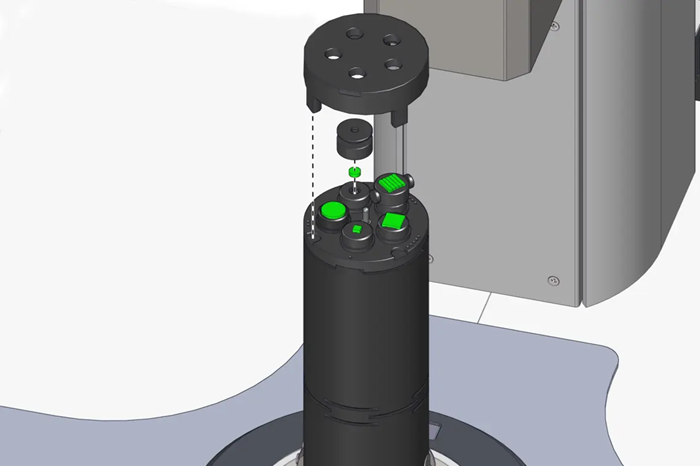
Image Credit: NETZSCH-Gerätebau GmbH
Discover superior performance with the LFA 707 StratoFlash® Classic. Its fully automated sample changer allows assessment of various samples under the same conditions, ensuring consistently uniform and comparable results.
This smart automation significantly enhances productivity, rendering the system well-suited for research labs, product development groups, and quality assurance settings that require accuracy and efficiency. The LFA 707 StratoFlash® Classic optimizes the workflow, making it quicker and more dependable than before.
Smart Sample Organization for Maximum Lab Efficiency
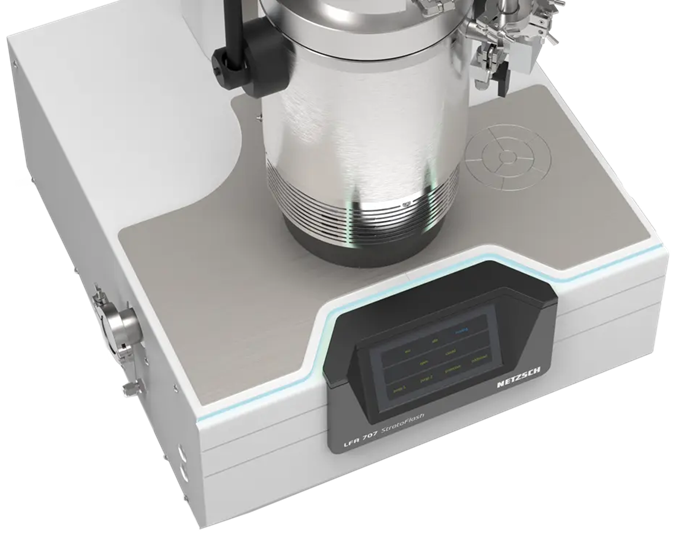
Image Credit: NETZSCH-Gerätebau GmbH
The top cover of the device serves as a practical space for sample preparation and storage. It has been carefully crafted with four clearly defined sections, each linked to particular specimen locations within the furnace.
This novel arrangement streamlines the process of identifying samples and preparing them for assembly, reduces the time instruments are inactive, and proves particularly advantageous in settings with multiple users.
Method
Efficiently Determine Thermophysical Properties with the Laser Flash Method
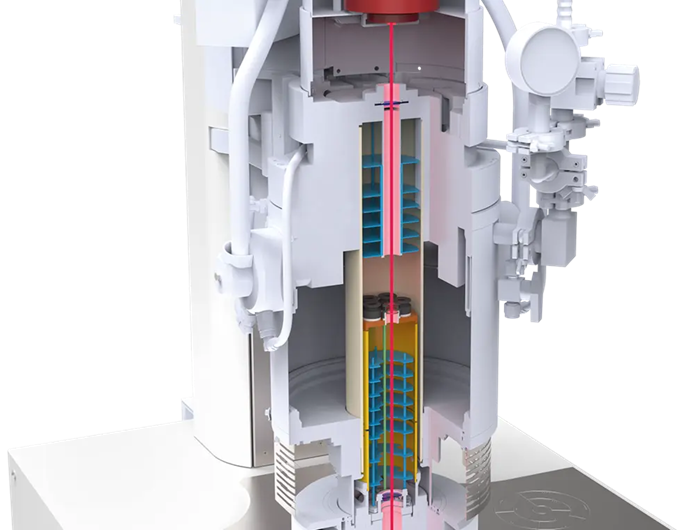
Cross-section of the LFA 707 StratoFlash®. Image Credit: NETZSCH-Gerätebau GmbH
The laser flash (LFA) method is a rapid, definitive, non-destructive, and non-contact technique used to precisely measure thermal diffusivity. This advanced approach not only assesses thermal diffusivity but also evaluates the specific heat of materials when a reference sample is employed.
During the LFA process, the front side of a plane-parallel specimen is heated by a brief burst of energy. An infrared (IR) sensor detects the subsequent temperature variation at the rear of the specimen. Utilizing this data, both thermal diffusivity and specific heat can be determined.
To work out thermal conductivity, the thermophysical characteristics are integrated with density through the formula: λ(T) = α(T)⋅cp(T)⋅ρ(T)
Where:
λ = thermal conductivity [W/(m·K)]
α = thermal diffusivity [mm2/s]
cp = specific heat capacity [J/(g·K)]
ρ = density [g/cm3]
Due to its ability to examine various materials at different temperatures, the LFA method is crucial for both researchers and industries seeking a comprehensive understanding of thermal characteristics.
Specifications
Source: NETZSCH-Gerätebau GmbH
|
LFA 707 StratoFlash® Classic |
| Temperature Range |
RT to 1600 °C |
| Heating rate |
0.01 K/min to 50 K/min |
| Automatic Sample Changer (ASC) |
Sample holder support with three insets for samples ≤25.4 mm
Sample holder support with five insets for samples ≤12.7 mm |
| Thermal diffusivity |
0.01 mm2/s to 2000 mm2/s |
| Thermal conductivity |
0.1 W/(m·K) to 4000 W/(m·K) |
| Laser System |
Pulsed Nd: Glass
- Wavelength: 1054 nm
- Software-controlled pulse width and voltage between <0.05 ms and 1.5 ms in steps of 0.01 ms
- Adjustable energy: 0.25–25 Joules/pulse
- Patented pulse mapping for finite pulse correction (patent number: US20040079886)
|
| Accuracy* |
Thermal diffusivity: ±2.5%
Specific heat capacity:± 5% |
| Repeatability** |
Thermal diffusivity: ±1%
Specific heat capacity: ±3% |
| Measurement atmospheres |
Inert or vacuum (< 2x 10⁻⁵ mbar; turbo molecular pump) |
| IR detector |
InSb: RT to 1600 °C, optional LN2 refill system including 35 liter dewar |
| Software including calculation and correction models |
Each model can be combined with four different baseline corrections (including shifted baseline) and w/o pulse correction; display of detector signal and model fit, data export; various special and extended models |
| Specimen dimensions and shapes*** |
Round: 6 mm, 8 mm, 10 mm, 12.7 mm, 20 mm, 25.4 mm; thickness: 0.1 mm to 6 mm
Square: 10 mm x 10 mm, 20 mm x 20 mm; thickness: 0.1 mm to 6 mm |
| Special sample holder systems |
- Molten polymers/low-viscosity liquids (including low-viscosity materials such as water)
- Sample holder especially for tests on resins during curing
- Pastes, powders, fibers
- Laminates
- In-plane
- Mechanical pressure
|
* Deviation of the measured value from the "true value" (literature value) according to validation with reference materials.
** Deviation using the same operator and equipment over a short time according to validation with reference materials.
*** Additional sample holders upon request.
Software
Proteus® Software is designed for LFA applications: fast, efficient, and seamlessly integrated!
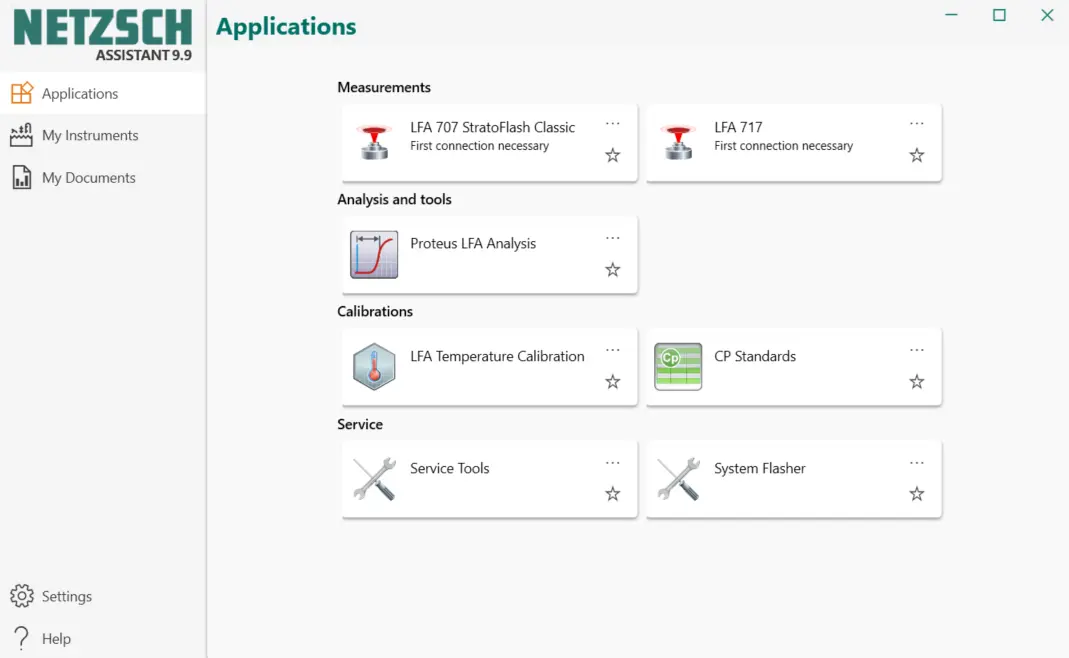
NETZSCH Assistant. Image Credit: NETZSCH-Gerätebau GmbH
The newly developed NETZSCH LFA software is setting new benchmarks in both functionality and user-friendliness, merging sophisticated automation with outstanding adaptability. Built on a strong 64-bit framework and featuring a built-in SQL database, its contemporary interface guarantees rapid loading speeds, efficient memory utilization, and a straightforward, uninterrupted experience from initiation to completion.
The latest version of the software includes the NETZSCH Assistant: a smart guide for efficient operation. This robust tool provides users with a comprehensive overview of all linked instruments and accessible software functionalities, guaranteeing a smooth and effective workflow from the beginning.
Software Advantages
- Modern user interface featuring easy-to-use navigation
- Robust SQL database enabling rapid processing
- Compatible with historic NETZSCH LFA data
- Sophisticated calculation models
- Significant adaptability achieved through a blend of automation and manual oversight
- Automated measurement evaluation
- Capability to export to widely used formats for effortless subsequent processing
Proteus LFA Measurement Features
- Complete automation of the optimization for amplification and measurement time
- Detailed instructions concerning the operational status of instruments and safety protocols
- Representation of pulse and detector signals throughout the measurement process
- Preliminary assessment of thermal diffusivity at the time of measurement
- Definition of any number of temperature steps and the number of shots per step
- Visualization of the sample position in the furnace
- Calibration of temperature to ensure optimal accuracy throughout the complete temperature spectrum
- Defined temperature program featuring customizable heating rates
- User-friendly definition of measurements on a modern and accessible interface
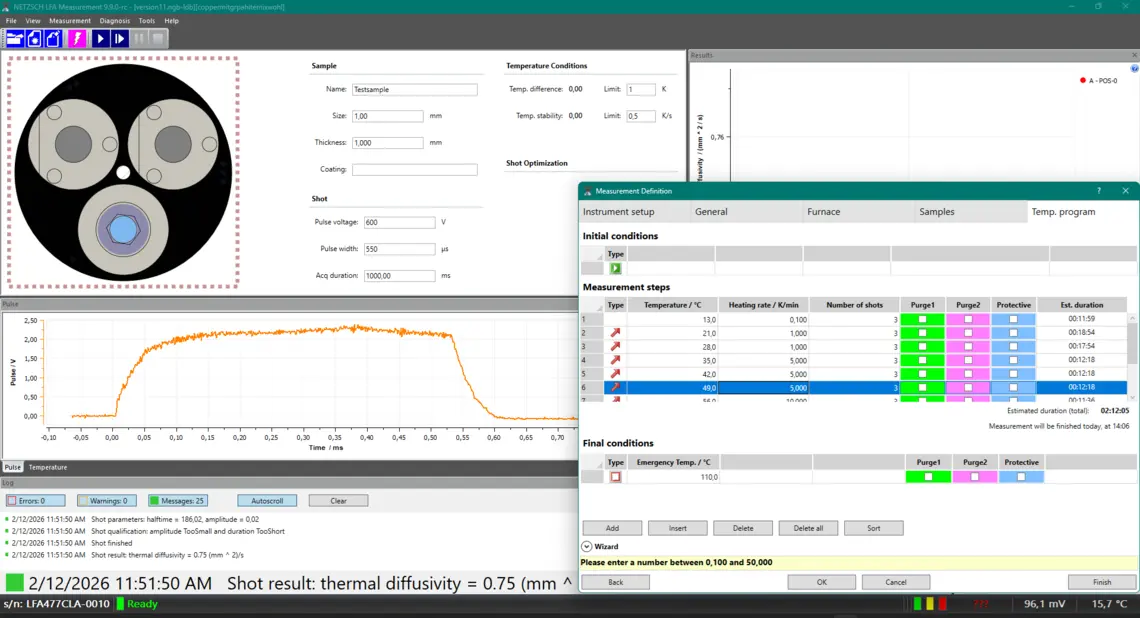
Graphical user interface of the measurement software during measurement definition. Image Credit: NETZSCH-Gerätebau GmbH
Proteus LFA Analysis Features
- Concurrent assessment of various measurements within a database
- Possibility to analyze data from earlier LFA generations
- Computation of the specific heat capacity (cp) through the comparison method
- Assessment of thermal conductivity by incorporating cp and thermal expansion information
- Display of pulse and detector signals, as well as corresponding curve fitting
- Averaging of multiple shots at the same temperature
- Simultaneous presentation of numerous measured parameters, including thermal diffusivity, thermal conductivity, and cp in relation to temperature
- Visual processing with extended detector signal smoothing functionality
- Explanation of how thermal characteristics depend on temperature through commonly used mathematical expressions (including polynomials, splines, and 1/T)
- Display of all relevant shot parameters and results in an extended info grid
- Calculation of “goodness-of-fit” for the purpose of identifying the most suitable calculation model
- Export functions to common file formats, such as .csv
- Zoom function for precise data analysis
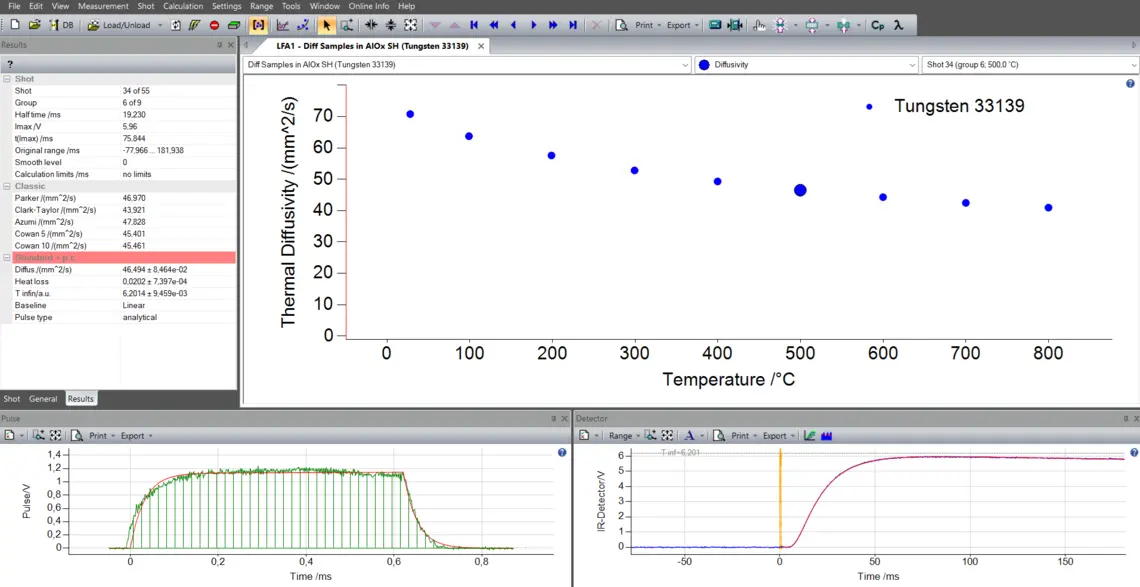
Graphical user interface for analyzing the measurement results. Image Credit: NETZSCH-Gerätebau GmbH
Models and Corrections
Unmatched comprehensive mathematical models are available for accurate and distinct assessment. Besides the conventional model designed for solid, uniform, and isotropic samples, known as the enhanced Cape-Lehman model, various models exist to address specific application needs and adjustments.
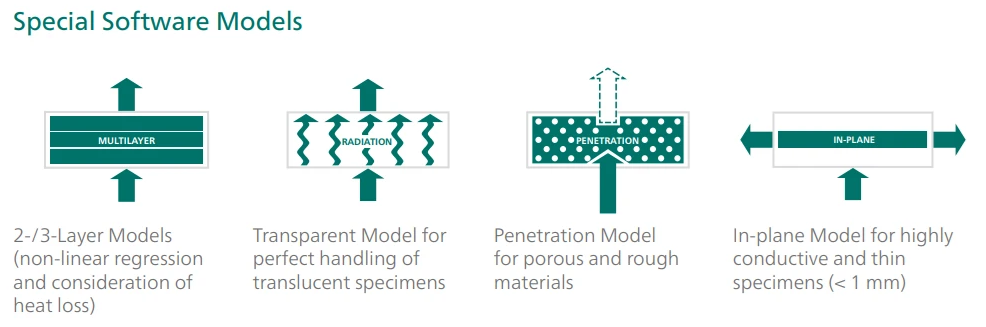
Image Credit: NETZSCH-Gerätebau GmbH
To ensure optimal fit and maximum effectiveness, every model is equipped with standard features including light pulse correction and baseline correction. Users can disable these corrections if they choose. Additionally, all previously referenced models consider heat loss, and the adiabatic (Parker) Model is also offered.
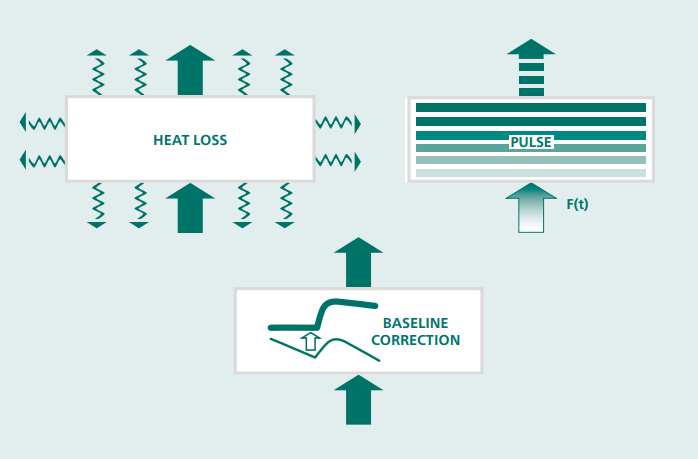
Image Credit: NETZSCH-Gerätebau GmbH
Enhanced Pulse Corrections
The latest software update features enhanced pulse correction capabilities, which greatly enhance the accuracy and time resolution for the analysis of thin or highly conductive substances. Techniques for correction, including equivalent square, center of gravity, and double exponential, markedly influence the model's fit, thereby guaranteeing more dependable thermal diffusivity outcomes.
Precise Evaluation of In-Plane Diffusivity
The majority of LFA software packages employ a one-dimensional assessment model for in-plane measurements. This approach primarily emphasizes in-plane diffusivity while neglecting the impacts of through-plane heat transfer.
To obtain precise results, the effects of through-plane conductivity must be taken into account. Neglecting this consideration may result in considerable discrepancies, especially in materials where the characteristics of in-plane and through-plane properties are markedly different, which can undermine the reliability of the data.