A magnesium–molybdenum trioxide battery was tested in the gastrointestinal tract, powering wireless tracking and electrical stimulation while researchers examined how long it could operate and what happened as its materials degraded.
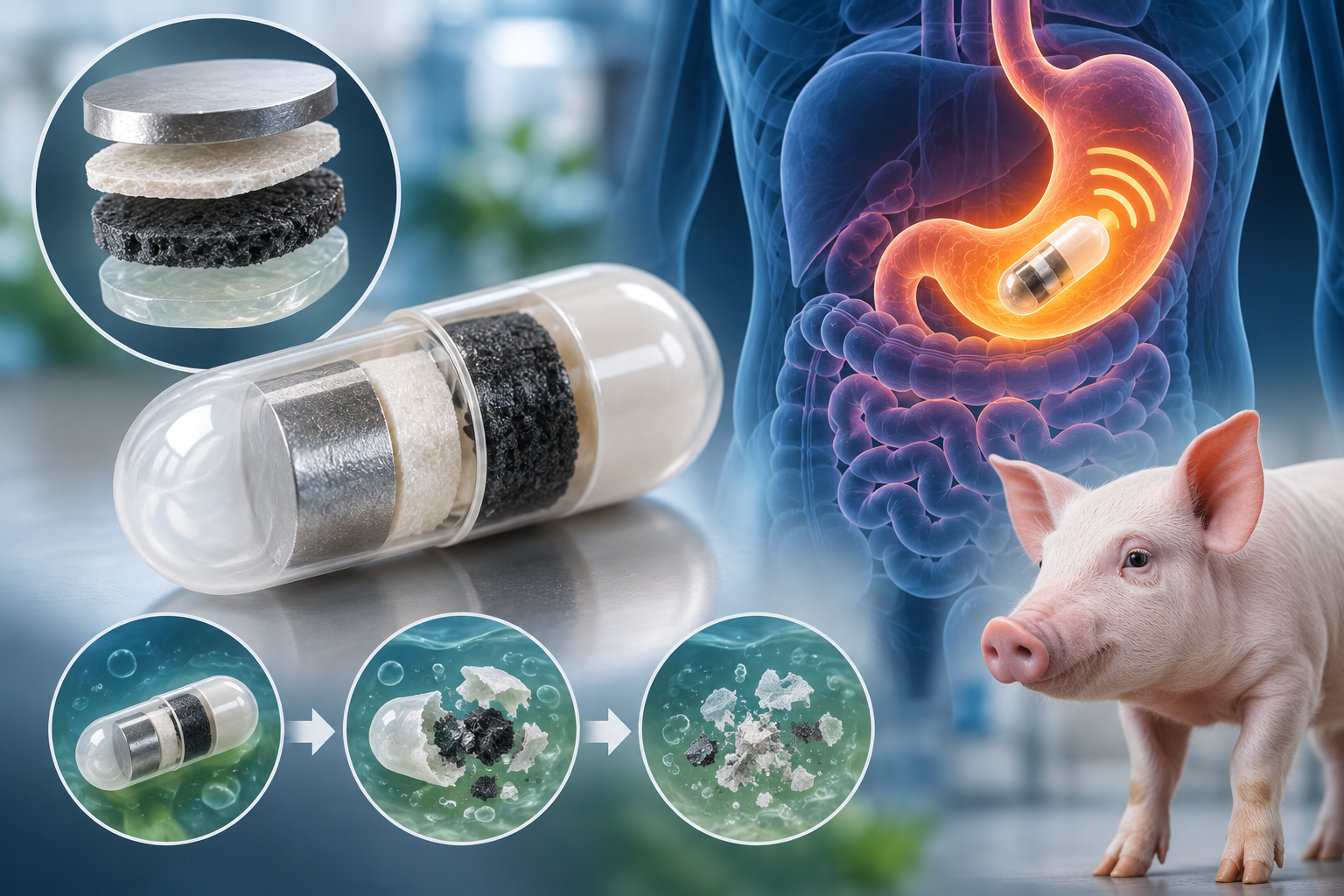
Paper: Bioresorbable batteries for transient ingestible bioelectronics. Image Credit: AI-generated abstract conceptual image created using ChatGPT/OpenAI
A recent study published in the journal Nature Chemical Engineering introduced a bioresorbable magnesium-molybdenum trioxide paper battery with a peak open-circuit voltage of 1.84 V, measured with no electrical load connected.
Researchers developed the battery to power capsule-scale medical devices in the gastrointestinal (GI) tract, with its components designed to degrade into physiologically processable products after use. The battery remained functional during the tested operating periods in laboratory and swine studies, and estimated exposures to magnesium- and molybdenum-derived products were below cited daily intake levels.
For devices retained in the stomach, bioresorbability could reduce the need for endoscopic retrieval and limit electronic waste.
Challenges in Powering Ingestible Devices
Ingestible and implantable electronic systems are being developed for continuous health monitoring, targeted drug delivery, diagnostic biosensing, and related medical uses. Powering these devices remains a major challenge due to biocompatibility concerns and the waste generated by conventional batteries. Alkaline and lithium-ion cells can pose serious safety risks when used inside the body.
Electrochemical side reactions or packaging failures can lead to toxic electrolyte leakage, tissue damage, or gas formation. Non-degradable casings can cause problems if a battery is retained or damaged, and they can add to electronic waste.
For capsules that pass through the GI tract within 1 to 3 days, the paper describes bioresorbability primarily as an added safety margin. For devices retained in the stomach for several days, it can remove the need for a later retrieval procedure.
The Magnesium-Molybdenum Trioxide Battery
Researchers built the bioresorbable battery around magnesium-molybdenum trioxide chemistry. The anode was a 250 μm-thick bioresorbable AZ31 magnesium alloy, selected for its high energy density and ability to degrade into ions that the body can process.
The cathode comprised a 200 μm-thick molybdenum trioxide paper composite layered onto a 25 μm-thick molybdenum foil current collector. Cellulose nanofibrils served as the cathode binder, improving mechanical integrity and allowing precise control of active material loading.
The electrolyte was a biodegradable ionic liquid made by melting choline chloride with DL-lactic acid. It was incorporated into a gelatin-based gel matrix to maintain contact between the battery components. Beeswax served as the main encapsulation material for short-term gastric protection. Candelilla wax was added in longer-retention and passage studies because it degrades more slowly and provides a stronger humidity barrier.
Researchers laser-cut the electrodes and current collectors and used 3D printing for molds, capsule bodies, and retention structures. The smaller cell, about 7.5 mm in diameter, was sized to fit inside standard 000-size gelatin capsules. A larger planar battery was made for devices requiring more power.
Electrochemical Performance and Testing Outcomes
Electrochemical testing showed that the bioresorbable cells could power ingestible devices. The large-area battery reached a maximum capacity of 3.5 mAh at a current density of 0.2 mA/cm². During discharge, it maintained an operating voltage of about 1.6 V for 24 hours and achieved an areal energy density of 4.13 mWh/cm², the energy stored per unit battery area.
Live swine were used to assess the wax-encapsulated batteries under gastric conditions. The 000-size batteries were placed in arm-shaped capsules intended to prevent passage through the pylorus, the outlet from the stomach to the small intestine. Large-area battery capsules were attached to the gastric wall with an endoclip.
Measurements taken after retrieval at 24 or 72 hours showed that the batteries remained electrically functional, though their voltage and energy density declined as the protective layers and internal materials degraded.
Separate experiments characterized material breakdown under simulated GI conditions. In accelerated simulated gastric fluid tests at 75 °C, the wax layers progressively delaminated, the electrodes dissolved within two weeks, and complete structural degradation occurred over several months. Open-circuit voltage fell at a near-linear rate during prolonged exposure, with self-discharge and corrosion contributing strongly to the decline.
In GI passage studies, capsules softened and fragmented over one to two weeks, and small metallic traces were occasionally detected.
The authors estimated that magnesium- and molybdenum-derived products were below cited daily intake levels. They cite these calculations and earlier biocompatibility studies in support of the proposed safety profile, but the evidence does not establish human clinical safety.
Implications in Gastrointestinal Monitoring and Therapy
In one demonstration, the battery powered a radio-frequency identification (RFID) tag. Communication was measured up to 4 m in air and 1.5 m in the swine esophagus. The in vivo test identified ingestion from a sudden change in received signal strength under fixed reader conditions. It did not track continuous movement through the upper GI tract. The RFID chip, about 18 mm², was the system's non-resorbable component and was expected to pass naturally through the GI tract.
The battery also powered a largely biodegradable capsule designed for gastric electrical stimulation. The internal circuit delivered electrical pulses to the stomach mucosa through molybdenum electrodes. Bench testing showed that a single battery could power continuous stimulation for up to three days, while the hormone experiment itself used 20 minutes of stimulation.
In the three stimulated swine, plasma ghrelin increased by an average of 36.3% ± 12.85%, with a maximum increase of about 50% at the end of the 20-minute stimulation period. The printed circuit board was not biodegradable, remained intact during passage tests, and was naturally excreted. These results show that the capsule can alter a hunger-related hormone in this preclinical model, but they do not establish therapeutic benefit in humans.
Future Directions in Bioelectronic Medicine
The study developed a bioresorbable battery that pairs biodegradable materials with the electrochemical output needed for ingestible bioelectronics. Biodegradable ionic liquid electrolytes and cellulose-bound electrodes allowed the battery to power electronic devices during operation and then degrade after use.
The battery could support retrieval-free designs, but the demonstrated RFID and stimulation systems still contained non-resorbable electronic components expected to pass naturally through the GI tract.
Future research could examine manufacturing consistency, shelf life, control of functional lifetime and degradation rate, behavior under fed-state conditions, changes in pH, mucus and motility, and pharmacokinetics. The in vivo experiments involved small cohorts of fasted swine, so further safety and performance studies are needed before clinical testing in humans. The paper also states that M.G.S. and G.T. are co-inventors on a patent application describing the reported system.
Disclaimer: The views expressed here are those of the author expressed in their private capacity and do not necessarily represent the views of AZoM.com Limited T/A AZoNetwork the owner and operator of this website. This disclaimer forms part of the Terms and conditions of use of this website.