Design Approaches to Enhance Electrical and Dielectric Properties of Engineering Plastics
Conclusion
References and Further Reading
The uses of engineered plastics are widespread, and they're especially important in modern electronics. Dielectrics can insulate, separate charges, and store energy in some cases. Even in the (at times) punishing conditions of the tech world - high temperatures and strong electric fields - they allow electronics to perform.
Image Credit: ShiningBlack/Shutterstock.com
Plastics are inherently dielectrics or electrical insulators, with electrons tightly bound within their covalent polymer chains, preventing the free flow of charge. This property makes them indispensable in electrical and electronic applications, including wire coatings, switches, and insulating components.
The dielectric behavior of plastics depends on their molecular structure, which classifies them as either polar or nonpolar. Polar plastics exhibit dipolar polarization with frequency-dependent dielectric behavior, while non-polar plastics rely on electronic polarization, yielding lower dielectric constants.
By engineering plastics, we can design and enhance the fundamental properties of a polymer for its intended application. These enhancements are achieved by introducing polar functional groups, high-dielectric or conductive fillers to increase polarization and reduce charge migration, and by applying precise processing techniques that ensure uniform microstructure and minimize defects.
Combining these strategies, engineered plastics can deliver high dielectric strength, low energy loss, and thermal stability, making them suitable for high-voltage, high-frequency, and high-temperature applications in motors, capacitors, sensors, connectors, and other advanced electrical and electronic systems.1,2
Design Approaches to Enhance Electrical and Dielectric Properties of Engineering Plastics
Supramolecular Network Engineering
Engineering a polymers supramolecular network involves introducing non-covalent interactions, such as coordination bonds, π-π stacking, hydrogen bonds, and dipolar interactions, within or between polymer chains.
These interactions result in a number of changes. They restrict segmental chain mobility and reinforce mechanical integrity, introduce charge-trapping sites that retard carrier migration, and modify polarization behavior. Collectively, these small tweaks improve the dielectric constant, breakdown strength, and high-temperature stability, without the dispersion challenges associated with inorganic fillers.
Boron-Nitrogen Coordination in PEI for High-Temperature Dielectric Stability
A recent study in the Journal of Materials Chemistry A showed the success of introducing a boron-containing small molecule into a polyetherimide (PEI) matrix to improve dielectric stability. The boron addition formed B-N coordination bonds between boron atoms in the additive and nitrogen sites along the polymer backbone.
This coordination network increased mechanical rigidity and reduced charge migration, improving dielectric stability at temperatures up to 200 °C. The modified polymer exhibited substantially higher energy density and efficiency while maintaining flexibility and long-term electrical reliability.3
Enhancing PEI Dielectrics via In Situ Supramolecular Polymerization
In another study, researchers doped PEI using diketopyrrolopyrrole derivatives (DPP-nC) with tunable spacer lengths to induce in situ supramolecular polymerization.
By selecting DPP-4C, which has the strongest tendency to polymerize, they created a highly ordered supramolecular crosslinked network within the matrix. This network enhanced interfacial and orientation polarization, increased dielectric constant, restricted chain mobility, and introduced effective charge-trapping sites, improving breakdown strength and suppressing leakage currents at elevated temperatures.
The resulting PEI-DPP-4C composite achieved a discharge energy density of 5.89 J cm-3 at 150 °C and 4.19 J cm-3 at 200 °C with charge-discharge efficiencies approaching 90 %, while maintaining stable performance over 105 cycles at 200 MV m-1 and 200 °C.4
Saving this article for later? Grab a PDF here.
Additive Manufacturing and Multiscale Filler Techniques
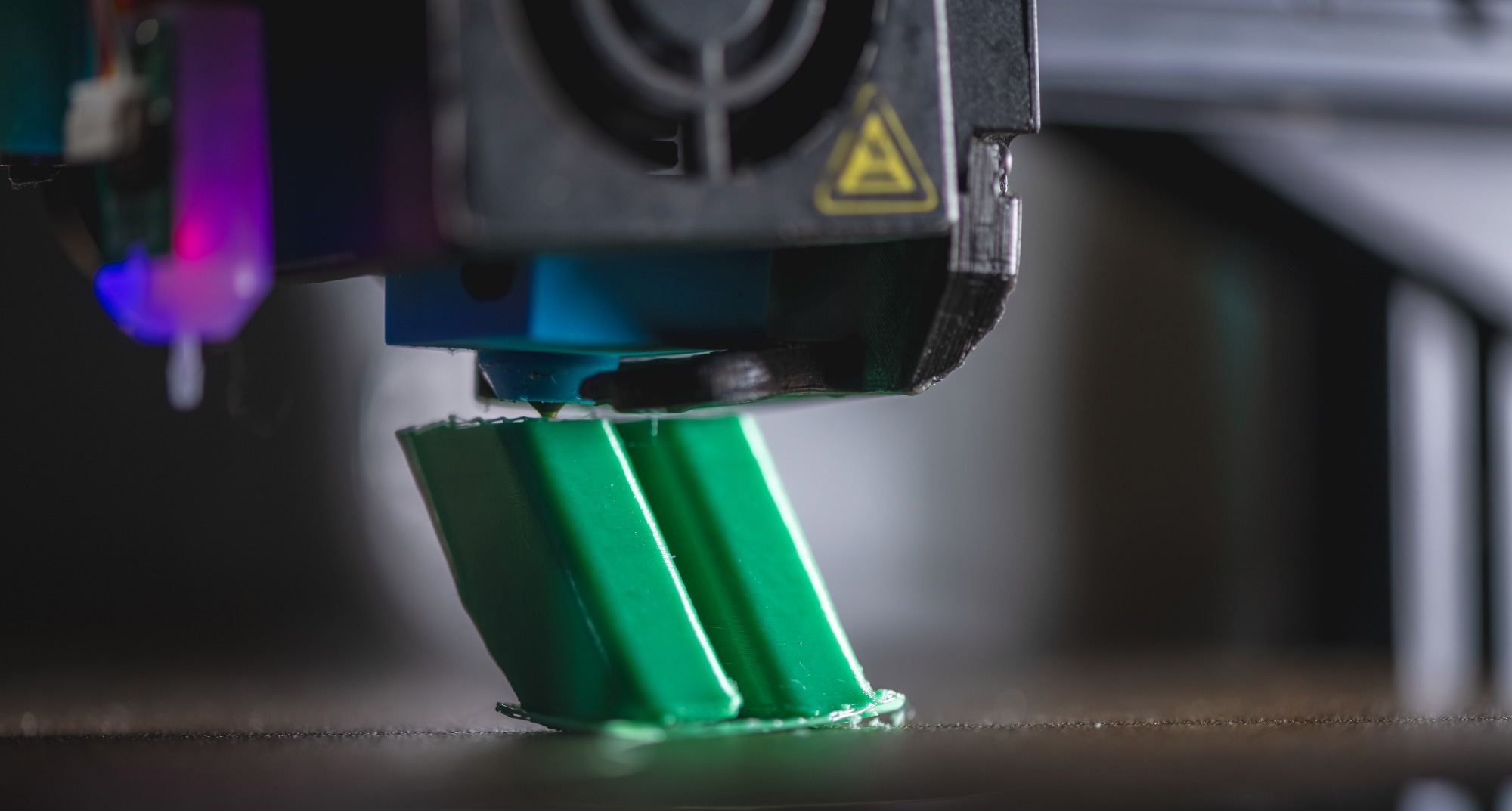
Image Credit: Olga Ilina/Shutterstock.com
Additive manufacturing is another approach to improve plastic dielectricity. With 3D printing, filler dispersion can be tightly controlled, minimizing overall defects such as voids and micro-cracks, and enabling tailored microstructural design.
When combined with multiscale filler techniques, it allows the integration of micro- and nanoscale fillers that create hierarchical structures, enhance interfacial polarization, and introduce effective charge-trapping sites.
This approach improves the uniformity of ceramic and conductive fillers within a polymer matrix, strengthens interfacial interactions, and optimizes local polarization, collectively increasing dielectric constant, breakdown strength, and thermal stability.
FDM-Enabled Dielectric Enhancement
Another study has demonstrated this effect using fused deposition modeling (FDM) 3D printing to fabricate three-phase nanocomposites of poly(vinylidene) fluoride (PVDF), barium titanate (BT), and multiwalled carbon nanotubes (MWCNTs).
The process ensured uniform dispersion of BT and MWCNTs, minimized agglomeration, and reduced microstructural defects. The use of BT improved overall dielectric strength, while the addition of MWCNTs enhanced local polarization.
The nanocomposite exhibited a dielectric constant of 118 and a loss of 0.11 at 1 kHz, clearly indicating the possibility of additive manufacturing in producing high-performance, scalable polymer dielectrics.5
Filler-Engineered High-Performance Dielectric Vitrimers
Another study in the Journal of Materials Chemistry A reported the application of multiscale filler engineering to epoxy vitrimers by incorporating boron nitride (BN) micro-platelets and using theoretical calculations of filler-polymer interfacial energy levels to guide dispersion and matrix interaction.
The fillers were aligned using additive manufacturing to create efficient thermal and electrical transport pathways. This produced a composite plastic with high thermal conductivity, an elevated glass transition temperature, and improved dielectric breakdown strength, maintaining stability even at 180 °C and achieving a 67 % improvement over the unfilled vitrimer.6
Combined Molecular and Insulation Structure Design
Combined molecular and insulation-structure design can enhance dielectric performance by integrating polymer chemistry with an optimized insulation geometry.
Molecular modifications, whether adding branching units or polar groups, tune the dielectric constant, breakdown strength, and charge trapping, while structural design controls the electric field distribution and reduces partial discharge risks.
Traditionally, these strategies have been applied separately, either by increasing insulation thickness to lower local field strength or by modifying polymer chemistry through nanoparticle doping. But both approaches have limitations. Examples include reduced power density, poor filler dispersion, and processing complexity.
The joint approach overcomes these challenges, simultaneously improving material and structural performance, enabling higher voltage operation, increased energy density, and reliable insulation in components such as motor windings, capacitors, and high-voltage cables.
Branch-Structured Polyimide Insulation for High-Voltage Motor Windings
In a study published in Polymers, researchers combined these methods by synthesizing a polyimide matrix with a controlled molecular weight and introducing partial branching units via isocyanate trimers to tune the dielectric properties, while simultaneously optimizing the insulation structure to manage electric-field stress.
This design reduced the outermost electric field strength by 22.11 %, increased the breakdown margin by 26.85 %, and raised the turn-to-turn partial discharge inception voltage by 8.90 %.
In addition, it achieved a dielectric constant of 3.8 and a breakdown field strength of 190 kV/mm, demonstrating that coordinated molecular and structural engineering provides a scalable pathway to enhance the voltage-handling capability and reliability of high-performance enameled wires for new energy vehicle motors.7
Conclusion
The dielectric performance of engineering plastics is shaped by molecular architecture, microstructure, and processing, and the most interesting work right now sits at the intersections.
Supramolecular networks can add charge control without heavy filler loads; additive manufacturing can reduce defects and even orient functional phases; and combined molecular/structural design can raise voltage capability without simply making insulation thicker.
Together, these approaches are helping polymer dielectrics keep their footing as electrification pushes components toward higher temperatures, tighter packaging, and more demanding electric fields.
References and Further Reading
- Tangram Technology. (2026). Plastics Topics – Dielectric properties of plastics. [https://tangram.co.uk/wp-content/uploads/Plastics-Topics-Dielectric-properties-of-plastics.pdf](https://tangram.co.uk/wp-content/uploads/Plastics-Topics-Dielectric-properties-of-plastics.pdf)
- Haque, S. M., Alfredo, J., Abdullahi Abubakar Masúd, Umar, Y., & Albarracin, R. (2017). Electrical Properties of Different Polymeric Materials and their Applications: The Influence of Electric Field. Intechopen.com. [https://doi.org/10.5772/67091](https://doi.org/10.5772/67091)
- Chen, X., et al. (2026). Enhanced energy density of polymer dielectrics at high temperature by building a B–N coordinated supramolecular network. Journal of Materials Chemistry A, 14(11), 6509–6521. [https://doi.org/10.1039/d5ta07894f](https://doi.org/10.1039/d5ta07894f)
- Yang, X., Wu, D., Xie, H., Yan, Z., Luo, H., & Zhang, D. (2026). Enhanced high-temperature energy storage density of all-organic dielectrics by supramolecular crosslinked networks. Chemical Engineering Journal, 528, 172119. [https://doi.org/10.1016/j.cej.2025.172119](https://doi.org/10.1016/j.cej.2025.172119)
- Zhang, Y., Huang, Z., Li, J., & Li, H. (2026). Multiscale structural design of epoxy vitrimers for stabilizing high-temperature dielectric insulation. Journal of Materials Chemistry A, 14(8), 4433–4443. [https://doi.org/10.1039/d5ta07717f](https://doi.org/10.1039/d5ta07717f)
- Kim, H. et al. (2018). Enhanced dielectric properties of three phase dielectric MWCNTs/BaTiO3/PVDF nanocomposites for energy storage using fused deposition modeling 3D printing. Ceramics International, 44(8), 9037-9044. [https://doi.org/10.1016/j.ceramint.2018.02.107](https://doi.org/10.1016/j.ceramint.2018.02.107)
- Yu, Y., Li, S., Weng, L., Zhang, X., Liu, L., & Chen, Q. (2024). Optimization of Insulation Structure Design for Enameled Wires Based on Molecular Structure Design. Polymers, 17(8), 1002. [https://doi.org/10.3390/polym17081002](https://doi.org/10.3390/polym17081002)
Disclaimer: The views expressed here are those of the author expressed in their private capacity and do not necessarily represent the views of AZoM.com Limited T/A AZoNetwork the owner and operator of this website. This disclaimer forms part of the Terms and conditions of use of this website.