In this interview, industry expert Weilin Deng explains the importance of compression pads in managing pressure in lithium-ion batteries. He highlights their role in improving safety, durability, and performance through tailored materials, simulation-driven design, and validated long-term reliability.
To get started, can you give us an overview of why compression pads are important in lithium-ion batteries?
Compression pads play an important role in lithium-ion batteries because cells naturally expand and contract during charge-discharge cycling and can also swell over time. If these changes are not properly managed, battery performance and lifetime can suffer.
By helping maintain the right amount of pressure on the cells throughout operation, compression pads support better capacity retention and longer battery life. They also help accommodate cell movement while contributing to functions such as vibration reduction and electrical insulation within the battery module.
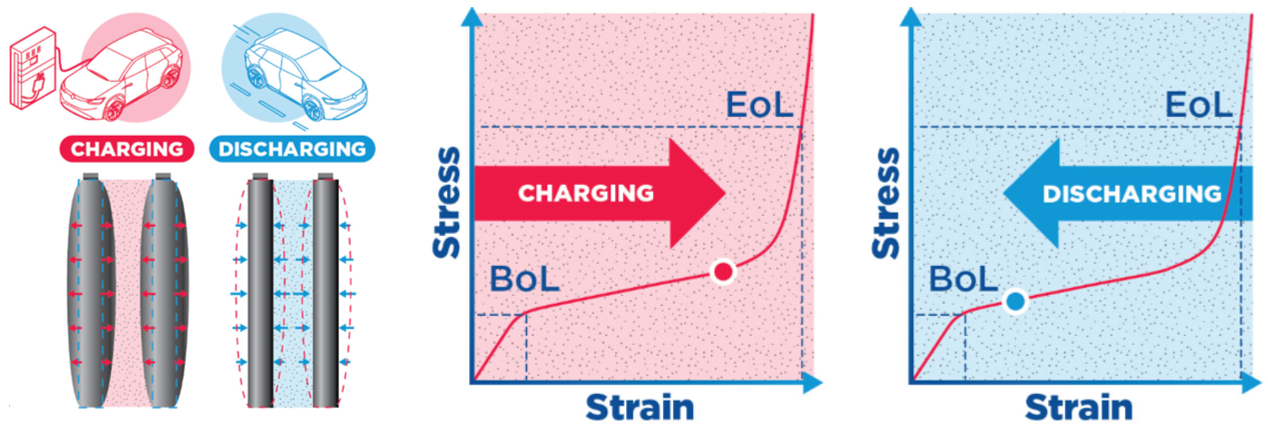
Image Credit: Saint-Gobain Tape Solutions
Why is pressure management in particular so important in lithium-ion battery cells?
Lithium-ion battery cells naturally “breathe” during operation, meaning they expand and contract throughout charge and discharge cycles. Over time, they also experience irreversible swelling.
Research over the past decade has shown that the level of pressure applied to the cell directly impacts its lifetime and capacity retention. There is an optimal pressure range, for example, typically around 20 to 40 kilopascal for pouch cells, that maximizes performance and longevity. . If the pressure is too high or too low, the battery can degrade much faster or even fail prematurely.
Because of this, our goal is to design materials that consistently maintain this optimal pressure throughout the battery's entire lifecycle.
What role do compression pads play in electric vehicle battery systems?
Compression pads are positioned between cells in an electric vehicle battery module, often referred to as cell-to-cell (C-to-C) pads. Their primary function is to accommodate the volume changes of the battery cells during operation while maintaining consistent pressure.
This is a highly dynamic process. As cells expand during charging, the pads compress to absorb stress. When cells contract during discharge, the pads recover and push back to maintain pressure.
In addition to pressure management, compression pads also provide vibration damping and electrical insulation between cells, both of which are critical for safety and performance.
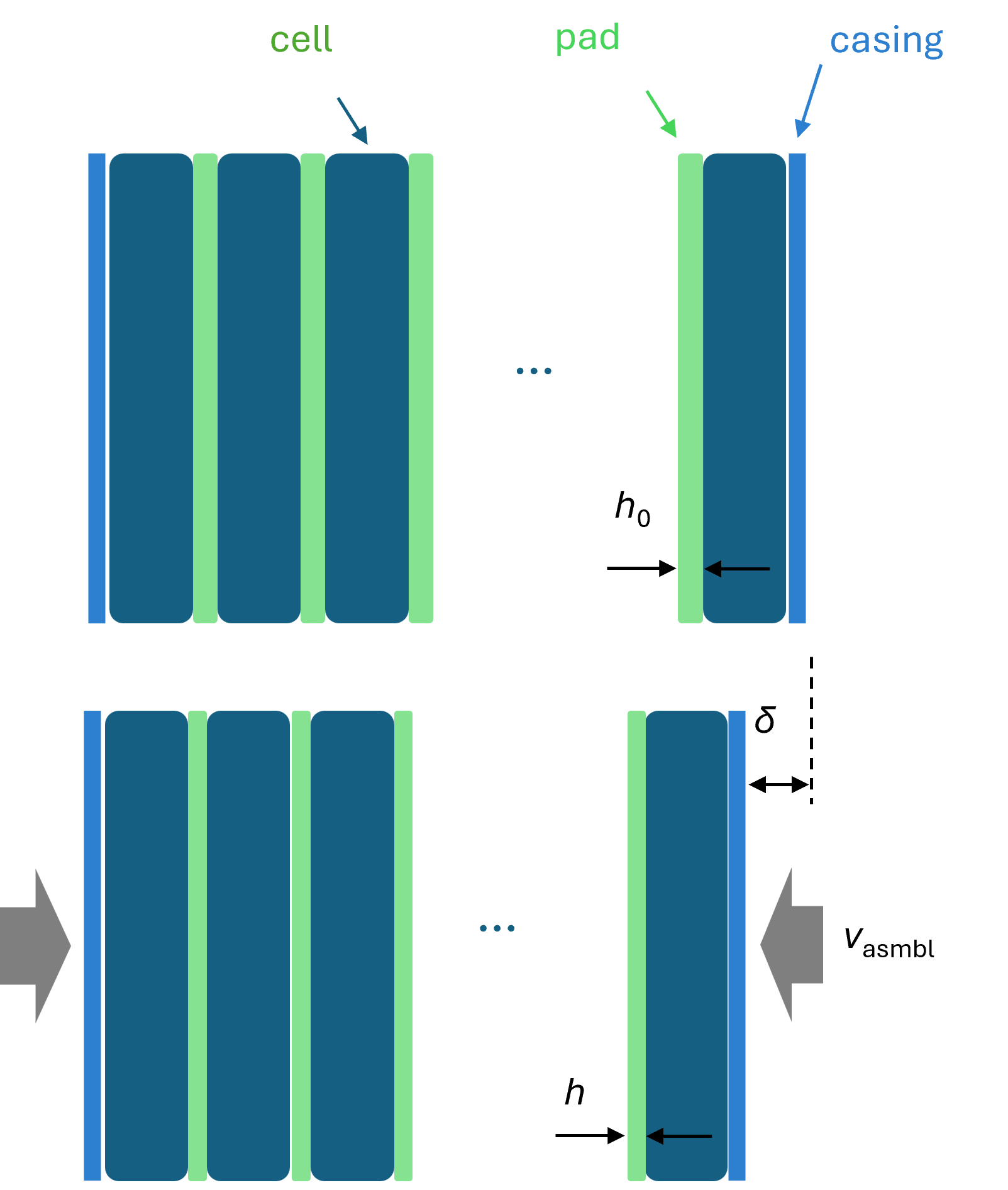
Image Credit: Saint-Gobain Tape Solutions
How do compression pad requirements vary across different battery types?
There is no one-size-fits-all solution because battery requirements vary depending on cell chemistry and design. For example:
- Prismatic cells need moderately stiff materials
- Pouch cells typically require softer compression pads
- Solid-state batteries require very stiff compression pads
We can tailor the compression properties of our materials accordingly. Using compression force deflection (CFD) data, we evaluate performance at different compression levels, such as 20%, 50%, and 70%, to match specific application needs.
Materials like polyurethane foam and silicone foam can be engineered to deliver optimal cushioning, low compression set, and consistent pressure over time.
How does your simulation-driven design model improve compression pad development?
Simulation allows us to rapidly design and optimize compression pads without relying solely on time-consuming lab testing.
For example, when a customer provides a target stress-strain requirement, often referred to as a “green corridor”, we can evaluate whether existing materials meet that requirement. If they do not, we can simulate combinations of materials to achieve the desired performance.
This approach significantly reduces development time while expanding the design space.
What capabilities does your digital design tool provide?
We have developed a digital tool, Maxio-EV tapes, that enables application engineers to enter customer specifications, such as beginning-of-life (BOL) and end-of-life (EOL) gaps and stress targets.
The tool then recommends suitable materials and optimal thicknesses while displaying the corresponding stress-strain curves. For example, it may suggest a material like PF150 at a specific thickness to meet defined critical-to-quality (CTQ) requirements.
It also supports multi-material designs, allowing users to combine different foams and instantly evaluate their combined compression behavior. This greatly accelerates product development and customization, such as designing a composite and bi-functional compression pad that combines both good mechanical cushioning and thermal insulation properties.
How do you test compression pads for strength and durability?
Battery systems are expected to last 10 to 15 years, which translates to thousands of charge-discharge cycles. Depending on the chemistry, this can range from 1,000 to 2,000 cycles for NMC batteries to 2,500 to 5,000 cycles for LFP batteries.
To simulate these conditions, we conduct cyclic fatigue testing across a wide temperature range, from subzero temperatures up to 60-70 °C.
One of our most rigorous tests is a 3,000-cycle constant-strain cyclic compression test, which simulates long-term operational stress on the material.
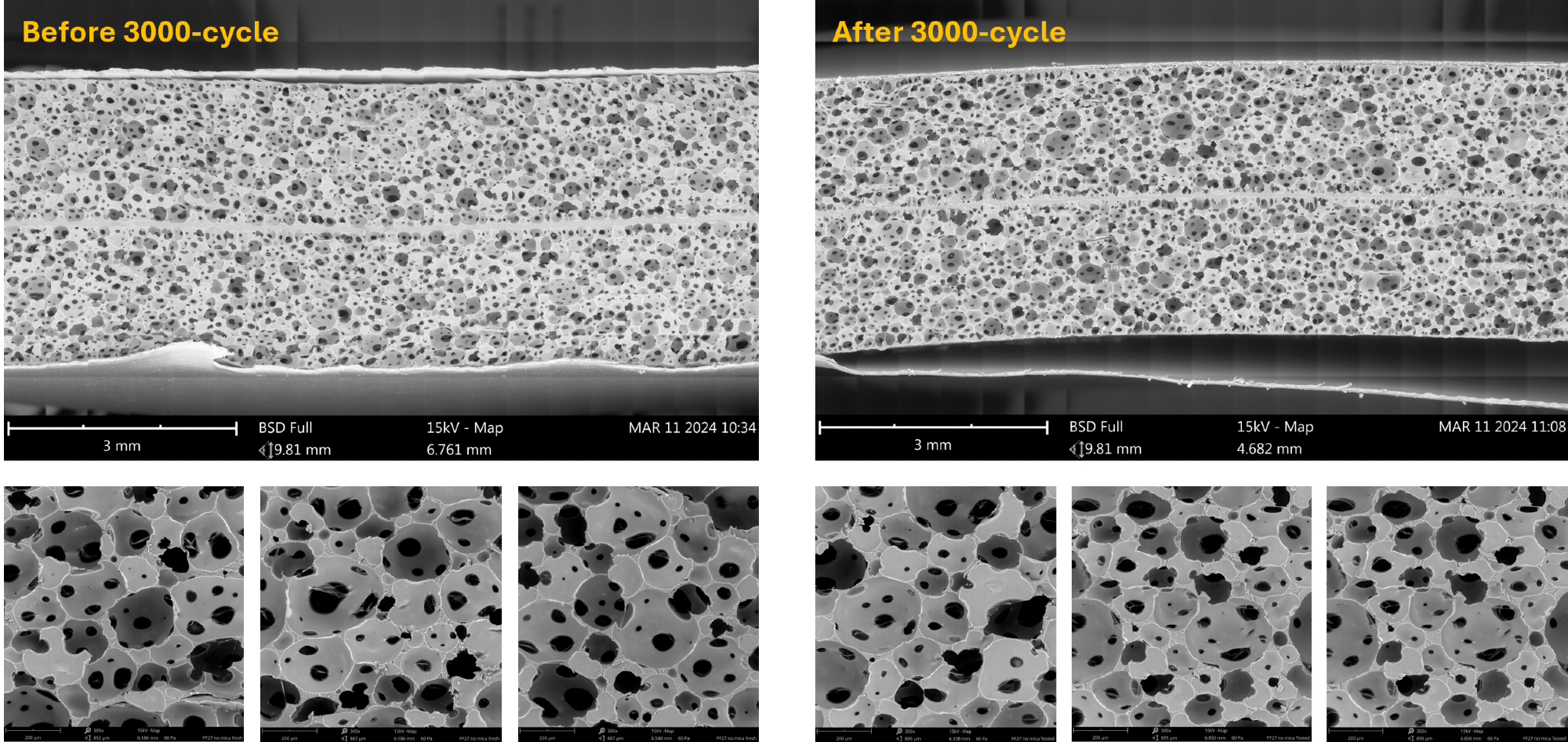
Image Credit: Saint-Gobain Tape Solutions
What were the most significant findings from cyclic fatigue testing?
The results demonstrate exceptional material resilience.
At room temperature (RT) and 60 °C, the stress-strain curves across 3,000 cycles are nearly identical, indicating stable mechanical performance. The maximum stress remains constant, and the compression properties before and after testing show no meaningful change.
The thickness reduction is minimal, only about 3%, which confirms low compression set and strong durability.
How do these materials perform under extreme cold conditions?
At -20 °C, the foam shows slightly slower recovery because this temperature is closer to the glass transition temperature, where viscoelastic effects become more significant.
Even so, the key performance indicators remain very stable. The maximum stress remains consistent throughout testing, the compression properties before and after cycling are nearly identical, and the thickness change is extremely small at around 0.4%.
Overall, this shows that the material maintains its structural integrity and performance even under extreme cold conditions.
What are the main takeaways from your work?
The main takeaway from this work is that compression pad solutions can be tailored to different battery chemistries and cell formats by adjusting their mechanical properties to meet specific requirements.
It also shows that simulation-driven design can accelerate development, reduce cost, and make it easier to identify suitable solutions for complex applications.
Just as importantly, our materials demonstrate strong resilience, maintaining consistent performance over thousands of cycles and across extreme temperatures.
Overall, these high-performance foam materials provide reliable pressure management, support safer battery operation, and help extend battery lifetime.
Want to learn more about this topic? Here's a link to the full paper.
About Weilin Deng 
Weilin Deng earned a Ph.D. in Mechanics of Solids from Brown University, following M.Eng. and B.Eng. degrees from Tianjin University. Since joining Saint-Gobain Research North America in 2020 as a Senior Research Engineer, he has built experience in mechanics and materials research, with a strong background in structural and thermomechanical stress analysis and non-linear finite element analysis

This information has been sourced, reviewed, and adapted from materials provided by Saint-Gobain PPL Corp.
For more information on this source, please visit Saint Gobain PPL Corp.
Disclaimer: The views expressed here are those of the interviewee and do not necessarily represent the views of AZoM.com Limited (T/A) AZoNetwork, the owner and operator of this website. This disclaimer forms part of the Terms and Conditions of use of this website.