Sponsored by TescanReviewed by Ify IsiborNov 16 2026
Nitrogen-vacancy (NV) centers are point defects commonly formed in diamonds. They possess exceptional physical properties. When excited by green laser light, they emit red photons with an intensity that depends on the spin state of the defect due to a favorable cross-relaxation mechanism.
By applying an external magnetic field together with resonant microwave excitation, it becomes possible to manipulate and optically read out the spin state of the NV center, with coherence times reaching milliseconds at room temperature.
This capability has created exciting opportunities for highly sensitive magnetic sensing and imaging at the nanoscale.
In practice, the formation of dense, shallow nitrogen-vacancy (NV) ensembles with good spin properties and precise spatial positioning is critical for the development of high-performance diamond-based quantum sensors.1
Ion implantation is a key technique for precisely controlling the spatial distribution and density of NV color centers in diamond. Typical ion fluences range from 108 to 1015 ions/cm2 to produce either isolated NV centers or dense NV ensembles, with concentrations reaching several hundred parts per billion (ppb).
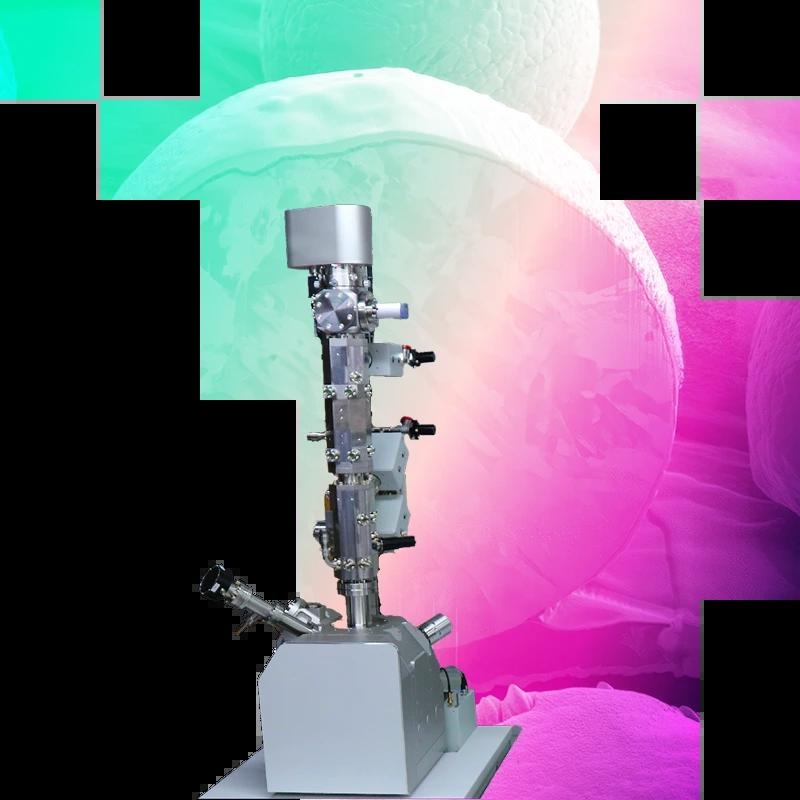
Image Credit: Tescan
Identifying the optimal ion implantation conditions is essential for controlling the density and properties of NV centers in diamond, making it an important step in the fabrication of diamond-based quantum sensors.
However, NV color centers generally exhibit low creation yields, and excessive ion fluences can significantly damage the crystal lattice.
Above a certain implantation dose, the concentration of vacancies generated by the ion beam exceeds a threshold of approximately 1022 vacancies/cm3, causing irreversible amorphization of the diamond lattice and degradation of NV center performance.
By combining ion implantation with high-temperature in situ annealing, the academic team at IRCP has successfully produced high-density NV ensembles with sub-micron spatial resolution.
Implantation at 800 °C increases the photoluminescence intensity of NV ensembles by a factor of three to four compared with samples implanted at room temperature (RT), indicating a higher NV creation yield.
Experimental results also show that, due to high-temperature implantation, fluences above 2 × 10¹⁴ ions/cm2 can be applied without causing graphitization of the diamond film, unlike implantation performed at room temperature.2
References
- Achard, J., Jacques, V. and Alexandre Tallaire (2020). Chemical vapour deposition diamond single crystals with nitrogen-vacancy centres: a review of material synthesis and technology for quantum sensing applications. 53(31), pp.313001–313001. DOI: 10.1088/1361-6463/ab81d1. https://iopscience.iop.org/article/10.1088/1361-6463/ab81d1.
- Ngambou, M.W.N. et al. (2024). Hot ion implantation to create dense NV center ensembles in diamond, Applied Physics Letters, 124(13). DOI: 10.1063/5.0196719. https://pubs.aip.org/aip/apl/article-abstract/124/13/134002/3279666/Hot-ion-implantation-to-create-dense-NV-center?redirectedFrom=fulltext.

This information has been sourced, reviewed, and adapted from materials provided by Tescan.
For more information on this source, please visit Tescan .